Governor Ige: Leadership, Core Values and Resolve Under Pressure

Governor David Ige’s leadership, core values and resolve under pressure was clearly demonstrated by his recent signing into law SB3095.  Hawai‘i residents concerned about their health and the health of their children and grandchildren should thank him.  Progressives and those who fight daily to protect the health of our natural environment should also thank and acknowledge his leadership on this issue.

The measure was simple yet comprehensive and the protections now in place include a phased in ban of the neurotoxin chlorpyrifos, mandatory disclosure of all users of Restricted Use Pesticides (RUP), modest buffer zones around schools, pesticide drift studies and increased funding for the Department of Agriculture so it can properly do its job.

The pressure on Governor Ige to either let it pass into law without his signature, or to veto this measure must have been significant.  The largest chemical companies in the world were in strong opposition.  I know from personal experience that the forces aligned against his signing are formidable and they play hard ball.  Over the past 5 years alone, they have spent tens of millions of dollars in Hawai‘i fighting attempts to regulate their industry.  They spend big money on major media promoting their agenda, they invest heavily in local political campaigns and often have a “take no prisoners” attitude when it comes to politics and their opposition to increased government regulation.

However, Governor Ige chose to do the right thing and put the protection of the health of children above the political pressure and the profits brought and sought by these international corporations who produce, sell and use chlorpyrifos and other dangerous RUP’s.

This is the same pesticide that sent a dozen Syngenta workers to the hospital last year on Kaua‘i’s west side.  It has been found in small amounts at Waimea Canyon Middle School and in other areas when testing has been done in the past.  This same chemical has been banned already for residential use, and the EPA was preparing to implement a ban on agricultural use until its new Director Scott Pruitt reversed that decision.

To be real, the Governor could have easily come up with a reason not to sign the Bill, or to even veto it.

You can be sure the companies threatened to sue.  They would have also said that “the science is inconclusive”, as the industry has legions of scientists in their employ whose studies naturally favor their perspective.  And of course they would have argued that this will “hurt small farmers”.  It is ironic that the original proposals only impacted the very largest users, and was expanded to include “all users” only after the big companies (and their supporters in the legislature) insisted that all farmers big and small should have to comply. But the truth is that most small farmers do not use chlorpyrifos at all.

Yes, Governor Ige could easily have side-stepped this issue and derailed its passage. And he could have come up with an explanation for his action, that for many people would have appeared reasonable.

But he did not.  He could have used the standard excuses others at both the state and county level have used in the past to delay and avoid passage of similar measures.  He could have alluded to perceived deficiencies (the Bill is too weak or the Bill is too strong), offered to strengthen the “voluntary program”, expressed concern about the legal status, and/or fallen back on the dependable “this proposal needs more study” tactic that others in the past have used to avoid making a tough decision in an election year.

But he did not.  He looked at the evidence, he spoke to his advisers I am sure and reviewed the information provided by both sides.  Then he took the side of protecting the health of children and signed SB3095 into law as Act 45.

Governor Ige’s own words upon signing demonstrate his desire and commitment to protect health while acknowledging the importance of supporting agriculture, and that these goals are not mutually exclusive.  He should be commended for his leadership on this issue.

“Protecting the health and safety of our keiki and residents is one of my top priorities. We must protect our communities from potentially harmful chemicals. At the same time, Hawai‘i’s agriculture industry is extremely important to our state and economy. We will work with the Department of Agriculture, local farmers and the University of Hawai‘i as we seek safe, alternative pest management tools that will support and sustain our agriculture industry for generations to come,” said Gov. Ige.

First published in The Garden Island Newspaper on June 20, 2018
Posted in Uncategorized | 6 Comments

Kauai Elections and Voting By The Numbers

Of the approximately 72,000 residents now living on Kauai, about 56,284 are adults and eligible to vote during the upcoming Primary election on August 11, 2018.  Yet, during the 2016 Primary only 15,273 people actually voted.  10,000 of these votes were cast via early voting and absentee ballots.  

Consequently, two-thirds of Kauai’s votes are cast before election day.  

Sobering numbers indeed.

Statewide the statistics are similar.  There were 252,725 votes cast (also around 35% of registered voters) in the 2016 Primary statewide.  156,519 of these votes were counted as early voting and absentee ballots.

This means of course that when the day of the Primary actually gets here, the winners and losers have, for most races already been decided by the early absentee voters. 

The first absentee ballots are scheduled now to be mailed to overseas voters on Wednesday June 27th, only two weeks from today, with the mailing of the bulk of absentee ballots completed by July 20th (approximate only dates).

In Hawaii, which is ostensibly a single party State dominated by the Democratic Party, August 11th is often the only date that matters.  Most partisan races are decided then, with little if any, real General election competition from the Republican or any other political parties.  

While it is always possible for a Republican candidate to “pull something out of the hat”, for all intents and purposes, the August 11th Primary election will decide who will be the next Governor, the next Lieutenant Governor, the next members of Congress and just about every seat in the State House and Senate.  

On Kauai, this translates to the voters decision as to who will be the next Representative for House District #15 where the incumbent James Tokioka is running against Elaine “Queenie” Daligdig  and House #16 where incumbent Daynette “Dee” Morikawa is being challenged by Stephanie Iona.  District #14 Representative Nadine Nakamura is unopposed (and you can imagine of course that she is very happy about this).

In addition on Kauai, the top 14 County Council candidates and the top two Mayoral candidates who survive the August 11th Primary will move on to the General Election.

Conventional wisdom would say that for all state races, by July 20th it is all over but the crying.  

And it would say that any candidate that is not already in full battle campaign mode by now, will be hard-pressed to finish on top August 11th. 

Based on historic numbers the General election dynamics are similar but not as stark as the Primary.  During the 2016 General election the Kauai turn-out was 27,225 or 62% of registered voters, with 15,221 votes being cast early and absentee.  Statewide, the turnout was 437,664 or 58% of registered voters, with 234,336 votes cast early and absentee.

Quick recap for Kauai: 15,273 voters showed up in the 2016 Primary while 27,225 showed up in the General.

On August 12th, all eyes on the Garden Island will then turn to the Council and the Mayoral races.   

The top two finishers (out of presently 7 candidates) in the Mayor’s race will then go toe to toe, while the top 14 finishers from an initial field of 24 aspiring Council candidates will then ramp up their efforts for the home stretch sprint toward the General election of November 6, 2018.  

While the top 14 Council candidates will make the first cut, history shows that rarely does any candidate “move up” from below the #9 slot, into the top 7 winners circle.  Once in a while candidates will move up from lower rankings in the Primary to a winning slot in the General, but this is indeed rare.  However, with 3 incumbents leaving their seats open, anything can happen.

Bottom line for candidates: You are way behind where you need to be, people will be voting very soon so turn it up!  

For the rest of us: Take responsibility for your government.  Find a candidate you like and support him or her.

Most of all vote!  Then remind your neighbors to vote.

First published in The Garden Island Newspaper 6/13/18

Posted in Uncategorized | 1 Comment

There are no perfect candidates.  

While there are good people and good candidates, none are without flaws and all have strengths and weaknesses.

So how does one choose from a list of imperfect individuals?  What criteria is best for judging who is best suited to serve in public office?

There are over 20 candidates running for election to the Kauai County Council.  I am clear there are 7 among this group who have the potential to serve us well.

But how to choose?

Personally, I start with a process of elimination.

First I eliminate the jerks, the bigots, the misogynists, the bullies, and the ignorant, pompous know-it-all’s.

Next, I eliminate those candidates who IMHO have clear conflicts of interest via their employer or other business affiliations.  My preference is that the candidate if elected will serve only one master, and that would be the people.

Then, assuming there are still options left on the prospective candidate list, I eliminate the ungrounded, unstable, and those without roots in the community.

I realize the above process of elimination may seem harsh, and is a personal and subjective evaluation.  But hey, it’s my vote to do with as I like in the privacy of the voting booth.

Once the negative process of elimination is out of the way, I rank the remaining candidates based on trust, core values, competence, life experience and strength of character.  Again this is a personal score card, based mostly on instinct and general observations of the candidates actions and history in the community.

I am seeking candidates whom I know with certainty will not abuse the public trust.  And who share my general world view of putting people and the environment ahead of the profits of business.  Competence, life experience, and specific skill sets are of course also important.

I look for balance.  Diversity is important.  Historically women have been underrepresented and sometimes geographical and other demographic representation is lacking.

My practice when voting for the County Council, is to only vote for those individuals I truly want to see elected, even if this means voting for only a handful of candidates and not using my full allotment of 7 votes.

Our community is fortunate to have a large and diverse field of candidates running for the County Council this year.  I encourage all to get to know them, scrutinize their records, attend the forums.  Then vote wisely on August 11 or register for an absentee ballot and submit before August 11.

First Published in The Garden Island Newspaper 6/6/18

Posted in Uncategorized | Leave a comment

A straight-forward description of what Act 45 (formerly SB3095) actually does in terms of pesticide regulation

Act 45 (formerly SB3095CD1) contains 6 main components:

1- A ban on the use of the RUP and neurotoxin chlorpyrifos. This ban takes effect immediately however temporary permits will be granted allowing continued use for up to 4 years, at which time no new permits will be issued and no chlorpyrifos will be allowed in the State of Hawaii. The practical expected impact of the ban’s 4 year implementation will be a gradual decline in use, culminating in a complete ban after 4 years.  Though several have tried, Hawaii is the first State in the nation to have any type of ban whatsoever.

2- Mandatory statewide reporting of annual RUP use for ALL RUP USERs to the State Department of Agriculture (SDOA) that includes: RUP product used, amount of RUP used, and the date and location of the usage.  Every single user of RUP’s in the state of Hawaii will be required to report their usage.  This information is subject to HRS Chapter 92 (public records law).  Prior to passage of this law, there was no State requirement for any RUP use reporting at all.  In the future we will know what was sprayed, how much was sprayed, where it was sprayed and what day it was sprayed.

3- Annual Public Summary Reports of statewide RUP usage by County reporting the types, amounts and area of the applications.

4- A prohibition against using RUP’s within 100 feet of school grounds during school hours (excluding termite fumigation).  There were zero buffer zones requirements in place prior to passage of this law.

5- The SDOA will conduct a pesticide drift monitoring study to evaluate pesticide drift at three schools within the State.

6- Approximately $700,000 in general funds are being added to the SDOA annual budget, plus two additional positions. These are intended to support the increased pesticide oversight and the drift monitoring studies. Historically the Department has been grossly underfunded and understaffed.

While many of us who have been working hard on this issue for the past years would have preferred various aspects to be stronger, it is without question that the sum total of the above components represent a strong and meaningful step forward in securing increased health and environmental protections.

The ban on chlorpyrifos alone will have tangible health implications and the statewide reporting provisions have the potential to generate long term, consistent data necessary for those seeking to research the issue to determine specific impacts.

 The summary data by County will allow residents the information needed to make a more informed decision as to where they choose to live, work, play or go to school. 

Clearly the 100 feet buffer zone around schools is inadequate and must be expanded in the future but it is more than we have in place now, which is zero. 

The drift monitoring study if done correctly has the potential to yield much needed data but for its results to be credible will require significant forethought and careful planning. Of course the additional financial and personnel resources provided to the SDOA will be hugely helpful in their efforts to properly manage the use of RUP’s while protecting health and the environment.

Posted in Uncategorized | 2 Comments

Hawai‘i does what EPA failed to do: first U.S. ban on chlorpyrifos enacted into law

Hawai’i made history today when Governor David Ige, watched by representatives of the community from across the islands, signed into law Senate Bill 3095, banning all uses of chlorpyrifos, a neurotoxin that has been banned for home use for over 10 years because of its known impacts on the developing brains of children. This law also mandates 100 foot no-spray buffer zones around schools to protect children from open air spraying of Restricted Use Pesticides (RUPs) during school hours. Chemical companies will have to report regularly on the RUPs they sprayed, when and where they sprayed, and in what quantities. This will allow impacted communities to access information about what they are being exposed to, and regulators to make informed decisions about protecting public health, the environment and endangered ecosystems.

This new law is the culmination of nearly six years of grassroots organizing by small, rural communities facing daily pesticide exposure, fighting lawsuits and millions spent on lobbying by the chemical companies. A coalition of families, teachers, scientists, health professionals, and advocates from the Hawai’i Alliance for Progressive Action (H.A.P.A.), Hawai’i Center for Food Safety, Hawai‘i SEED, and Pesticide Action Network worked for years to push forward this legislation to protect our keiki, despite millions spent by the agrochemical industry to thwart the democratic process.  For the first time in the United States, this bill said NO to chlorpyrifos, a pesticide that can trace its origin to nerve agents developed by the Nazis in World War II.

“As a mother who agonized about the dangers of sending my children to a school next to Monsanto’s fields where RUPs were sprayed regularly, I am so grateful to see this bill become law,” said Molokai lawyer and activist, Keani Rawlins-Fernandez,

“This law is our message to the EPA and to the chemical companies that we will no longer tolerate being ground zero for the testing of toxic pesticides that are damaging our children’s health and poisoning our environment,” said Gary Hooser, former Majority Leader of the Hawai’i Senate, and founder of the Hawaii Alliance for Progressive Action. Hooser, who lives on Kauai, led the “Protect our Keiki” coalition of diverse residents from across the islands through the complex political process that resulted in this much needed compromise law to regulate how highly toxic chemicals like chlorpyrifos are unleashed on the community.

“Hawaii’s efforts have set a precedent, and we hope this will pave the way for other states that are looking to enact similar legislation,” said  Leslee Matthews from Pesticide Action Network

 A win that will reverberate across the nation

“This is Hawai’i fighting back against the disrespect for science and public health—and winning! In the era of Trump, states must lead,” added Hooser.

Background

Large agrochemical operations operate year round and take advantage of Hawaii’s three growing seasons.  Consequently, there are areas where communities are exposed daily to the impacts of open spraying of Restricted Use Pesticides. Local county ordinances on each island to regulate pesticide use and protect public health were met with lawsuits by the chemical companies. The 9th Circuit court ruled in favor of the chemical companies and invalidated county regulations, arguing that only the state had the authority to pass such laws.

Hawaii sets precedent for other states

Today the state exercised that responsibility to protect its citizens.  Governor David Ige’s decision to sign the bill into law was an affirmation of how government is supposed to work when it listens to what the people need.  Hawai`i did what the Environmental Protection Agency failed to do. It responded to the abundant data and studies that point to the adverse effects of R.U.P.  Scientists, including some who had previously worked for the E.P.A. weighed in. Physicians weighed in, calling for a ban based on clear health impacts that they were seeing. Mothers, in tears about the terrible risk to their children’s health, weighed in. It was time to act. And Hawai`i did, with passage and enactment of SB3095 into law.

From the Hawaii Alliance for Progressive Action (HAPA): June 13, 2018

Posted in Uncategorized | Leave a comment

Winter is coming – be prepared

I have been warned by many friends on every island that those in traditional positions of power are concerned that the progressive movement is growing too strong.

They are concerned we will in fact win too many seats at the legislature in 2018, they are wary of our growing numbers, our increasingly effective organization, and what this means for the future.

They know that if we are successful, in 2019 Hawaiʻi will pass not just a $15 per hour minimum wage measure but possibly even one that mandates an actual living wage.

They know that if we succeed on August 11th that the public trust protection for our streams and rivers will be preserved and that big business will likely lose control of the water systems. And yes, they know that a bold social, environmental, and economic justice agenda will move forward more rapidly than ever before.

Attacks in the coming weeks and months should be expected.

Trust me, I have been there and have witnessed this scenario many times in the past.

Remember the attacks that were made against our friends on Maui in 2016. Remember what the SuperPac “Forward Progress” did in the past to former Governor Ben Cayetano and others. Those attacks were ruthless. A new SuperPac “All Hawaiʻi Stand Together” has recently been formed and appears to have a base within the same/similar group.

So expect the attacks, and when they come, you will know who is behind it. We can and must be prepared to respond quickly and to rally behind the candidates and organizations that are the targets.

Your help is needed now more than ever to continue the fight and to continue winning.

Please help if you can. Join us here:

And please, donate here if you can:

Yes, my job is to ask.

In solidarity,

Gary Hooser


Posted in Uncategorized | 3 Comments

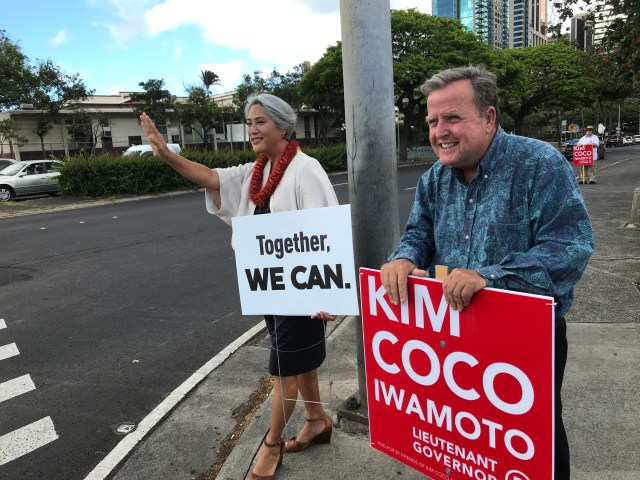
Why Gary Hooser is supporting Kim Coco Iwamoto to be Hawaii’s next Lieutenant Governor.

Kim and Hooser holding signsI have known and worked with Kim Coco Iwamoto for over 16 years and she has my total support in her quest to become Hawaii’s next Lieutenant Governor.  

Kim Coco is the real deal.  She is bright, articulate, hard working and smart as a whip.  Her record of accomplishments and service to our community is long and storied.  Her core values are my core values, and I know first hand that she is willing to fight hard for justice at all levels.  

Kim Coco Iwamoto walks the talk.  She gives selflessly of her time and her own personal resources to support progressives causes and promote progressive values. And she expects nothing in return expect perhaps the personal satisfaction of simply doing the right thing.

While Kim Coco is certainly no shrinking violet, she knows the importance and value of listening and in working in collaboration with others.  She is able to go toe-to-toe with the big boys on Bishop Street, but she is also comfortable in Thomas Square listening and helping those who are less fortunate.

During my service as Majority Leader in the Hawaii State Senate, on the County Council on Kauai and in general working in the government and political arena, I have met only a handful of people whose judgement in the area of public policy I trust completely, and Kim Coco is one of them.  

When Kim Coco Iwamoto says, “If elected, the office of the Lieutenant Governor will be the peoples office.” I know this will in fact be true.  She will create a space for the people to meet, to collaborate, and to share ideas and dreams.  And this space will be on the 5th floor of the Capitol, directly across from the Governors office and above the House and the Senate offices, a proper place where the people’s work can truly be done.

All of the people running for the Lieutenant Governor slot bring something different to the table.  I know personally and have worked extensively over the years with each and every one of the main contenders running for this office.  But when I weigh all of the factors and all of my experience, I am supporting Kim for election to the office of Lieutenant Governor, and I hope you will join me. 

The most recent polls show that all of the candidates running for LG are within striking distance, and it is anybody’s race to win.  Kim Coco Iwamoto can win but to do so, each of us has to push a little harder for her and like I am doing today, make our support known to our friends and family, loud and clear. 

Please also make a small contribution, even $25 to $100 to her campaign and volunteer to help.  https://www.kimcoco.com

We need Kim Coco Iwamoto to be Hawaii’s next Lieutenant Governor.  Let’s make it happen.

Posted in Uncategorized | 1 Comment

The Democratic Party of Hawaii – Unity, Trust, Resistance and Moving Forward 

I want to thank Keali’i Lopez and Tim Vandeveer for their commitment to the Democratic Party, and for being willing to “put themselves out there”, for all of us.

In a 529-472 (weighted) vote this past Sunday, May 27, Tim Vandeveer, the Chair of the Democratic Party of Hawaii, lost his bid for re-election. As per the Party Bylaws, votes are weighted for delegates that had to travel to the Convention from a different island.

There are cautions and wisdom to be gleaned from what transpired.

I love Tim.  He is an awesome human being who at one time stood up for me when I needed him.  On Friday, I flew to the Democratic Convention in Kona to stand up for him.

It was an exhausting roller coaster of a weekend consisting essentially of a battle between what most would label the establishment and progressive wings of the Democratic Party (less nuanced observers might say the corporate and the democratic socialist factions).

Upon arrival at the convention I discovered that the person competing for the position of Party Chair, Keali’i Lopez, is a registered lobbyist whose clients include the agrochemical industry.

You really can’t make this stuff up.

We spend years fighting this industry and now their lobbyist is going to be put in charge of our Party?

Anger, shock and disbelief came together in me at that moment, fueling even greater personal resolve to ensure Tim’s victory.

As the events at the convention unfolded, I told myself that this could not be happening and that if the corporate lobbyist won, I was done with the Democratic Party.  I would walk out of the convention, quit the Party and just move on.

But in his gracious and wise remarks on stage following his loss, Tim Vandeveer convinced me otherwise.  He reminded me and the other 600 attendees in the room of our common values and that we are all in this together.  He spoke of the unity of purpose that brought us to the Democratic Party in the first place, and had brought all of us together for that weekend.

The impulse to quit and walk away quickly shifted to a desire to roll up my sleeves and work even harder.  I then spoke briefly to our new Party Chair Keali’i Lopez offering my congratulations and expressing my willingness to help her move our Party forward.  Her response was gracious and receptive.

In a conversation earlier in the day, prior to the election, she and I had engaged in another fairly animated discussion where I expressed my strong concerns about her role as a corporate lobbyist.  She pushed back hard, defending her occupation and her ability and commitment to serve as Party Chair.  We agreed to disagree on this point, reaffirmed our mutual respect and then shared a commitment to work together for the common good.

I don’t doubt her good intentions. But I have no reason to trust the intentions of the corp ag industry, who employ her as a lobbyist.

For five years I have watched them use every tool at their disposal, from threats to lawsuits to thwart the community’s desire to shield their children from dangerous neurotoxins in pesticides sprayed near schools and homes. That is not going to change. Now their lobbyist is leading the Democratic Party. What should we anticipate them doing?

Tim Vandeveer’s loss was a huge disappointment for many across the State. However, in these fractious times when women and indigenous rights are being trampled upon, there is much to celebrate in the election of Keali’i Lopez.

The convention weekend included many significant wins.  Our unwavering support of economic, social and environmental justice remains intact, and many new strong progressives were elected to the State Central Committee (SCC) and key Party leadership positions.

While I had not gone to the convention with the intention of running for election to a Party leadership position, the transition of leadership at the top of the Party motivated me to run for and consequently be elected to the #2 slot, of Vice-Chair.

It’s up to the community now to hold all of us, and the entire apparatus of the Democratic Party accountable. Can we serve competing interests? Can we indeed protect and enhance the public good while at the same time protecting corporate profits?  Or is there an inherent conflict of interest when compelled to do both?

Thank you Tim Vandeveer  for your leadership and service.  I look forward now to working together with Keali’i Lopez as Chair of our Party.

Mahalo as well to friends and convention delegates who encouraged me to run for the Vice-Chair position and offered their support.   I am looking forward to working with all of you and our extended Ohana through-out Hawaii to achieve our shared core vision of justice.

Now more than ever, we need everyone to sit up, pay attention, seek solutions and ask tough questions that transcend place of birth, the 2016 elections, and special interests.

Most of all we need each and every one of you to vote.

This past weekends election should leave you in no doubt that YOUR vote matters.

And yes, tell a friend to vote too.

*First published in The Garden Island Newspaper on May 30, 2018.

Posted in Uncategorized | 11 Comments

A Question For The Ballot Box – Paying For Education

The legislature and the public has been playing a game of “whack a mole” for a long, long time, effectively dodging the question and responsibility of properly funding Hawaii’s public education system. They say no to increasing the General Excise Tax (GET), they say no to raising tourist taxes (except for rail of course), they say no to taxing sugar drinks, and they say no to legalizing and taxing cannabis. In the past they have said no to taxing retirement income and casino gambling and/or a lottery (all bad ideas IMHO) have never gotten off the ground.

Whack the mole, pass the buck, and kick the can down the road is how our state has dealt with funding public education, and we all should be a little ashamed of ourselves for letting that happen.

Hawaii teachers are the lowest paid in the country, when the cost of living in Hawaii is factored in.  To attract and retain qualified teachers they must be paid properly, and currently that is not the case.  According to the Hawaii State Teachers Association (HSTA) each year over 1,000 teacher positions remain vacant, and positions are often filled by uncertified and unqualified long term substitutes.  In addition to low teacher pay, small class sizes which have been proven to increase student learning also require a public investment.  The list of funding needs for public education is long, and the neglect by the legislature to adequately funding those needs extends even longer.

Somebody has to pay for underfunding our public education system. Right now the teachers and students are effectively paying this cost through low wages and crowded classrooms, and they have been for years.

But the public will soon be given a chance to reverse the neglectful trend.

On November 6, 2018 Hawaii voters will be asked,  “Shall the legislature be authorized to establish, as provided by law, a surcharge on investment real property to be used to support public education?”

My vote will be a strong yes.

If approved by the voters this change to the Hawaii Constitution will allow the State legislature to then pass legislation essentially adding an “education tax or surcharge” on investment real estate. Investment real estate is generally defined as real estate that is not owner occupied.  The enabling legislation, will clarify the definition and establish which properties will be subject to the new surcharge/tax and how much that tax will be.

The legislative intent as expressed in the public record, is to levy the surcharge on luxury homes and condominiums that are used as second homes, vacation rentals and or simply sit vacant as investment properties.

As someone who has served at both the County and the State level, I know how difficult politically it is to raise taxes.  I also know that there are numerous exemptions and other mechanisms that can and will be put into place to protect local families and the local rental market.  The political pressure on the legislature to do so will be tremendous, of that you can be sure.

This conversation has been happening now for many years. There is no right way to raise taxes that pleases everyone, so the result is nothing happens.

Few if any legislators nor members of the public who are familiar with the issue will say that Hawaii’s teachers are paid adequately.  Most will agree also that small class size is important and that our students deserve much more than they are getting.  These same individuals will agree that to achieve these goals requires an additional investment in our public education system.

But at this point is where the conversation historically collapses.  No one it seems wants to pay for it.  Instead, we force our teachers to subsidize our education system by working for substandard wages, and our students and community as a whole pays the societal costs.

Any tax increase will gore someones ox, and thus all increases are always opposed (except for rail).

For those whose response is “someone else should pay”, I ask who?

The issue is complex and yet it is not. To attract and retain qualified teachers they must be paid properly, and currently that is not the case. Small class sizes have been proven to increase student learning and this also costs money. No amount of streamlining or decentralization or other rearranging of the deck chairs will achieve these objectives.

This is a crazy cycle of neglect, with real consequences and it must stop.

The constitutional amendment that will be on the ballot this coming November, allows the public to choose to increase the funding for public education via a surcharge on investment properties, or the public can choose to do nothing and just keep whacking the mole.

First published in The Garden Island Newspaper on May 23, 2018.

Posted in Uncategorized | 4 Comments

2018 Kauai Election & Hard Choices Ahead (5/18/18 candidate update)

With less than three weeks left until the filing deadline, the latest Office of Elections Candidate Filing Report of Friday May 18, makes for interesting reading and rife speculation.

At the top of the ticket for the County is the Mayor’s race and the contenders so far remain unchanged.  Derek Kawakami, Debra Kekaualua, Leonard Rapozo Jr., Melvin Rapozo, and Clint Yago have all pulled papers and filed.

Councilmember and former Mayor JoAnn Yukimura who has announced her candidacy for this seat, and whose signs have been popping up around the island, has not yet taken out nomination papers to run.   All candidates have until June 5th to formally file their nomination papers.

Kauai Senator Ronald Kouchi and Kauai County Prosecutor Justin Kollar are both in the middle of 4 year terms and not up for re-election.

The list of candidates for the Kauai County Council continues to grow.  Twenty-four individuals have “pulled papers” indicating an interest in running, with fourteen of these (indicated in bold) having “filed” indicating they are in active campaign mode.

Dominic Acain, Arthur Brun, Bob Cariffe, Mason Chock Sr., Felicia Cowden, Bill Decosta, Norma Doctor Sparks, Luke Evslin, Victoria Franks,  Richard Fukushima, John Hoff, Cecelia Hoffman, Shaylene Iseri, Joseph Kaauwai Jr., Ross Kagawa, Arryl Kaneshiro, Kipukai Kualii, Nelson Mukai, Wally Nishimura, Adam Roversi, Roy Saito, Shirley Simbre-Medeiros, Milo Spint and Harold Vidinha.

Projecting forward, the field of Kauai County Council candidates is destined to be a large one.  With fourteen candidates having already filed, plus the high likelihood that all  incumbents (in italics) will eventually file, translates to 17 confirmed candidates with 17 days still remaining for new candidates to jump in.  Clearly the fact there are 3 “empty seats” up for grabs due to the departure of three incumbents, continues to motivate new candidates and this in my opinion is a good thing.

For the State House of Representatives, the three incumbents: District #14 Nadine Nakamura, District #15 James Tokioka and District #16 Daynette “Dee” Morikawa are so far running unopposed.  Most students of government and politics would say that competition is a good thing, and it is likely that at least one of these incumbents will have a serious challenger.

The final day for filing papers as a candidate in any and all races is not until June 5, and consequently all of the above is subject to change.

There remains a sense of dissatisfaction among many with the candidate choices available so far.  This feeling seems strongest among those citizens concerned about the impacts of unrestrained growth.  The unrelenting traffic, the astronomical rents and the crowded beach parks are constant reminders of the unavoidable impact the visitor industry has on our island.  Yet there is little mention of this issue by most candidates, let alone proposals for potential solutions.  The “M word” is avoided like the plague with incumbents and challengers alike sticking to the premise that there is little the County can do and that a moratorium on growth is outside the realm of County options.

There are of course options the County could pursue to aggressively address all three core issues of traffic, affordable housing and degrading public facilities at our beach parks.  There are also strategies the County could pursue to limit growth, based on the availability of infrastructure and thus force new growth into existing urban areas.

These are not new problems but they have now reached a tipping point, where the publics frustration is at a peak, and where political action is therefore possible.  In the world of public policy and politics, most would say the issue of growth management is “ripe” for political action.  Actually, it is over-ripe and will soon begin to reek with the odor of rotting vegetables.  I digress.

This ripeness of the issue presents an opportunity for new candidates especially, to distinguish themselves.  Those who are willing to discuss the issue and who demonstrate a willingness to consider the tough choices necessary to begin managing our islands growth, are in my opinion the candidates to watch and support.

Election years always represent an opportunity for change.  Now is the time when residents must obtain commitments from those seeking their votes.  Now is the time for residents to frame the debate, force a public discussion on the issues that matter most to us, and then select those candidates, committed to working on solutions.

The challenges and impacts of seemingly unrestrained growth compounded with an infrastructure that is woefully inadequate, must become the defining issue of this election.  Trust me on this one.  When the people lead, government will follow.

Posted in Uncategorized | Leave a comment