Kauaʻi Council Brings Christmas Early To Rice Street

With the passage of Bill 2687 the Kauaʻi County Council seems poised to gift millions of dollars of increased property values to a relatively small number of owners located in Lihuʻe along Rice Street with “no strings attached”.  Land owners could get their density allotments doubled which doubles the number of homes/units they are entitled to build on their property, but there is no mandate for a reciprocal public benefit requirement.

They apparently are not required to do anything at all in return for the largess of the Council and could literally sell their property the day after this is signed into law and reap the profits, without turning a single shovel full of dirt.

Following todayʻs, Wednesday July 11th Council meeting is a Public Hearing on Bill 2687 introduced by Councilmember Arthur Brun.  Testimony may be made in person at 1:30pm at the Historic County Building or via email at counciltestimony@kauai.gov

Please read the actual Bill here: https://tinyurl.com/y9bonclf

The measure is framed as an initiative that will help alleviate the Kauaʻi housing shortage, but unless it is significantly amended it is appears to be just a gift to the landowners on Rice Street.

First in the warm and fuzzy section, Bill 2687 states:

“Findings and Purpose. The Council of the County of Kauaʻi finds that there is an urgent need to address the shortage of available housing units on Kauaʻi.”

Then finally when you get to the meat of the measure Bill 2687 states:

“By increasing the upper limit of the Residential Zoning designation for the Rice Street Neighborhood Design District from R-20 to R-40, the infill development capacity for creating a significantly greater number of residential density factors within the LIhuʻe urban town core will essentially be doubled.”

Most who study and seek answers to Kauaʻi’s ongoing affordable housing crisis, agree that increasing density in Lihuʻe is a key piece of the puzzle.  But granting a windfall profit to property owners without obtaining a reciprocal commitment to fulfill the need to actually build affordable units for local residents is selling our community short.

I have written in the past, and I will repeat it again here:

“The invisible hand makes them do it.  Without government serving as a counter balance, the invisible hand of free enterprise drives all development to sell to the highest bidder.  More homes built for the market do not create more affordable housing.  The trickle down theory does not work.”

The Council will hopefully amend this measure to require the development of affordable (clearly defined) units (for sale or rent), in return for the increased density that is being granted.  Hopefully also they will put in place a clear time line to motivate the landowners to take action soon and certainly within a stated time period of say, 5 years.

Yes, the private property owners must earn a profit in return for their effort and risk, and yes government must provide incentives for the development of affordable housing.  But it is reasonable and necessary that the Council act in the publics best interest by putting in requirements to ensure that affordable housing is indeed constructed in return for the benefit granted.

Otherwise, this is just a gift to the landowners along Rice Street.

Posted in Uncategorized | Leave a comment

Meet me on the barricades. Let’s do this.

For those of us focused on bringing about a political revolution in Hawaii, that time has arrived.

All the essential elements are in place.

  • There is a wide array of solid, qualified candidates on every island who share our values of economic, environmental and social justice. They are running strong campaigns and they can win.
  • We have established a strong, state-wide, grass-roots network of citizens and like-minded organizations who are more aligned and more connected than ever before.
  • The recent wins at the State Legislature prove that when our community is engaged, focused and involved in making change happen, it does indeed occur.
  • People are energized and motivated.

We have an opportunity before us to change the nature of politics and government in Hawaii for decades to come.

But the candidates need our help now.

On Maui, Kauai, the Big Island and through-out Oahu PHI has endorsed high quality, values centered candidates, that can win. 

But the clock is ticking and it’s time now to step up our game. Absentee ballots are being mailed “as we speak” (which represent about 50% of the vote), and August 11th, the final day to cast your vote for the all important primary election is less than 30 days away.

The Primary Election is everything.  The Republican Party is pretty much non-existent in Hawaii and consequently almost every state legislative race will be over with August 11th.

What do candidates need?

  1. Boots on the ground – Candidates need your help holding signs and knocking on doors.  This is where your help is most needed.
  2. Social Media Boosts – Please “like” and “share” the candidates FaceBook postings thus helping to increase their visibility online.
  3. Money – Every candidate needs funding, especially at this crucial moment (between now and July 20) as they put together last minute absentee mailings and their final push toward the finish line.  $20, $50, and $100 contributions – all are welcome.

Yes, the much needed political revolution in Hawaii can happen.  The pieces are all in place, but to take it all the way we must work very hard for the next 3 weeks.

We must hold nothing back.

The Pono Hawaii Initiative (PHI), also needs your help.  100% of contributions received between now and July 20th will go toward direct but non-coordinated candidate support. Contributions of any amount are welcome and much needed. Donate online here: https://ponohawaiiinitiative.org/donate/

As the Executive Director for PHI, I welcome calls or emails from those of you who want to step up and help, and perhaps need more information.  I am happy also to meet in person, on any island at any time.

Thank you so very much to all who have already stepped up to help.  For the next few weeks, I will continue pushing as hard as is humanly possible, and I trust and hope that you will join me.

Winning means Hawaii will be a better place and our children will live in a better world.

Let’s do this.

Sincerely,

Gary Hooser

Notes on just a few of the PHI endorsed candidates:

On Oahu, Ikaika Hussey is running for the Honolulu City Council. His singular presence on that body without exaggeration will have a significant impact for the better.  Check out his really, cool website – read about his vision for Honolulu’s future.

For Kauai County Council, PHI has endorsed 3 very strong, value centered and integrity based candidates –
Felicia Cowden  Adam Roversi Mason Chock
Read more about the process here: 

Take a moment and watch a short introductory video by Kauai Council Candidate Felicia Cowden.

Maui candidate for the State House, Tiare Lawrence also has a short video you might enjoy watching.

NOTE: The statement above represents my personal opinion, is sent to my personal email list and written on my own time on a Saturday morning. My words, are simply my words and do not represent the official position of any organization. In addition, no candidate has approved or is even aware of this message prior to it being sent.

Posted in Uncategorized | Leave a comment

The most important voter on August 11th will be the non-voter

On this auspicious holiday, the 4th of July, when much of Hawaii’s population is in a celebratory mood and perhaps distracted from the fundamental purpose of the occasion, it is appropriate to pause for a moment and think about why we celebrate.

The Declaration of Independence essentially affirmed that the people residing in the 13 colonies had the right to be free from tyranny and had the right to self governance.  The words put down on that single sheet of paper stated unequivocally that individual citizens had the inherent right to gather together to discuss the issues, to decide for themselves the rules and structure of their society, and to elect their own government leaders.

The most famous of the words are the preamble which states:

“We hold these truths to be self-evident, that all men are created equal, that they are endowed by their Creator with certain unalienable Rights, that among these are Life, Liberty and the pursuit of Happiness.”

While we can debate, and argue and in the end concede that many injustices and in fact genocides have been and continue to be put upon the planet by so-called civil society, the fundamental truth to this statement remains.

For me, the 4th of July is a celebration and a reminder of the peoplesʻ right to self governance.  Along with the right to self governance comes the obligation to be involved and to take ownership of our government.

We either let it happen, or we make it happen. We are responsible for our governments conduct, at all levels: County, State, and Federal. 

Whether the problem is the condition of our roads or our schools, there is no one to blame but ourselves.  The lack of affordable housing, the dirty parks, and the long lines at the DMV are the result of our inattention to our government and the abdication of that power to others.

Less than 30% of eligible residents will vote on August 11th.  While many will grumble about the candidates, they will not themselves run for office nor often even show up to vote.

I come into contact with people on a regular basis who say to me (sometimes apologetically and sometimes in defiance), “I don’t do politics.”  The truth of course is that “If you don’t do politics, politics will do you.”

With such a small number of voters determining the leadership in our County and State, there is a huge opportunity for those who do “do politics” as even a modest increase in the number of people showing up on election day can sway the results.

The secret weapon in the quest to elect new leaders at both the County and State level are consequently, the new voters.

Think about it. 70% of people eligible to vote are, if past trends continue, not going to vote in the primary election on August 11th.  This pool of voters is a YUGE untapped resource for change.  Who are these “untapped voters”?  Conventional wisdom would indicate that they consist of the three groups who historically have the worst voting records: Hawaiians, young voters, and new residents.

The Declaration of Independence, was a document essentially written by one man, Thomas Jefferson.  He was part of a committee of 5 that included Benjamin Franklin, John Adams, Roger Sherman, and Robert Livingston. They were assigned the task of putting the words on paper, but the initial draft and ultimate majority of the document was written by Thomas Jefferson alone.

If 5 guys can get together and come up with the Declaration of Independence, think about what a handful of people here can do to make positive systemic change happen in our community.

Remember August 11th is the day!

And remember also that if you have never voted, or if you rarely vote, on August 11th, your vote will be the one that makes the difference.

Originally posted in The Garden Island Newspaper on July 4th, 2018

Posted in Uncategorized | Leave a comment

An Election Year: The intersection of policy and politics – 3% for affordable housing

There is something about an election year that brings out the best in “sitting politicians” running for re-election.  With their political futures uncertain, and their elections soon to be determined by sometimes fickle voters, those in elected office often will initiate actions that in the normal political environment might seem too bold and thus politically risky.

This is the time when true leaders throw the long ball.  While others in the same situation may hunker down and plug away at the same ole same ole, leaders who are committed to making a difference will go long.

Political leaders in this situation know that “it is now or never” and will at this moment in time, introduce something truly meaningful that has the potential for long-term systemic impacts.

For the Councilmember willing and prepared to give it the heave, this is normally a win-win situation.  If the proposal passes, it will be a legacy act with long term tangible benefits to the community.  And the introducer can rightfully take credit for the action in the years and sometimes generations to follow.  If the proposal fails to pass the Council, the introducer can rightfully point to their own initiative and to the lack of support offered by others on the Council (who incidentally are also running for election).

Councilmember Yukimura’s proposal to dedicate 3% of property tax revenue toward affordable housing initiatives is such a bold move, and I for one applaud her for making it.  It will be interesting to see now if her effort is supported by the rest of the Council, two of whom are her opponents in the race to be Kauai’s next Mayor.

It is a brilliant move actually.  The proposal in short involves allowing voters to decide whether or not to dedicate 3% of property tax revenues toward supporting the building of affordable housing.  The proposal does not increase property taxes and the expectation being presented is that this 3% would come out of existing revenue and be achieved via increased government efficiencies, and the restructuring of County priorities.

The lack of affordable housing is an issue of crisis proportions.  People are hurting and not enough is being done by government to fix the problem.  You hear rumblings from some candidates about the need to “streamline” the development process.  Others go on about how “all new housing is good housing”, and advocate for a “just let them build” mentality, thinking somehow that affordable units will trickle down to the many residents desperately in search of decent and affordable housing.

Note to candidates and voters: “Streamline the process” is code for the reduction and elimination of public input and environmental protections.  Making it easier for developers to build without strict affordable mandates, just means they will build more and more expensive homes.  All landowners, developers and builders will build to market, and will not build to sell or rent to affordable levels (ie. below market) unless subsidized and/or mandated to do so by government.

The invisible hand makes them do it.  Without government serving as a counter balance, the invisible hand of free enterprise drives all development to sell to the highest bidder.

More homes built for the market do not create more affordable housing.  The trickle down theory does not work.  While yes, more inventory at all levels does provide some relief at all levels, the answer to our affordable housing crisis is not to loosen standards and requirements in the hopes that all ships will rise.  They won’t.

It is an election year and the entire 7 member Council is being asked to support affordable housing, to increase government efficiency, and to let the voters decide this for themselves.

How could any Councilmember vote against this?

The truth is, you can be sure that one or several members of the Council, possibly even a majority will be in opposition.

Some will attempt to frame the measure as a “tax increase” which it is not.  Yes, it will require 3% of property tax revenue to be used for affordable housing and yes, this revenue has to come out of somewhere but it is not a tax increase.  If a tax increase is needed in the future, the Council can transfer this tax responsibility to the hotel and visitor industry, and the very high end investor owner who does not live here.  After all, this is who should be subsidizing our affordable housing inventories.  For what it’s worth, I have heard of no hotel or investor owners threatening to “pull out of Kauai” because our property taxes are too high.  We have some of the lowest property taxes in the country. The County has a plethora of property tax options and protections for the elderly, those on fixed income, owner occupants and those who rent at affordable rates.

There are lots of strategies to increase the supply of affordable housing and all of them cost money.  The proposed 3% funding would allow the County a valuable tool and resource to leverage all sorts of opportunities in this area.  I am hoping a majority of the Council agrees and will allow the residents to vote on the measure and decide for themselves.

By the way.  The Public Hearing is, Wednesday June 27th at 1:30pm in the Council Chambers.  Testimony may be submitted in person or via email at counciltestimony@kauai.gov

Brilliant.  Truly brilliant.

Posted in Uncategorized | Leave a comment

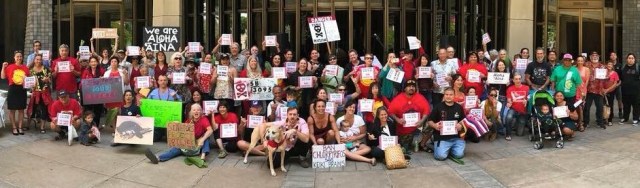
Heroes of SB3095 – This is what democracy looks like

group-shot-3095.jpg

By now, most of you have heard that Governor David Ige has signed into law SB3095.

Yes, we won.

It’s amazing really. 

The real story of course is about how it happened. How a small group of dedicated citizens in the middle of the Pacific ocean, took on the largest chemical companies in the world, and won.  

4 years ago Syngenta, Dow, Dupont and BASF successfully sued Kauai County for the right to spray poisons next to schools, and not tell us about it.  Today, as a result of the passage of this measure they can no longer do this.  Plus, over the next 4 years the Restricted Use Pesticide  (RUP)and neurotoxin chlorpyrifos, will be phased out and its use totally prohibited.  

Though other States have tried, none have been successful and Hawaii is the first.

The credit goes to a handful, and to thousands.  As in any achievement of significance, it required both.

In this case a small group of committed, talented and incredibly tenacious individual citizens, mostly from the neighbor islands of Kauai, Maui and Hawaii County, joined with a handful of organizations in partnership with an even fewer number of legislators in the Hawaii House and Senate, to make this happen.  Governor David Ige, capped it all off on June 15th when he signed it into law.  

This win is an important moment in the longer arc of the movement towards food justice in Hawaii. Many individuals and organizations have paved the way, stepped up along the timeline of this longer arc, and each of their contributions made this win possible. The legal support from Earthjustice, the early educational efforts of HawaiiSEED and the Mom’s Hui, and the street movement and grassroots organizing on Kauai led by Dustin Barca, the provocative and unapologetically radical work of Babes Against Biotech, Hector Valenzuela, Dr. Lorrin Pang, Walter Ritte, Jeri Di Pietro and so many others – ALL elevated this issue and ignited community engagement across Hawaii.

The Hawaii Center for Food Safety’s key report “Pesticides in Paradise” in 2015, provided an invaluable contribution by bringing key peer-reviewed scientific studies, rigorous data driven research on agrochemical footprint and pesticide usage in Hawaii to bear on state-level policy work. The HCFS team laid the groundwork for an informed and rigorous discussion of these issues and took on much of the heavy lifting throughout the state legislative process.

It is clear to me that SB3095 would not have passed into law without the phenomenal work, and the personal commitment to the cause made by Tiare Lawrence, Autumn Rae Ness, and Lauryn Rego (Maui) and Keani Rawlins-Fernandez (Molokai). 

I will never forget one particular incident, when I ran across this group accompanied by handful of other women from Maui while walking the halls of the state capitol.  I commented to Autumn, “I see you brought the big guns today.”  Without missing a beat Autumn replied, “We don’t have any little guns left.  All we have left are the big guns.” 

As the women from Maui, represented the thousands who are responsible for passing the “Maui Miracle” ballot initiative that also strove to regulate this industry, Fern Holland another wahine powerhouse likewise represented those many Kauai residents who stepped up to create and carry Bill 2491 through the Kauai County Council process.  From Hawaii County Councilmember Jennifer Ruggles also symbolizes the commitment and effort from that far end of the island chain.  On Oahu suffice it to say that Mae Fuimaono, and Mary Laques can hold that space today.

When all is said and done, SB3095 passed unanimously in the House and the Senate because of the pure force of will and commitment made by a relative handful of committed local residents who worked tirelessly, often at great personal sacrifice because they believed in their cause and refused to give up or back down.  Yes, they had science and the testimony of the American Academy of Pediatrics on their side.  And yes, their fundamental cause was a righteous and urgent one.

But make no mistake about it, laws are not passed based on the cause being a righteous or urgent one.  Unfortunately, they are also not passed just because a prestigious group of physicians provide incontrovertible evidence of a substance’s harm.

Passing a law of any significance, requires a marshaling of forces to push and pull and cajole and threaten if needed (in a political election year sense), until the critical majority vote is achieved. There are always forces “on the other side”, pushing back. The larger the stakes, the greater the push back and the tougher the fight.

Nothing is ever cut and dried.  There there are always “experts” who will testify in opposition to the other “experts”.  There are always reasons that “now is not the time” to pass any and all measures that are introduced each year.

It is only through the marshaling of broad-based, strong, unrelenting community support that SB3095 was able to be passed through the legislature.

It was 4 women from Maui and Molokai combined with a handful of other likeminded friends on Kauai, Oahu and the Big Island who by their sheer force of personality and will, made this happen.  They showed up.  They reached out to their networks.  They asked for help.

And then from all corners or the island chain others stepped up to give that help.  Friends and relatives and neighbors and co-workers inevitably would respond,“Ok, I will send yet another email of testimony in, and yes I will also make a call or two to my legislator.”  

Over and over this cycle would be repeated.  The voice mail of the legislators would be full of messages from district constituents when they came to work in the morning. The incoming email would be non-stop, and daily they would see those 4 women from Maui walking the Capitol halls, often with friends from Kauai, Oahu and Hawaii Island.

Next came the teachers in support, then the Sierra Club and then other disparate groups committed to protecting health and environment, and to fighting back against the abuses of large corporate agriculture.  All the while, the testimony of the American Academy of Pediatrics stood as the bedrock of legislative justification.

And then we won. 

Unanimous votes, in the House and in the Senate.  Who would have thought?

First they ignore you.

Then they laugh at you.

Then they fight you.

Then you win.

Mahatma Gandhi* (question as to attribution)

Mahalo to Governor Ige for capping off this effort by signing SB3095 into law. 

He could easily have sidestepped this politically sensitive issue, but instead he showed courage and leadership by putting his name on it in support.  Please take a moment and read my remarks about his support.  

Senator Russell Ruderman as the primary introducer of the Bill, and Senator Mike Gabbard who shepherded the measure through the committee process deserve the lions share of the credit in the Senate.   

In the House, Representative Chris Lee and Representative Richard Creagan are to be especially thanked for their leadership.

There are many legislators and individuals who deserve thanks and who stepped up at key moments.  My listing of a few names here is meant to especially acknowledge the handful who, if not for their individual efforts, this measure would not have passed.  These individuals symbolize and represent many others, that space will not allow me to list today.  And yes, I know I risk leaving key people out, but I do not want that fear to keep me from recognizing those who especially deserve it.

Is this the end of the journey? Absolutely not. We have more work to do. But Act 45 represents a significant and meaningful step in the right direction. For the many who have contributed in small and large ways, take a moment to savor this win. Let us also take a moment to rededicate ourselves to work of protecting what we love.

In solidarity,

Gary Hooser – Hawaii Alliance for Progressive Action (HAPA)

Note: The provisions of SB3095 and a short history of the 5 year journey can be found here. 

Please take 4 minutes and watch this very brief excellent, high quality video for some historical context:

P.S.  Some had indicated that the link to this previously posted piece was not working so am reposting:  “Bad News: Waiting For The Other Shoe To Drop – Winter is Coming”

Below are national/international news stories about the passing of Bill 2491:

The Nation: Hawaii Just Made A Brilliant End Run Around Scott Pruitts EPA

https://www.thenation.com/article/hawaii-just-made-brilliant-end-run-around-scott-pruitts-epa/

The Ecologist: Hawaii Bans Harmful Pesticide

https://theecologist.org/2018/jun/18/hawaii-bans-use-harmful-pesticide

Think Progress: Hawaii Becomes First State To Ban Pesticide Linked to Brain Damage

https://thinkprogress.org/hawaii-becomes-the-first-state-to-ban-the-use-of-pesticide-linked-to-brain-damage-884f61d24814/

Civil Eats: Hawaii Shows States Power To Regulate Pesticides

https://civileats.com/2018/06/20/hawaii-shows-states-power-to-regulate-pesticides/

Posted in Uncategorized | 4 Comments

Governor Ige: Leadership, Core Values and Resolve Under Pressure

Governor David Ige’s leadership, core values and resolve under pressure was clearly demonstrated by his recent signing into law SB3095.  Hawai‘i residents concerned about their health and the health of their children and grandchildren should thank him.  Progressives and those who fight daily to protect the health of our natural environment should also thank and acknowledge his leadership on this issue.

The measure was simple yet comprehensive and the protections now in place include a phased in ban of the neurotoxin chlorpyrifos, mandatory disclosure of all users of Restricted Use Pesticides (RUP), modest buffer zones around schools, pesticide drift studies and increased funding for the Department of Agriculture so it can properly do its job.

The pressure on Governor Ige to either let it pass into law without his signature, or to veto this measure must have been significant.  The largest chemical companies in the world were in strong opposition.  I know from personal experience that the forces aligned against his signing are formidable and they play hard ball.  Over the past 5 years alone, they have spent tens of millions of dollars in Hawai‘i fighting attempts to regulate their industry.  They spend big money on major media promoting their agenda, they invest heavily in local political campaigns and often have a “take no prisoners” attitude when it comes to politics and their opposition to increased government regulation.

However, Governor Ige chose to do the right thing and put the protection of the health of children above the political pressure and the profits brought and sought by these international corporations who produce, sell and use chlorpyrifos and other dangerous RUP’s.

This is the same pesticide that sent a dozen Syngenta workers to the hospital last year on Kaua‘i’s west side.  It has been found in small amounts at Waimea Canyon Middle School and in other areas when testing has been done in the past.  This same chemical has been banned already for residential use, and the EPA was preparing to implement a ban on agricultural use until its new Director Scott Pruitt reversed that decision.

To be real, the Governor could have easily come up with a reason not to sign the Bill, or to even veto it.

You can be sure the companies threatened to sue.  They would have also said that “the science is inconclusive”, as the industry has legions of scientists in their employ whose studies naturally favor their perspective.  And of course they would have argued that this will “hurt small farmers”.  It is ironic that the original proposals only impacted the very largest users, and was expanded to include “all users” only after the big companies (and their supporters in the legislature) insisted that all farmers big and small should have to comply. But the truth is that most small farmers do not use chlorpyrifos at all.

Yes, Governor Ige could easily have side-stepped this issue and derailed its passage. And he could have come up with an explanation for his action, that for many people would have appeared reasonable.

But he did not.  He could have used the standard excuses others at both the state and county level have used in the past to delay and avoid passage of similar measures.  He could have alluded to perceived deficiencies (the Bill is too weak or the Bill is too strong), offered to strengthen the “voluntary program”, expressed concern about the legal status, and/or fallen back on the dependable “this proposal needs more study” tactic that others in the past have used to avoid making a tough decision in an election year.

But he did not.  He looked at the evidence, he spoke to his advisers I am sure and reviewed the information provided by both sides.  Then he took the side of protecting the health of children and signed SB3095 into law as Act 45.

Governor Ige’s own words upon signing demonstrate his desire and commitment to protect health while acknowledging the importance of supporting agriculture, and that these goals are not mutually exclusive.  He should be commended for his leadership on this issue.

“Protecting the health and safety of our keiki and residents is one of my top priorities. We must protect our communities from potentially harmful chemicals. At the same time, Hawai‘i’s agriculture industry is extremely important to our state and economy. We will work with the Department of Agriculture, local farmers and the University of Hawai‘i as we seek safe, alternative pest management tools that will support and sustain our agriculture industry for generations to come,” said Gov. Ige.

First published in The Garden Island Newspaper on June 20, 2018

Posted in Uncategorized | 6 Comments

Kauai Elections and Voting By The Numbers

Of the approximately 72,000 residents now living on Kauai, about 56,284 are adults and eligible to vote during the upcoming Primary election on August 11, 2018.  Yet, during the 2016 Primary only 15,273 people actually voted.  10,000 of these votes were cast via early voting and absentee ballots.  

Consequently, two-thirds of Kauai’s votes are cast before election day.  

Sobering numbers indeed.

Statewide the statistics are similar.  There were 252,725 votes cast (also around 35% of registered voters) in the 2016 Primary statewide.  156,519 of these votes were counted as early voting and absentee ballots.

This means of course that when the day of the Primary actually gets here, the winners and losers have, for most races already been decided by the early absentee voters. 

The first absentee ballots are scheduled now to be mailed to overseas voters on Wednesday June 27th, only two weeks from today, with the mailing of the bulk of absentee ballots completed by July 20th (approximate only dates).

In Hawaii, which is ostensibly a single party State dominated by the Democratic Party, August 11th is often the only date that matters.  Most partisan races are decided then, with little if any, real General election competition from the Republican or any other political parties.  

While it is always possible for a Republican candidate to “pull something out of the hat”, for all intents and purposes, the August 11th Primary election will decide who will be the next Governor, the next Lieutenant Governor, the next members of Congress and just about every seat in the State House and Senate.  

On Kauai, this translates to the voters decision as to who will be the next Representative for House District #15 where the incumbent James Tokioka is running against Elaine “Queenie” Daligdig  and House #16 where incumbent Daynette “Dee” Morikawa is being challenged by Stephanie Iona.  District #14 Representative Nadine Nakamura is unopposed (and you can imagine of course that she is very happy about this).

In addition on Kauai, the top 14 County Council candidates and the top two Mayoral candidates who survive the August 11th Primary will move on to the General Election.

Conventional wisdom would say that for all state races, by July 20th it is all over but the crying.  

And it would say that any candidate that is not already in full battle campaign mode by now, will be hard-pressed to finish on top August 11th. 

Based on historic numbers the General election dynamics are similar but not as stark as the Primary.  During the 2016 General election the Kauai turn-out was 27,225 or 62% of registered voters, with 15,221 votes being cast early and absentee.  Statewide, the turnout was 437,664 or 58% of registered voters, with 234,336 votes cast early and absentee.

Quick recap for Kauai: 15,273 voters showed up in the 2016 Primary while 27,225 showed up in the General.

On August 12th, all eyes on the Garden Island will then turn to the Council and the Mayoral races.   

The top two finishers (out of presently 7 candidates) in the Mayor’s race will then go toe to toe, while the top 14 finishers from an initial field of 24 aspiring Council candidates will then ramp up their efforts for the home stretch sprint toward the General election of November 6, 2018.  

While the top 14 Council candidates will make the first cut, history shows that rarely does any candidate “move up” from below the #9 slot, into the top 7 winners circle.  Once in a while candidates will move up from lower rankings in the Primary to a winning slot in the General, but this is indeed rare.  However, with 3 incumbents leaving their seats open, anything can happen.

Bottom line for candidates: You are way behind where you need to be, people will be voting very soon so turn it up!  

For the rest of us: Take responsibility for your government.  Find a candidate you like and support him or her.

Most of all vote!  Then remind your neighbors to vote.

First published in The Garden Island Newspaper 6/13/18

Posted in Uncategorized | 1 Comment

There are no perfect candidates.  

While there are good people and good candidates, none are without flaws and all have strengths and weaknesses.

So how does one choose from a list of imperfect individuals?  What criteria is best for judging who is best suited to serve in public office?

There are over 20 candidates running for election to the Kauai County Council.  I am clear there are 7 among this group who have the potential to serve us well.

But how to choose?

Personally, I start with a process of elimination.

First I eliminate the jerks, the bigots, the misogynists, the bullies, and the ignorant, pompous know-it-all’s.

Next, I eliminate those candidates who IMHO have clear conflicts of interest via their employer or other business affiliations.  My preference is that the candidate if elected will serve only one master, and that would be the people.

Then, assuming there are still options left on the prospective candidate list, I eliminate the ungrounded, unstable, and those without roots in the community.

I realize the above process of elimination may seem harsh, and is a personal and subjective evaluation.  But hey, it’s my vote to do with as I like in the privacy of the voting booth.

Once the negative process of elimination is out of the way, I rank the remaining candidates based on trust, core values, competence, life experience and strength of character.  Again this is a personal score card, based mostly on instinct and general observations of the candidates actions and history in the community.

I am seeking candidates whom I know with certainty will not abuse the public trust.  And who share my general world view of putting people and the environment ahead of the profits of business.  Competence, life experience, and specific skill sets are of course also important.

I look for balance.  Diversity is important.  Historically women have been underrepresented and sometimes geographical and other demographic representation is lacking.

My practice when voting for the County Council, is to only vote for those individuals I truly want to see elected, even if this means voting for only a handful of candidates and not using my full allotment of 7 votes.

Our community is fortunate to have a large and diverse field of candidates running for the County Council this year.  I encourage all to get to know them, scrutinize their records, attend the forums.  Then vote wisely on August 11 or register for an absentee ballot and submit before August 11.

First Published in The Garden Island Newspaper 6/6/18

Posted in Uncategorized | Leave a comment

A straight-forward description of what Act 45 (formerly SB3095) actually does in terms of pesticide regulation

Act 45 (formerly SB3095CD1) contains 6 main components:

1- A ban on the use of the RUP and neurotoxin chlorpyrifos. This ban takes effect immediately however temporary permits will be granted allowing continued use for up to 4 years, at which time no new permits will be issued and no chlorpyrifos will be allowed in the State of Hawaii. The practical expected impact of the ban’s 4 year implementation will be a gradual decline in use, culminating in a complete ban after 4 years.  Though several have tried, Hawaii is the first State in the nation to have any type of ban whatsoever.

2- Mandatory statewide reporting of annual RUP use for ALL RUP USERs to the State Department of Agriculture (SDOA) that includes: RUP product used, amount of RUP used, and the date and location of the usage.  Every single user of RUP’s in the state of Hawaii will be required to report their usage.  This information is subject to HRS Chapter 92 (public records law).  Prior to passage of this law, there was no State requirement for any RUP use reporting at all.  In the future we will know what was sprayed, how much was sprayed, where it was sprayed and what day it was sprayed.

3- Annual Public Summary Reports of statewide RUP usage by County reporting the types, amounts and area of the applications.

4- A prohibition against using RUP’s within 100 feet of school grounds during school hours (excluding termite fumigation).  There were zero buffer zones requirements in place prior to passage of this law.

5- The SDOA will conduct a pesticide drift monitoring study to evaluate pesticide drift at three schools within the State.

6- Approximately $700,000 in general funds are being added to the SDOA annual budget, plus two additional positions. These are intended to support the increased pesticide oversight and the drift monitoring studies. Historically the Department has been grossly underfunded and understaffed.

While many of us who have been working hard on this issue for the past years would have preferred various aspects to be stronger, it is without question that the sum total of the above components represent a strong and meaningful step forward in securing increased health and environmental protections.

The ban on chlorpyrifos alone will have tangible health implications and the statewide reporting provisions have the potential to generate long term, consistent data necessary for those seeking to research the issue to determine specific impacts.

 The summary data by County will allow residents the information needed to make a more informed decision as to where they choose to live, work, play or go to school. 

Clearly the 100 feet buffer zone around schools is inadequate and must be expanded in the future but it is more than we have in place now, which is zero. 

The drift monitoring study if done correctly has the potential to yield much needed data but for its results to be credible will require significant forethought and careful planning. Of course the additional financial and personnel resources provided to the SDOA will be hugely helpful in their efforts to properly manage the use of RUP’s while protecting health and the environment.

Posted in Uncategorized | 2 Comments

Hawai‘i does what EPA failed to do: first U.S. ban on chlorpyrifos enacted into law

Hawai’i made history today when Governor David Ige, watched by representatives of the community from across the islands, signed into law Senate Bill 3095, banning all uses of chlorpyrifos, a neurotoxin that has been banned for home use for over 10 years because of its known impacts on the developing brains of children. This law also mandates 100 foot no-spray buffer zones around schools to protect children from open air spraying of Restricted Use Pesticides (RUPs) during school hours. Chemical companies will have to report regularly on the RUPs they sprayed, when and where they sprayed, and in what quantities. This will allow impacted communities to access information about what they are being exposed to, and regulators to make informed decisions about protecting public health, the environment and endangered ecosystems.

This new law is the culmination of nearly six years of grassroots organizing by small, rural communities facing daily pesticide exposure, fighting lawsuits and millions spent on lobbying by the chemical companies. A coalition of families, teachers, scientists, health professionals, and advocates from the Hawai’i Alliance for Progressive Action (H.A.P.A.), Hawai’i Center for Food Safety, Hawai‘i SEED, and Pesticide Action Network worked for years to push forward this legislation to protect our keiki, despite millions spent by the agrochemical industry to thwart the democratic process.  For the first time in the United States, this bill said NO to chlorpyrifos, a pesticide that can trace its origin to nerve agents developed by the Nazis in World War II.

“As a mother who agonized about the dangers of sending my children to a school next to Monsanto’s fields where RUPs were sprayed regularly, I am so grateful to see this bill become law,” said Molokai lawyer and activist, Keani Rawlins-Fernandez,

“This law is our message to the EPA and to the chemical companies that we will no longer tolerate being ground zero for the testing of toxic pesticides that are damaging our children’s health and poisoning our environment,” said Gary Hooser, former Majority Leader of the Hawai’i Senate, and founder of the Hawaii Alliance for Progressive Action. Hooser, who lives on Kauai, led the “Protect our Keiki” coalition of diverse residents from across the islands through the complex political process that resulted in this much needed compromise law to regulate how highly toxic chemicals like chlorpyrifos are unleashed on the community.

“Hawaii’s efforts have set a precedent, and we hope this will pave the way for other states that are looking to enact similar legislation,” said  Leslee Matthews from Pesticide Action Network

 A win that will reverberate across the nation

“This is Hawai’i fighting back against the disrespect for science and public health—and winning! In the era of Trump, states must lead,” added Hooser.

Background

Large agrochemical operations operate year round and take advantage of Hawaii’s three growing seasons.  Consequently, there are areas where communities are exposed daily to the impacts of open spraying of Restricted Use Pesticides. Local county ordinances on each island to regulate pesticide use and protect public health were met with lawsuits by the chemical companies. The 9th Circuit court ruled in favor of the chemical companies and invalidated county regulations, arguing that only the state had the authority to pass such laws.

Hawaii sets precedent for other states

Today the state exercised that responsibility to protect its citizens.  Governor David Ige’s decision to sign the bill into law was an affirmation of how government is supposed to work when it listens to what the people need.  Hawai`i did what the Environmental Protection Agency failed to do. It responded to the abundant data and studies that point to the adverse effects of R.U.P.  Scientists, including some who had previously worked for the E.P.A. weighed in. Physicians weighed in, calling for a ban based on clear health impacts that they were seeing. Mothers, in tears about the terrible risk to their children’s health, weighed in. It was time to act. And Hawai`i did, with passage and enactment of SB3095 into law.

From the Hawaii Alliance for Progressive Action (HAPA): June 13, 2018

Posted in Uncategorized | Leave a comment