Lowering the cost of living & supporting agriculture – a twofer

Politicians and lawmakers often lay the blame for their perceived impotence on the nature of dealing with “complex issues and intractable challenges”.

This is kind of true, but not really.

Many if not most of our state’s most serious challenges, can be resolved or at least greatly alleviated, with literally the stroke of a pen.

Some small changes to current policy could have huge beneficial effects, with many solutions costing zero not zillions of dollars.

Most of the issues and their proposed solutions have been around for decades, debated, studied, and deferred, ad nauseam.

Changes in “public policy” can often be made with zero impacts on the state budget. Simply changing tax policy, by reducing the amount of taxes now paid by local residents and increasing the taxes paid by absentee owners, foreign investors, very high-income individuals and visitors is one tangible example.

With the stroke of a pen our state legislature could lower the cost of living, for all of us who live here.

But to find a majority in the House and the Senate with the common purpose and drive needed to actually stroke that pen, is another story.

Of course with every action done by the legislature, someone’s ox is gored. In the case of lowering the taxes of local residents while increasing taxes on the wealthy and elite, the wealthy and elite will scream very loud.

There are few policy initiatives that will make everyone happy. In this case, making positive changes to help local residents is our priority. The fear-mongering by those who will pay more though will be palpable, and big business and big money will align in opposition.

“We could do this but…”. There is always a “but” standing in the way of progress. There is always fear of the unknown, and there are always excuses for the inaction.

One would think that if politicians could lower the cost of living for hard-working local residents AND increase food self-sufficiency while supporting local agriculture – they would be tripping over themselves to make it happen.

It’s only complicated for those who want it to be complicated. Trust me on this, it’s not.

With the stroke of a pen, the legislature could remove the 4.5% General Excise Tax (GET), including County surcharge, on fresh non-processed food and long-term rents. Voila! The effective cost of living for local residents is significantly reduced, PLUS the market for fresh locally grown food is increased.

That’s fresh non-processed food. We are not talking fast food, canned food, boxed food or restaurant food. You get the picture- fresh, healthy, and hopefully locally grown food, is what we are talking.

And long-term rents mean long term rents and NOT short-term vacation rentals.

Ideally, but yes it does now get more complicated – the GET could be removed from other “essential” items such as toilet paper, diapers, soap, toothpaste and other personal hygiene products.

And those minuscule but important tax credits that currently apply to low income working people? Those need to remain as well. No bait and switch to the detriment of the 48%, please.

The “lost income” to the state could be made up by a modest increase to the GET on all other non-essential items.

Hawaii has 1,400,000 permanent residents, 48% of whom are one paycheck away from being on the streets. 10,000,000 tourists are expected to visit Hawaii next year. Our visitors and others who can well afford it, need to pay a larger share of the GET, and local residents need to pay less.

Think about it as a public policy “twofer” – food and economic justice via the stroke of a pen.

What a day that would be. Imagine a legislature that lowered the cost of living for local residents, and helped our small farmers – all in a single legislative session.

It’s doable you know. We are not talking pie in the sky, fantasy type make-believe policy. This could be real and could be done in a single year – if a majority in the legislature wanted it.

Gary Hooser

Subscribe to my policy and politics newsletter and get regular “action alerts” here: http://garyhooser.com/#four

Posted in Uncategorized | 1 Comment

Food Fight – The battle to preserve brand integrity

Recently, the Kona Coffee Farmers Association (KCFA) approached me about helping them with legislative advocacy. The core issue is one of preserving “brand integrity” which is hugely important to all agricultural products grown in Hawaii – so naturally, I said yes.

While conducting my initial due diligence, I’ve discovered that just about anyone can slap a label on a product that implies the product was grown in Hawaii, when in fact it may not contain any Hawaii grown contents whatsoever.

At the local supermarket, I found “Hawaiian Hazelnut Flavor Coffee – 100% Arabica”. In fine print on the back of the package were the words: “Does not contain Hawaiian grown coffee.”

On a nearby shelf was another bag of coffee loudly proclaiming its Kona roots, as a “Kona blend” with only 10% of the coffee in the bag actually being grown in Kona. The label gives no clue as to where the other 90% is from. Still other bags of coffee declared they were “roasted in Hawaii”, but yet contained no coffee actually grown in Hawaii.

On other shelves, I find instant Idaho mashed potatoes and clear labeling indicating the Idaho Potato state-required registered trademark. And in the wine section, I discover that a Napa Valley “blend” must contain at least 85% wine from grapes that were actually grown in Napa Valley.

Idaho protects the brand integrity of its famous potatoes:
“All persons doing business in the state of Idaho are required to disclose the growing area of origin upon all potato containers in accordance with this rule…Private brands or labels of containers that reference an Idaho location or geographical feature, or otherwise attempt to imply directly or indirectly that a container of potatoes contains potatoes grown in Idaho when in fact such is not the case are prohibited…”Idaho Code

California also protects by law the “brand integrity” of their wines:
“To be designated as a “California” wine, 100% of the grapes used in the wine must be grown in that state. To bear a viticultural area designation such as “Napa,” “Sonoma,” or “El Dorado County,” 85% or more of the grapes used must be grown in the designated area.” Avvo Legal Guide

The preservation of brand integrity is essential in order for small farmers to prosper in Hawaii. While local consumption is critical to provide base markets for local farmers, the true gravy for small farmers resides in the sale of high-value niche agricultural products – to visitors and for export.

Brand integrity ensures both consumers and farmers are protected. Maintaining and enhancing the quality of the product and thus the price-point and marketability of that product, are essential to ensuring profitability.

Whether it be Kona coffee, Maui coffee, Ka’u coffee, Kauai coffee or coffee grown in other Hawaii geographical locations, or any number of food and drink items whose marketing is based on locally grown agricultural products – preserving brand integrity is essential.

The Kona Coffee Farmers Association (KCFA) will once again be leading the effort during the 2020 state legislative session to strengthen Hawaii’s coffee labeling laws. It is with great enthusiasm that I offer them my help and assistance as their legislative consultant and yes, their lobbyist.

Our goal is to form a coalition of farmers large and small from all islands and from all coffee growing areas who share the common goal of preserving that hard-earned and well deserved, “geographic brand identity”. We invite all farmers whether you grow coffee, chocolate, vanilla, onions, lavender, papaya, macadamia nuts, pineapple, hemp or any Hawaii agricultural product – to join in our effort as well.

To be successful during the 2020 legislative session means starting now.

There are three things you can do today that will help tremendously.

1) Send an email or make a call to your state legislator (House and Senate) and let them know that brand integrity and the passage of a 51% minimum threshold for coffee blenders are critically important to you. Contact info is at https://www.capitol.hawaii.gov

2) Write a “letter to the editor” supporting the preservation of brand integrity and the 51% minimum threshold for coffee blenders.

3) Pass the word! Contact other farmers AND consumers and ask them to join us in the effort.

If you want to get more involved but not sure how, please email me at GaryLHooser@gmail.com

Thank you in advance for your help and support. This is a just cause and winning helps not only our coffee farming friends but is a strong step toward preserving brand integrity for all of Hawaii’s niche and value-added locally grown products.

Note: If you are willing to send in supporting testimony to legislative committees, please send me your email address and you will receive alerts as to when testimony is needed–beginning in January or early February.


Posted in Uncategorized | 2 Comments

Title: A non-political Thanksgiving message

Believe it or not, a non-political Thanksgiving message is indeed possible and especially needed today, and in these times.

While it sometimes feels as if we are surrounded by pain, tragedy, and sorrow, it is essential that we take a day or two to rest and reflect on the good in the world, lest we risk getting buried in that darkness.

When children are lost and families plunge into despair, seeing the good in the world may seem an impossible task. My own father never made it to the age I am today. And to the great sadness of my family, my older brother left the world far sooner than anyone thought possible.

On days like this, those of us who are fortunate to live in a privileged bubble without hunger, sickness, pain or sorrow, often feel guilty and undeserving of our good fortune.

In my core, I know that those of us who have more, are bound to offer our hand to those who through no fault of their own, have less. We are all in this together, and the notion that we live in a world where it’s “every man/woman for himself/herself” is one I reject.

If we each track our genealogy back far enough, you will find we are all related.

My heart, and yes my prayers as well go out to those who because of sorrow, sadness or circumstances, may feel that celebrating a day of Thanksgiving is not possible. Life has dealt me moments of darkness and great stress as well. But somehow I survived and grew stronger, pushed onward by the basic knowledge that the sun always comes up the next day. My mother would tell me that God has a plan and that things happen for a reason – though more often than not I could not fathom what that plan or reason might be.

I am blessed today with a loving and growing family. I live in one of the most beautiful places imaginable and am surrounded by friends and colleagues united in the common purpose of making our world a better place. I cannot remember the last time that I awoke to anything less than total excitement about the day ahead.

Yes, I have much to be grateful for, and many, many people to thank.

I am grateful to those who work and fight daily for justice. Whether your focus is on economic, social, environmental or cultural issues – mahalo plenty for all that you do.

It is often said that work in politics, “is a thankless job.” For me, I have not found that to be the case. While the work is not without its stress and sometimes vocal detractors, the aloha and support expressed to me daily by residents from all walks of life, easily overwhelm any negatives.

Please know that I am deeply appreciative of the many, many people in our collective community who have supported and helped me over the years. From those of you who have voted for me in past elections to those who continue to help and support the advocacy work I am doing on Kauai and throughout the State – I offer you my deepest gratitude. The faith and confidence you have placed in me, and the honor you have given me via your personal help and support – make me a better person and help keep me on track.

I tell people that I am stuck in a positive feedback loop – and you are part of it.

Have a Happy Thanksgiving. Celebrate if you can. Reach out and offer your love and aloha, and whatever support you are able – to help those in need and who may be suffering.

Hug your family, hug your friends – tell all who care to listen of your thanks and gratitude to simply be alive.

Slightly edited from a column first published in The Garden Island newspaper, 11/27/19

Posted in Uncategorized | Comments Off on Title: A non-political Thanksgiving message

Increasing Hawaii’s Minimum Wage – It’s the right thing to do

During the 2019 Legislative Session, residents from across Hawaii engaged the legislative process, debating the question of whether or not to increase Hawaii’s minimum wage. Many, already struggling to make ends meet took off from work, arranged childcare and traveled to the State Capitol from the neighbor islands.

Thousands of people submitted testimony, committee hearings were held, and legislators voted publicly on multiple occasions – overwhelmingly in support. From that process, emerged HB1191 HD1 SD2, proposing to increase Hawaii’s minimum wage to $15 per hour (phased in), from it’s existing $10.10 per hour. 

Hope and optimism among advocates was running high as the legislative session neared its conclusion and the Conference Committee was convened.  Then on April 26th, those hopes were dashed when it was announced than an agreement between the House and Senate could not be reached.

Advocates were told, “Come back next year, submit another bill and try again” – sorry, not sorry.

Article III, Section 15 of the Hawaii Constitution states in part:

”Any bill pending at the final adjournment of a regular session in an odd-numbered year shall carry over with the same status to the next regular session.”

Thus there is nor need or reason to “submit another bill”, and no reason that thousands of local residents have to yet again submit testimony, take off work and endure the often arcane practices of the legislature – only to wind up at the same exact place.

Upon the opening of the 2020 Legislative Session, leadership in the House/Senate could simply reconvene the Conference Committee, amend HB1191 HD1 SD2 as needed to remove any sections that are problematic, and pass it to the floor for a full vote.  

While still short of a true living wage, the $15 per hour (phased in) proposal now on the table, represents a strong step in the right direction.

According to the Hawaii State Department of Business and Economic Development (DBED) – $17.50 per hour (approximately) is a “subsistence” wage for a single person without children. This means a person needs $17.50 an hour to simply survive. 

If the legislature included an annual cost of living adjustment (COLA), plus a small additional increase every year – eventually a true living wage could be achieved.

Recent studies (the ALICE Report) have concluded 48% of Hawaii residents are either already living in poverty or one paycheck away from being on the streets.

To add salt to the wound, without a single legislative hearing or a public vote, every member of the Hawaii Senate and House of Representatives will receive a pay raise starting in January of 2021. Likewise, the Governor, the Lieutenant Governor, all State Judges and most top executives in State government will receive substantial pay raises.

To be clear, I do not begrudge increasing the pay for legislators and top administrators for the state. But to do so while at the same time denying low-income working people a much-needed increase – is glaringly hypocritical and totally inappropriate.

Hawaii has the highest per capita rate of homelessness in the entire United States. Every day the legislature fails to authorize a minimum wage increase, is another day that low-income workers fall further behind. 

As someone who served in public office at both the state and county level for over 16 years, I know many of these legislators personally.  I also know without a doubt whatsoever, that a majority of them if given the chance, would vote in support of a phased-in $15 per hour minimum wage, with a COLA provision.

I implore upon leadership in the House and the Senate, as the first order of business in the 2020 Legislative Session, to provide that chance. 

It’s simply the right thing to do.

First published in Civil Beat, 11/26/19

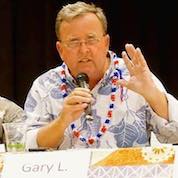
gary at mic with lei

Posted in Uncategorized | Comments Off on Increasing Hawaii’s Minimum Wage – It’s the right thing to do

Food/Farm Policy, Hawaii Style

According to numerous reports Hawaii imports about 90% of its food and exports approximately $3 billion a year paying for it. 

All will agree I hope, that reversing this statistic so that 90% of our food is grown in Hawaii, and all of that money is circulated in our local economy – is a worthy goal.  

Clearly, we have the land and the water to support our basics – meat, vegetables, fruit, and starches.  

Meat – Fortunately, due to the pioneering efforts of local ranchers, the locally grown grass-fed beef component seems to be on track. It goes without saying that the market for hamburger alone in the state of Hawaii is massive. Think of all the fast-food restaurants, think of all the hotels – and think about something the government has control over, which is the food purchased by schools, prisons, and state hospitals. 

Vegetables –  A wide assortment of green leafy and other veggies are also grown through-out Hawaii in back-yard farms and on larger tracks of land.  

Fruit – In my yard, growing almost effortlessly on a quarter acre of land we have a consistent supply of papaya, banana, star-fruit, mango, orange, lemons, limes, pineapple, and an occasional dragon-fruit.  There are few things more gratifying than eating something every single day that has been grown in your own yard. While I have some understanding of the challenges that commercial farmers face when attempting to grow and distribute larger quantities of fruit, clearly a wide variety of fruit thrive in our soil, sun, and water.

Starch – I am tempted to say forget rice for a moment, but I am fully aware this suggestion would not be a palatable one. However, without any hesitation at all, I give a full-throated shout-out to ulu (breadfruit)! Trust me on this. My wife and I literally have our “picker” in the car at this moment preparing to head out to a couple of secret locations where the ulu is ready to fall to the ground. While there is a “learning curve” to its preparation – ulu has come to be one of our favorite foods. Taro is the other obvious starch that can be grown in abundance here in Hawaii, is a traditional food source, and highly nutritious. 

What about fish? I purposely have left fish off the list. Personally, I have concerns about “fish farming” and even more concerned about the potential for over-fishing of our local waters.  So for now, my practice is to buy fish, when available from my local fisher-friends.

So, what is keeping us from growing our own food and feeding ourselves?

Not a whole lot actually.  There are really only a handful of core elements that need to be in place – and all can be achieved via basic changes in public policy.  As is most often the case the policy changes can be phased in – 10% per year over 10 years and voila, Hawaii has achieved food sustainability.

Some stuff, we as individuals can, should and must do NOW.

If local residents made a concerted effort to ALWAYS shop at the local farmers market, and ALWAYS buy local beef and pork  (and fish from local fisher-friends, and eggs when you can get them) – then small local farmers could and would be sustainable.  If we who live here, purchased 100% of our fruit, veggies, meat, and starches from local farmers, it would make an incredible difference.  

And if our state government required that all (or at least 90%) of food purchased for schools, prisons and state hospitals be locally grown – think what a tremendous market opportunity that would offer for local farmers.

Of course, if the visitor industry and a few fast-food chains made a commitment to spend 90% of their budget on locally produced food – that also would be huge.

Local farmers on all islands are pretty much unanimous in their message to policymakers: They need a steady market for their products and they need access to farm-worker housing options, low cost and long term land leases, and affordable water. 

  1. Farm-worker housing – Policymakers can and must make this happen.  Farmers and their workers need to be able to live on their land which is often-times leased and not necessarily zoned for residential use. Some progress has been made on this issue, but the process continues to be far too complex and unwieldy. The challenge for policymakers is to make this easy for “real farmers” but prevent the historical abuse that has resulted in a proliferation of “fake farms” and “transient vacation rentals”.
  2. Land – Farmers need affordable and long term leases. Unfortunately, Hawaii’s largest private landowners are hesitant to grant the affordable long term leases needed by serious farmers.  Policymakers could direct the Agribusiness Development Corporation (ADC), a state agency that manages thousands of acres of publicly owned agricultural land, to make local food production their top priority. Today the ADC’s largest tenants are the agrochemical companies whose primary products are not food for local consumption but rather genetically modified corn exported for the eventual production of high fructose corn syrup, ethanol and/or cattle feed.
  3. Water – Access to affordable water is essential and government has a central role in managing and protecting this public trust resource.  Historically large landowners have used agriculture merely as a “front” to preserve their control over water that is ultimately diverted for real estate development. In addition, the negative legacy of pesticide contamination must be avoided. The sugar and pineapple plantations of the past are as guilty as today’s GMO industrial/ag companies. Recent testing of soils, surface streams, near-shore waters, and even our drinking-water aquifers, all show evidence of pesticide contamination caused by large agribusiness. Public policy changes aimed at both preserving water quality and ensuring water availability to farmers who practice regenerative farming methods must be a priority.

Simply making local food production a goal is not enough.  Government policy-makers must take action.

First published on 11/20/2019 in The Garden Island newspaper

gary at mic with lei

Posted in Uncategorized | 3 Comments

Hawaii County Proposal To Ban Synthetic Herbicides – Bill 101 courtesy of Blake Watson

It’s been a long journey, but it looks like we are almost done passing a bill to ban the County’s usage of synthetic herbicides, Bill 101. The final hearing is set for 9am on November 20th and is being held at the Kona council chambers. Chemical industry, and chemical farming talking points were made against the bill by several testifiers in the last hearing, yet the bill still passed first reading of the Council 8-1. Tim Richards was the only “no” vote. It should be noted that this bill does not affect agriculture, while this was the main talking point of those opposed to the bill. Matt Kleinfelder expressed additional concerns about the use of neonicitinoids – a class of pesticides that is not covered bill but is of no doubt a serious concern with the health of bees and other wildlife.

Also, of note, the bill was passed as amended to include an exemption for the Big Island Invasive Species Council and others to continue to do their important work of invasive tree control, without having to apply for an emergency pest exemption through the process already provided for in the bill.

Please send in testimony to counciltestimony@hawaiicounty.gov or show up in Kona or any of the videoconferencing sites to testify. We expect that the chemical ag proponents will come out in force, since this is the final vote. We need a solid show of support. Additional to that you are also encouraged to testify on the options available that the county could use for weed management/ replacement. We know that many of you have first-hand knowledge of the plant ecology in your particular area of the island, and this could be helpful information for the county. Also, if this passes, we will need qualified community members to volunteer for the Transition Commission. Please consider applying if you feel qualified under the provisions of the bill.

In general, to support this legislation (besides testifying) some ideas for community help are:

1. Have a background in herbicide-free landscape management and would like to sit on the transition committee OR help with the transition at your neighborhood park

2. Are a parent, or a kids sports coach that can teach your playgroup or sports team how to spend a few minutes pulling weeds on your field.

3. Have ideas or resources that will help our public works crews manage the weed growth on county roads.

Bill 101 fact sheet:
🌱Bill 101 bans the use of herbicides by “the county” on County-owned lands.

🌱Bill 101 does not prohibit herbicide use on any privately owned or state land, including agriculture, landscaping or home care activities.

🌱Since Bill 101 only applies to herbicide use by “the county” on county-owned lands, it allows for herbicide use on county-owned agricultural lands that are leased to private individuals. It also allows for herbicide use by entities like Big Island Invasive Species Committee, even on county-owned land, as BIISC employees are not “the county.”

🌱It completely exempts the direct application of herbicides through cut stump or incision point injection, which will allow for the continued use of herbicide to control things like albizia.

🌱We recognize that the County itself doesn’t really do long term invasive species eradication, but if it ever does, they will be covered in the section that allows for a temporary exemption from the council. I have spent time with various invasive species eradication agencies, and recognize that strategic use of herbicides, when it’s a small part of a long term plan, especially in reforestation work, should be allowed. At the moment, county agencies are generally not using herbicides as part of a long term eradication plan, but when they do, this waiver section will allow for that.

🌱A Vegetation Management Transition Committee will be established to monitor, educate and assist county staff and the public about alternative weed management practices. If you have experience or knowledge in one of the following fields, please consider applying to sit on this committee: Native Hawaiian plants, tropical horticulture, agroforestry, silviculture, organic landscape, permaculture, natural farming or weed science. Applications will be taken at a later time, but if you want to send a quick email to the County Council letting them know what skills you have to offer, it might let them and the departments know just how many resources we have on island to support the departments through this transition.

Testimony in support is needed NOW – prior to the hearing in Kona at 9am on November 20, 2019 Email counciltestimony@hawaiicounty.gov

Posted in Uncategorized | 1 Comment

“Legislature should raise the minimum wage to $15, without delay” by G. Hooser as published in the Honolulu StarAdvertiser

Every Hawaii legislator will receive a pay raise starting January 2021. Likewise, the governor, the lieutenant governor, all state judges and most top executives in state government will receive substantial pay raises.

Minimum wage workers will get nothing.

Legislators accepted their own pay raise with one hand, while blocked a raise for low-income workers with the other.

Multiple hearings were held on House Bill 1191 during the 2019 session. Thousands of people from all walks of life testified in support. Many took off from work and others paid to fly in from the neighbor islands. Countless hours were spent, waiting patiently for their name to be called, to offer heartfelt and compelling testimony.

As a result, HB 1191 was amended to increase Hawaii’s minimum wage to $15 per hour (phased in), and ultimately made it to the final conference committee. But the state House then pulled the plug: The excuse given was that a provision intended to help business was “possibly flawed” and there was not enough time remaining in the session to fix it.

Rather than pass a strong, reasonable minimum-wage measure phasing in a $15 per hour wage over several years, the joint House/Senate conference committee swallowed the poison pill provided to them by the business community and killed the entire measure.

Rather than pass the bill, they chose to pass the buck, doing nothing for another year. The consequences of this decision are devastating to Hawaii’s working families who will never catch up on the lost year. Some stats:

>> $17.50 per hour (approximately) is a “subsistence” wage for a single person without children. This means a person needs $17.50 an hour to simply survive, show numbers from the state Department of Business, Economic Development and Tourism.

>> 48% of Hawaii residents are either already living in poverty or one paycheck away from being on the streets, according to the ALICE Report.

>> Hawaii leads the nation in the number of houseless, per capita, says the U.S. GOV Council on Homelessness.

With January 2020 opening the second year of the Legislature’s biennium session, legislators could simply, if they so choose, pick up bills exactly where they were left off at the end of the 2019 session.

HB 1191 HD1 SD2, increasing Hawaii’s minimum wage to $15, remains stuck in conference committee purgatory. Upon start of the 2020 session, with the concurrence of Senate/House leadership, the committee could schedule a hearing, amend the bill as needed and pass it to the floor for a full vote. In two weeks, by the end of January, it could be done.

There’s no reason to force thousands of citizens to jump through the hoops of multiple hearings in the House and Senate, to take off work, arrange childcare, and incur the cost of traveling interisland — only to end up in exactly the same place.

Legislators have had many months since the close of the 2019 session to work out the kinks, meet with stakeholders, staff and the administration. They could, and should, have already come to an agreement on a clean bill, one that can be passed promptly upon the opening of the 2020 Legislature.

Regarding potential negative economic impacts of raising the minimum wage, the data is unequivocal: There is no credible research correlating elevated levels of unemployment, bankruptcy or inflation when wage increases are phased in gradually.

While not a living wage, or even a subsistence wage, $15 represents a strong step in the right direction. If tied to annual cost-of-living adjustments and future modest incremental increases, eventually a true living wage would be achieved.

Imagine that: A future where every Hawaii resident who works a 40 hour week can afford a dry, safe place to live, three meals a day and basic health care.

Published November 7, 2011 – in the Honolulu StarAdvertiser

Posted in Uncategorized | 1 Comment

The $13 message – it’s all about the subject line. Email legislators NOW.

Please help today, especially by the end of the day on Wednesday, January 29th, if you can –  The 2020 Hawaii State Legislative Session has begun and we need to get this important message out BEFORE THE HEARINGS START.

1) Email your District State Representative and Senator and let them know that $13 per hour is not acceptable and that Hawaii workers deserve a living wage.

Do your best to put your core message into the subject line!

Make sure the legislator knows that you live in their district.  Include your name and the island/town you live on in the body of the email.

Keep your message brief.  It’s all about the subject line and the fact that you live in the district they represent.

2) If you have already reached out to them, please do so again.  Keeping it very short is fine.  They are very busy during the session, but they still needed to be reminded of the importance of this issue.

Be respectful and professional, please.

3) Identify your District Representative and Senator and get their contact information HERE  https://www.capitol.hawaii.gov/findleg.aspx

If the above link is not working for you (it can be fickle), you can also click here to locate your Hawaii State Senator and Representative.

Email them BOTH.  It is important that your email identify the fact that you are a constituent and that you live in the district. 

And for this message – It’s all about the subject line!

Please also cc the email sent to your Representative to reps@capitol.hawaii.gov and cc the email sent to your Senator to sens@capitol.hawaii.gov


Posted in Uncategorized | 8 Comments

Turning marchers into voters, learning from the revolution of ’54

On March 28, 2019, over 2,500 Kaua’i residents marched on Rice Street. On O’ahu, over 20,000 marched through Waikiki. Similarly, on Maui and in Hawai’i County – thousands marched – For, justice and for Aloha ‘Āina.

Depending on the exact district, it can take less than 2,500 votes to win a State House seat and 7,500 votes to be a State Senator (some districts more and some districts less).

It doesn’t take a rocket scientist to figure out what could come next.

Imagine what could happen if those who marched were all registered to vote, all actually did vote, and their votes were focused on qualified credible candidates who supported their world view.

The potential for change is palpable.

Because all legislative decisions are driven by a “majority” and assuming there are already some legislators holding office now who share the values of those who marched – only a relative handful of newly elected individuals are needed to achieve bold systemic change.

Hypothetically speaking of course – if one wanted to plan or plot a Hawai’i political revolution – a very rough, “back of the envelope” estimate of the number of newly elected individuals needed might be as follows.

State House of Representatives: 51 Representatives total, thus a majority is 26.
State Senate: 25 Senators total, thus a majority is 13.

There are a handful of champions in both the House and the Senate, and numerous others who, when the crunch comes, will “do the right thing”.

Consequently, it is not necessary for those who seek a revolution, to achieve a clean sweep of all seats. In addition, because of the “multiple faction” nature of organizational leadership, electing even just 12 new legislators in 2020 would equate to a political earthquake not seen since the often heralded “Democratic Revolution of 1954”.

Of course, more is better, but the election of even just 12 new legislators who embrace the values of Aloha ‘Āina, put people and the planet above corporate greed and who recognize the urgency of the moment – would be huge.

The history is important:
“The Hawai’i Democratic Revolution of 1954 was a nonviolent revolution that took place in the Hawaiian Archipelago consisting of general strikes, protests and other acts of civil disobedience. The Revolution culminated in the territorial elections of 1954 where the long reign of the Hawai’i Republican Party in the legislature came to an abrupt end, as they were voted out of the office to be replaced by members of the Democratic Party of Hawai’i…” Wikipedia

While the “Revolution of 1954“ was driven largely by the labor movement, history will look back at the “Revolution of 2020” and see that it was the “Aloha ‘Āina” movement accompanied by a strong “progressive base” that fueled the change.

The “in-your-face injustice” now occurring in Hawai’i that pertain to issues of economic, environmental and social justice added to the heightened cultural awareness and ongoing “Hawaiian Renaissance” – has created an ideal environment for the revolution now occurring.

The litany of historical abuse and injustice heaped upon the Hawaiian people is no longer buried in the history books written by their oppressors.

The mismanagement of our natural resources is self-evident, on every island.

The selling of public trust resources to the highest bidder, the diversion and ultimately killing of our streams, reefs and nearshore waters, the development of our sacred and once-pristine spaces – All it seems, facilitated by government agencies who see environmental regulations as impediments to development, rather than valuable public resource protections.

Government agencies charged with regulating various industries now seem owned by those same industries.

The multinational agrochemical industry continues to pollute both our drinking water and our nearshore oceans. Government is aware and does nothing.

Meanwhile the poor get poorer, the rich get richer, and their enablers in government wring their hands and offer excuses for their inaction.

Hawai’i legislators will be getting their pay increases – while minimum wage workers will get nothing.

Government sweeps away our houseless brothers and sisters while facilitating the construction of luxury high-rises and multi-million dollar homes.

And criminal justice reform? Our government finds it’s easier and cheaper to just ship Hawai’i citizens off to private prisons in Arizona.

Some will say that I am being too hard on the good people now sitting in public office. They are trying their best, these issues are complicated and some meaningful progress is being made.

Others will say that I am not being hard enough. Simply trying your best, complaining about the complexity of the issues and taking baby steps while the world is crumbling down upon us – equates to gross negligence and is unacceptable.

A close friend told me once, “Remember Gary, the “Revolution of ’54” did not actually happen in ’54…it happened in ’48, ’50, ’52 and then culminated in ’54.“

In any case, the revolution is upon us. Tens of thousands of new Hawai’i voters will be showing up in August, of this I am sure. New credible and qualified candidates, who share the Aloha ‘Āina world view and a mindset that put people and the planet first, are already beginning to throw their hats in the political ring – on every island.

More are sure to follow.

Political revolutions of the non-violent sort, are important and necessary. Complacency and corruption increasingly infect the body politik. The swinging of the pendulum is inevitable.

Please, if you have not already done so, register to here: https://olvr.hawaii.gov/

Imua.

Gary Hooser
First published November 6th, 2019 in The Garden Island Newspaper.

Posted in Uncategorized | 9 Comments

Breaking: Kauai Councilmember Arrested

The primary question being asked by people is “What happens next?”

Many want to know if/when Councilmember Brun will be removed from office and if/when that happens, how is his replacement selected.

First of all, Councilmember Brun is allowed his day in court.  While the news does indeed look very damning, there may or may not be more to the story.  More will no doubt be coming out very soon.

I will attempt a short answer here and expound on this no doubt in the coming days.

According to The Garden Island newspaper: 

“Kauai police arrested a Kauai County councilman Tuesday afternoon after he attempted to flee from police during a traffic stop.

Arthur Brun, 47, of Waimea, was arrested for resisting an order to stop a motor vehicle in the first degree and assault against a law enforcement officer in the first degree, according to a county press release.

According to a preliminary investigation, officers pulled over a dark tinted silver Honda sedan fronting the Lihue Post Office during a traffic stop. Police approached the driver when the driver fled with the vehicle, hitting the officer.

Police followed the vehicle to Kauai Beach Drive, where they successfully stopped and detained the driver. Brun was transported to Wilcox Medical Center for a medical evaluation, then brought to Police Cellblock where he remained Tuesday night. Bail has not yet been set.

The officer involved reported non-life threatening injuries. The investigation remains ongoing.”

This news broke overnight and needless to say, late into the evening I fielded many calls, texts and Facebook messages on this.

First of all, Councilmember Brun is allowed his day in court.  While the news does indeed look very damning, there may or may not be more to the story.  More will no doubt be coming out very soon.

Notes: 

Councilmember Brun presently Chairs the Parks/Recreation & Transportation Committee and is Vice-Chair of the Public Safety & Human Services Committee

According to Councilmember Bruns FaceBook profile he is currently employed by Hartung (formerly Syngenta) as their “Community Liaison”. 

Disclaimer: I am not a lawyer

What happens next?  

It is my understanding that Councilmember Brun may be charged with a crime or crimes and then either be released on bail or held in jail if he cannot afford bail – pending a court appearance.  Then, it is up to the lawyers.  The Councilmember will have his defense lawyer and the County will be represented by Prosecutor, Justin Kollar.   Typically the Prosecutor will prosecute, and or strike a “plea deal” to lesser charges (avoiding the time, expense and uncertainty of a trial).

It is important to remember – the incidents reported are allegations of a crime/crimes and there has been no legal finding of guilt of any crime at this point.

Will Councilmember Brun be removed from office?  

Essential reading – Click here for a copy of the Kauai County Charter

My fairly quick read of the Kauai County Charter seems to indicate that Charter does not provide a provision allowing for the prompt or easy removal of a councilmember except for felony conviction or if the member does not reside in the county.  

There are provisions to remove any elected official via impeachment, but that requires a petition signed by 5% of voters registered in the last election (which means approximately 2,250 VERIFIED signatures) AND it requires petitioners to pay their own legal fees. There are also provisions allowing “recall” but this only applies to the Mayor and the Prosecutor.

The bottom line is that the removal of a councilmember is not easy, nor straightforward. The Council itself could propose and pass a Resolution demanding a councilmember resign.  The ethics commission could possibly pass a similar measure.

Relevant or mostly relevant and thus interesting sections of the Charter are here:

Section 3.04: “B. Any councilmember who removes said councilmember’s residence from the county or is convicted of a felony shall immediately forfeit the office.”

Section 3.07 “D. The council may, upon an affirmative vote of at least two-thirds of its entire membership, suspend without pay for not more than one month any member for disorderly or contemptuous behavior in its presence.” Note: This seems to apply to actions that occur only during a council meeting.

Section 23.13. Impeachment of Officers. Any officer appointed or elected may be impeached for malfeasance, misfeasance, or nonfeasance in office. Such impeachment proceeding shall be commenced in the Fifth Circuit Court, State of Hawai‘i. The charge or charges shall be set forth in writing in a verified petition for impeachment signed by not less than 5 percent of the voters registered in the last general election, except as to charges filed by the ethics board. If the court sustains the charge or charges, such officer shall be deemed removed from office. The petitioners seeking the impeachment shall bear their own attorneys’ fees and other costs of such proceedings, except proceedings initiated by the ethics board, the cost of which shall be paid by the county. 

Section 27.01. Recall Procedure. Any elected officer serving a four-year term as provided for in this charter may be removed from office by the voters of the county. The procedure to effect such removal shall be in accordance with this article. A petition demanding that the question of removing such official be submitted to the voters shall be filed with the county clerk. Such petitions shall be signed by currently registered voters numbering not less than 20 percent of the voters registered in the last general election. (Amended 1984)

If a councilmember is removed or resigns from office, how is his/her replacement selected?

Charter Section 3.05. Vacancy in Office. In the event a vacancy occurs in the council, the remaining members of the council shall appoint a successor with the required qualifications to fill the vacancy for the unexpired term. If the council is unable to fill a vacancy within thirty days after its occurrence, the mayor shall make the appointment to such vacancy.

The process that has occurred in the past involves the Council announcing the vacancy and accepting applications and conducting interviews. This is mostly done in private executive sessions.  At some point a majority of councilmembers (4) during the executive session will come to a general agreement on a certain individual, then a public and discussion will be held and a public vote taken. The issue of “the next highest vote-getter in the most recent election” being the preferred choice is not a rule nor required.  The only requirement is that whoever selected be able to obtain at least 4 council votes.


Posted in Uncategorized | 7 Comments