On DINO’S and Deadlines

June 2 is the filing deadline for prospective candidates interested in running in the upcoming 2020 elections. Those who might be interested in entering the race for County Council, the State House of Representatives, or the State Senate – need to have by the end of that day gathered the required signatures and had them confirmed by the office of elections.

The primary election is on August 8th. So far there are 10 members of the State House of Representatives and 4 members of the State Senate, who are running for reelection, who have no opposition whatsoever. Unless someone files prior to June 2, they will be getting a free ride, all the way through the primary on August 8 and the general on November 4th.

This is every incumbent’s dream, as no opposition means no campaign. It also frees up the person to help fundraise and assist other candidates while not having to worry about their own race.

I believe strongly that competitive primary elections are a good thing. No incumbent wants to hear this but competition makes us all better and Hawaii is essentially a single-party state, with very little political competition. I say this as the former Vice-Chair of the Democratic Party of Hawaii, and I understand it is not a popular thing to say among incumbent Democrats.

The Republican Party has a presence, as does the Green Party, the Libertarian Party, and now the newly formed Aloha Aina Party – but none have grown to be a force sufficient to challenge the entrenchment of incumbents elected under the Democratic Party banner.

The consequence of such dominance, in my personal and unofficial opinion, is that too many of those who serve in public office and label themselves as Democrats are in actuality, Democrats in name only or DINO’s.

The Hawaii State legislature now dominated by Democrats fails year after year to support the Party’s core legislative priorities. The legislature’s leadership, composed entirely of Democrats are known to block, dilute and often outright kill legislative initiatives that propose to increase environmental protection and expand economic justice.

The COVID-19 situation has changed the way campaigns are being run in the short term with zero door-to-door, no traditional political rallies and minimal sign-waving on the highway. This gives those with existing name recognition a huge advantage.

My hope is that Hawaii residents will continue to step up and run for office. The more choice we can give our community, the better the outcome. My further hope is that all will get involved at some level, researching the candidates and issues, picking a campaign, donating a little money, and volunteering to help. New candidates especially, need funding assistance to purchase signs and do the mailings necessary to get the word out.

Being actively involved in the political process is key to holding those elected accountable.

Ensuring that you actually vote on August 8 is of course most important. This year it will be an all mail-in ballot process. Do not expect to go to your traditional polling place to cast your vote because it will be closed – but this is another story.

Seriously thinking about becoming a candidate? If so, reading the below two short pieces might be helpful.

Key Questions Every Candidate Must Answer

A new candidates guide to running for office

Posted in Uncategorized | Comments Off on On DINO’S and Deadlines

Title: Legislature: Budget Work Is Only Half Of It

While Hawaii’s legislative leadership is crowing loudly about their proclivity in spending the COVID disaster money, balancing the state budget, and avoiding public worker layoffs and salary cuts – there is far too much still going undone.

The 2020 legislature is expected to adjourn very soon, rather than tackle the many additional challenges facing our collective community. Essentially, we are being told that the help and solutions needed now, must wait until May of 2021.

Legislative leadership no doubt will claim “there’s no money” or “it’s a federal problem and there’s nothing we can do about it”, or “this can wait until next year”. The truth is that with a little creativity, and just a touch of political courage, there is much the state legislature can do about a wide host of issues facing us, NOW.

Space does not allow me the room to list all that Hawaii’s legislative leadership could accomplish today, simply by adjusting state tax policy, but for starters here are some low hanging fruit:

Eliminate the state income tax currently due on unemployment benefits and the $600 per month “Federal Pandemic Unemployment Compensation (FPUC)” – This is the least our state government can do to help make up for the pain caused by the gross mismanagement of the unemployment application and implementation process.

Make “rent reductions and unpaid rent” a deductible expense for tax purposes, thus rewarding landlords who forgo or voluntarily reduce their rents to long-term tenants. Landlords would then receive a tax benefit above and beyond simply not being taxed on the income.

Create a punitive sized (as in very big) new tax on lending institutions (and related businesses, law firms, collection companies etc) who institute foreclosure proceedings on any Hawaii properties for a period of X years following the start of the COVID-19 stay at home orders.

Eliminate the General Excise Tax (GET) on “fresh food” (not prepared food or processed food) and “long term rental income” thus reducing the cost of living for all residents while supporting local agriculture and healthy meals. The term “fresh food” is utilized here to avoid interstate commerce and tariff restrictions. Obviously both ‘fresh food” and “long term rental income” would need to be defined in law to maximize the public benefits.

Support small farms that actually sell food for local consumption by exempting them from collecting or paying any GET whatsoever (on purchases or sales). This effectively reduces the cost of all of their expenses (equipment, seed, water, etc.) by 4.5% and gives their agricultural products a similar price advantage in the marketplace.

Implement a significant (as in punitive) short-term increase in the Transient Accommodations Tax (TAT) to further deter incoming visitors until appropriate screening and testing protocols can be developed and implemented. The tax could then be reduced but ultimately utilized as a “throttle” of sorts to control the number of visitors according to each island’s carrying capacity. This basic concept was presented by Tim Halliday, the chair of the Department of Economics at the University of Hawaii Manoa in the online news publication, Civil Beat.

Dramatically increase the tax on rental cars while retaining “Kama’aina Rates”. This would result in less traffic on the highways as visitors would spend more time within designated resort areas. Funding realized from this tax should be dedicated to supporting mass transit.

There are many ways that Hawaii’s legislative leaders could amend state tax policy to make life better and more equitable during these COVID-19 times. In addition, there is a long wide-ranging list of public policy initiatives that have already undergone 50% of the 2020 legislative session. This work will be effectively dumped in the trash should legislative leadership decide to adjourn without completing the task before them.

Now is not the time to do the minimal, close up the shop and go home. Hawaii deserves better.

Posted in Uncategorized | 2 Comments

COVID-19 Conspiracy – Connecting the dots, or not

A friend recently posted concerns about her mother being in a nursing home where residents had tested positive for the virus. A commenter quickly chimed in: “They are doing it on purpose. Sending corona people to those homes.”

That commenter, and many others, appear to believe that the pandemic is part of an international effort intended to depopulate the planet while making billions in profits off the vaccine.

Some versions of the theory end in the total subjugation of the remaining population via “medical martial law”. Others believe the vaccine will contain a microchip allowing government to monitor every citizen’s, every move. 5G cell-phone technology is also seen as a key factor in the overall scheme.

Almost daily, I receive email from people urging me to watch various YouTube videos of interviews with seemingly rational and educated experts asserting with the utmost confidence various scenarios.

The basic premise is that entities such as Bill Gates, the Rockefeller Foundation, George Soros, the Deep State, Jeff Bezos, the Military-Industrial Complex (MIC), and/or (fill in the blank), have individually or collectively, in collaboration with China, Russia, the Central Intelligence Agency CIA), Israel, and/or (fill in the blank), engineered and deliberately released into the world the COVID-19 virus.

The online chatter supporting various theories as to the origin of the virus and the intent of various persons, countries, and organizations, has in my opinion, gone way, way over the top.

The nature of a conspiracy theory is that it connects the dots of “known truths” with dots of “well, it could be true”, “it was once true”, “someone told me it was true”, and circling back around to “known truths”, with the dots accumulating and spreading in an ever-widening ring. The more the cycle is repeated, the more believable it becomes.

It is true that overpopulation is seen by many as a primary cause of much of our planet’s problems. It’s also true that many organizations have studied and implemented various strategies over the years, from increased access to birth control to government mandates, in an effort to slow population growth.

It’s also true that there is a segment of the population for whom vaccines aren’t good for, with some people becoming sick, or dying, from adverse reactions to certain vaccines.

Various groups and governments have over the years prepared for a COVID-19 type pandemic and even stockpiled supplies in anticipation. That does not mean they engineered it and made it happen.

The well known right-wing talk radio provocateur Rush Limbaugh is fond to say, “Well it could be true!” He is of course, correct. And also incorrect. This type of empty rhetoric echoed by many around the globe is the fuel that every conspiracy theory relies upon.

The earth could also be flat and, in fact, I could show you a dozen studies and a bunch of YouTube videos by ostensibly credible people to prove it.

But it ain’t true.

To be clear, I have an inherent distrust of “big pharma”, “big healthcare” and “big money” and I am fully aware that there are bad people, countries, businesses, and various organizations that do bad and arguably very evil things in the world.

But I cannot imagine or believe a scenario where a virus like this is developed and intentionally released as a strategy to achieve world domination, or as a way to make money.

I do my best to also “connect the dots” and come to my own conclusions about life. I look first and again last to those people in my community whom I trust. I also review a wide range of media. When a provocative “statement of fact” is made, I look for the source and do my best to determine if the fact is credible or not.

I often bounce these columns off of friends for review prior to submitting for publication. I was told by a reviewer today: “You are writing an article attempting to reason with irrational people; I don’t know if you can win”.

Perhaps that is the case. But if true, and I cannot win, at least I can have the last word. Suffice to say in conclusion, that we are all better served by making sure the dots we connect are based upon facts, reason, and an underlying faith in humanity.

“https://garyhooser.blog/wp-content/uploads/2019/04/gary-in-black-jacket-in-geneva-e1568144076442.jpg?w=200″ alt=”” width=”200″ height=”300″ class=”alignnone size-medium wp-image-1677″ />

Posted in Uncategorized | 11 Comments

Hawaii’s legislative leaders need to step up, or step aside

Our economic house is on fire. Passing a handful of budget measures supporting shovel-ready construction projects is not enough. Borrowing money from the federal government to avoid public worker layoffs and pay cuts, while critically important, is still not enough. There are far too many critical issues.

At the very top of the list are 230,000 newly unemployed workers struggling to pay their rent and feed their families. Most have spent many weeks without income and remain locked in a 24/7 seemingly futile effort to just submit an application for benefits they are entitled to.

The Legislature must step up now to provide immediate emergency financial support for those many families who through no fault of their own, remain entangled in this massive government fail.

Many of our recently unemployed friends and neighbors will also soon be losing their employer-mandated health insurance. Will the rush for MedQuest result in a similar administrative overload and subsequent breakdown?

Hard, tough, and thoughtful decisions surrounding our economic future must be made and they should not have to wait until the 2021 legislative session concludes next May, to be resolved.

Restarting and diversifying our economy needs immediate attention and the effort must start with a commitment to local agriculture and food self-sufficiency. Importing 90% of our food while exporting 100% of those dollars, is beyond ludicrous. The multiplier effect of those same dollars spent on local food, supporting local farmers is beyond significant. Add in the world market for high quality, organic and “Hawaii branded” agricultural products, and the economic potential goes through the roof.

Small farmers, small technology, small entrepreneurship and small business is where Hawaii should put its hopes, dreams and its dollars. To further kick-start and “seed” Hawaii’s economic diversification, the Legislature should consider a grant-in-aid program for local entrepreneurs focused on food-self sufficiency, import-substitution, recycling and natural resource protection.

Tourism remains a pillar of our economy, but its reopening must be managed with great care.

Anyone listening to the coconut wireless is clearly aware that the once-pent-up hostility among residents toward visitors, is no longer so pent-up. Increasingly, the anger and resentment have become more open and more ugly.

Allowing visitors to return prematurely without adequate health screening/testing and setting off a new round of COVID-19 infections, risks the explosion of an outright war between locals and tourists. This situation must not be treated lightly by the industry or by government. It is reality.

Many local residents are tired of the traffic and of the crowded beaches. They are tired of sharing the islands with “outsiders” and getting little in return. Unless they actually work in the industry, the average citizen sees no tangible benefit, only the inconvenience, and hassle.

Via changes in state and county laws, rules, permitting requirements, tax incentives, and tax/penalty disincentives, Hawaii’s visitor industry must be reshaped to the benefit of local residents.

For starters, hotels, resorts, airlines, and vacation rentals must pay every worker a living wage and health benefits; purchase their food from local farms and ranches; and educate their guests on cultural and local norms.

Visitor industry “carrying capacity” has exceeded its limits. New resort development must be frozen, and vacation rentals reduced. The transient accommodations tax must be increased with future automatic increases linked to rising visitor counts. Rental car taxes must also be significantly increased, decreasing traffic and supporting public transportation.

Commercial activity in public recreational areas should be banned on Sundays, and beach parks must set aside free parking for residents.

This moment in time represents a unique opportunity to reshape and revitalize our collective future. Our legislative leaders need to step up, or step aside.

First Published in the Honolulu StarAdvertiser on May 10, 2020

Note: Please consider subscribing and receive regular email updates/thoughts and occasional action alerts – on policy, politics, and life in general. Subscribe/Join:

Posted in Uncategorized | 2 Comments

Putting policy, politics and a pandemic into perspective

There is nothing quite like taking a long walk on the beach to put life in perspective.

While it’s far too easy sometimes to wallow in our misfortune, the truth is that many, if not most of us who live here in Hawaii, are among the luckiest people on the entire planet.

So my albeit uninvited advice for the day is to take a walk on the beach. Smell the ocean, feel the sand and the seawater between your toes and think about how fortunate you truly are. Yes, social distance and wear a mask as may be appropriate but take some time today or tomorrow, and go for a walk.

Those of us fortunate to live here and who are able to actually take that walk on the beach, are indeed privileged. If you have a family member or friend who is elderly or otherwise unable to walk, perhaps offer them a chair on the sand while you walk so they might also feel the ocean breeze and soak in the beauty of nature and the sea.

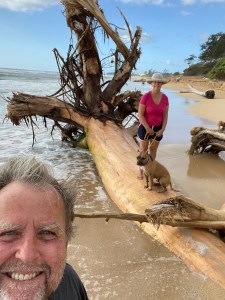
Credit for my walks without question goes to my wife Claudette. She is an avid walker and recently taken to dragging me out of bed early so we can be on the beach walking by 7am. We walk a stretch of coastline nearby that’s mostly deserted and devoid of other humans at that time of the morning.

Accompanied by our dog Max we walk a few miles along the coast, navigating the massive tree trunks buried in the sand, the twisted piles of driftwood, and the occasional rain squalls that come through from the east. We have that hour or two mostly to ourselves, sharing it only with an occasional fisherman or random jogger who without fail, gives us a smile and a pleasant good morning.

Our walk is mostly one of solitude. Claudette searches out and collects small pieces of driftwood, scraps of fish-net and other unique treasures to be incorporated into her craft creations that have taken up what seems like permanent residence, across our kitchen table.

Meanwhile, with Max on the requisite leash, he and I are on our own, walking together mostly along the high wash of the waves. Myself deep in thought while Max pulls me every-which-way smelling (and occasionally attempts to chew) anything and everything in his path. Max (Maximus Aurelius) is a bundle of joy, who also when permitted to do so, loves to play in the ocean. On some days, once we reach a point along the coast where no other human being or animal can be seen for at least a mile in either direction, Max is allowed to frolic in the waves. For those that worry about such things (and as a former State Senator and Councilmember, I count myself as one of those people), the leash law does not appear to apply to dogs swimming in the ocean.

During those early morning walks the troubles of our world seem to melt away.

Like everyone else, I worry about paying bills on the first of every month and about staying healthy. I worry about my family, about my extended ohana, and about the future of our community. Frankly, I worry about the planet.

But taking a walk on the beach early in the morning helps clear the worry from my brain. Looking out over the ocean, looking down what is essentially a wild coastline, watching Claudette intent on searching out and finding her treasures and Max who is locked into a veritable dog-heaven of smells and sensory overload – brings me a sense of peace and contentment.

Regardless of what the future might bring, we who call this place home are truly the luckiest most fortunate people alive on the planet today.

To be clear, I am optimistic about our future. Perhaps it’s because my life has historically been filled with very high peaks, and also sometimes deep almost bottomless valleys. Yet those valleys did have a bottom, and I know without a shred of doubt that this valley too has a floor, and across that floor on the other side lies another peak.

I encourage all to remember where you live and remember and appreciate just how fortunate you are. Go for a walk on the beach, recharge your batteries, and then get back to work protecting that which you love and building a positive future for yourself, your immediate ohana, and for our collective community.

First published 05/05/2020 in The Garden Island Newspaper

Note: Please consider subscribing and receive regular email updates/thoughts and occasional action alerts – on policy, politics, and life in general. Subscribe/Join:

Posted in Uncategorized | Comments Off on Putting policy, politics and a pandemic into perspective

Tell Hawaii’s legislators that it’s time to go to work. Please take action TODAY and before May 4th if at all possible.

Aloha Friends, Please email key legislators TODAY, and let them know using your own words’:

“Putting off the many critical issues facing Hawaii until 2021 will not serve us well. Please, reconvene the 2020 legislative session and extend into a special session if necessary. Do the work, until the work is done. Take whatever time is needed to accomplish the many tasks that await your attention.”

Background and context on this issue can be found here:

Civil Beat: Legislative leadership must rise to the occasion

Hooser Blog: Foresight, not hindsight should be our goal

Email:
Senate President – Senator Ronald Kouchi senkouchi@capitol.hawaii.gov
House Speaker – Representative Scott Saiki repsaiki@capitol.hawaii.gov

Please also email your own State Senator and Representative who represents the district where you live.

Here is a complete list of all State Senators and contact information.
https://www.capitol.hawaii.gov/members/legislators.aspx?chamber=S

Here is a complete list of all State Representatives and contact information.
https://www.capitol.hawaii.gov/members/legislators.aspx?chamber=H

You can also use this “Find My Legislator” search tool to identify who represents you in the State House and Senate, and their contact information.
https://www.capitol.hawaii.gov/findleg.aspx?street=Enter%20Street%20Name

Posted in Uncategorized | 7 Comments

The 2020 Hawaii State Legislature, must get back to work.

If sending flowers to mom is now considered an essential service, it would seem that it’s past time for the 2020 legislative session to likewise get back to doing “the people’s work”.

God knows, there is plenty of work to do.

Ensuring health care for the recently unemployed, standing up health screening/testing at airports, supporting local agriculture and food-self sufficiency, implementing remote testimony capability, passing automatic voter registration, and preserving the hard-fought Earned Income Tax Credit (EITC) and increases in Hawaii’s minimum wage are just a few of the critical items that must be addressed.

Kick-starting and diversifying our economy, implementing critical “Green New Deal” job-creating programs that focus on energy and food independence, and environmental resource management also require urgent attention.

With most of Hawaii either unemployed or otherwise fearing for their economic future, we are counting on you who were elected to represent our best interest, to in fact do your job.

There are no valid reasons to put off this important work.

The additional cost of an extended session is minimal as legislators and their core staff are paid year-round anyway. The cost of “session staff” and other incidental expenses are likewise minor in scope.

Public hearings and “floor sessions” can be conducted utilizing a combination of remote “Zoom type” technology and basic old fashion “social distancing”. House/Senate rules may need changing but that also is easily accomplished so long as the Senate President and House Speaker agree. Many other state legislatures and our own County Councils continue conducting their business in this manner, and there is no reason the Hawaii State Legislature cannot do the same.

Putting off these critical issues until 2021 will not serve us well. Please, reconvene the 2020 legislative session and extend into a special session if necessary. Do the work, until the work is done. Take whatever time is needed to accomplish the many tasks that await your attention.

Now is the time for Hawaii’s legislative leadership to rise to the occasion. We need you now more than ever before to show us what you got.

Note: Please consider subscribing and receive regular email updates/thoughts and occasional action alerts – on policy, politics, and life in general. Subscribe/Join:

Posted in Uncategorized | Comments Off on The 2020 Hawaii State Legislature, must get back to work.

Big Dog Politics & Post Pandemic Policy – Kauai Style

It was interesting to watch the recent mash-up between the big dogs – Honolulu Mayor Kirk Caldwell, Senate President Kauai Senator Ronald Kouchi, Kauai Mayor Derek Kawakami, and Lt. Governor Josh Green.

The Honolulu Mayor suggested last week that Kauai or “some neighbor island” might be the best place to test out the re-launch of the state’s tourism industry.

Kouchi threw the first punch saying, “I want to be clear to Mayor Caldwell. Kauai does not appreciate being identified as a potential test case to go bring in the tourists so you can make better decisions on Oahu,” (Honolulu StarAdvertiser)

Green, a likely opponent of Caldwell in the 2022 governor’s race also was quick with a body slam, saying he was “shocked at the idea of using the neighbor islands as a giant experiment to see if the virus kills people. It was a pretty stunning comment.” Civil Beat

Then on PBS Hawaii during a live “4 Island Mayor” interview program, Kawakami offered Caldwell a reasoned but sharp and direct rebuke saying, “We gotta be careful with our words…there’s already a situation where there’s a level of fear…when our people hear that we are going to be like a sacrificial lamb or the testing grounds…”

Mayor Kawakami is correct of course that “We gotta be careful with our words…”.

Caldwell has since acknowledged that saying Kauai might be the best place to “test” the relaunch of the state’s tourism industry, was a bad choice of words and a mischaracterization of his intent.

He should have perhaps said instead, that Kauai is in the best position to “lead”.

After all, it seems obvious that we are in fact in the best position to lead and are already doing so. Mayor Kawakami and the residents of Kauai are at this moment leading the effort to eliminate the spread of the virus among our local population with zero new cases of Covid infections occurring during the past 18 days.

Why wouldn’t we also lead the effort and set the example by slowly and thoughtfully reopening our local economy? Why wouldn’t we be the first to establish ultra stringent testing and screening protocols at the airport and then very slowly reopen travel to and from our island?

Who else is going to lead? Governor Ige? Mayor Caldwell? Are we to wait until Oahu gets it together before we venture out ourselves? If so, be prepared for a long, long wait and no telling what we will get on the other side.

If we allow Kauai to lead, think of the possibilities. Think of what we could do.

First, we make our island safe. This seems to be happening thanks to firm leadership and a population that cares about each other.

Next, we slowly reopen our local businesses.

Then with the help of the State and Federal government (funding and expertise), we establish at our airport the very best testing and health screening protocols available. We require health certificates from incoming passengers and continue the quarantine if needed.

Then and only then do we begin to slowly loosen the existing restrictions on incoming travel and closely monitor and track all incoming travelers (visitors and local residents). We adjust the plan moving forward tightening or loosening the requirements as needed to maximize the health protections of our community, while ever so slowly getting our economy back moving again.

But Kauai being Kauai, we will do much more than just open our doors while screening and testing for COVID. We will insist on the re-visioning and re-making of our visitor industry. There will be no going back to the same ole, same ole

Via changes in State and County laws, rules, permitting requirements, tax incentives, and disincentives, we can and must do things differently.

Hotels, resorts, airlines, and vacation rentals must be required to:
*Pay every worker a living wage and health benefits
*Purchase 90% of their restaurant items from local farms and ranches
*Educate all guests on cultural and local norms

We must also set strict limits on the number of visitor arrivals by:
*Freezing new resort development and reducing the number of vacation rental permits.
*Directly connect taxation of the visitor industry to the number of visitors served so that increasing numbers above a threshold, results in decreased profitability.

To ease our traffic congestion, we must dramatically increase the taxation of rental cars, utilizing those funds for public transportation.

In order to have at least one day a week free from the noise and activity brought to our public spaces by the visitor industry, we might also consider banning all commercial activity on all public lands, beaches, waters, and air space – on Sundays.

And of course, in all beach parks, we must set aside sufficient free parking designated for local residents only.

With bold, creative, and collaborative leadership – we could, in fact, accomplish all of the above and more. No, it’s not easy. Nobody said it would be easy. Leadership is not easy.

While Honolulu Mayor Caldwell stumbled on his words, his instinct was on target – Kauai should lead. And then, if they so choose – Oahu and the rest of the State could follow in our path.

Note: Please consider subscribing and receive regular email updates/thoughts and occasional action alerts – on policy, politics, and life in general. Subscribe/Join:

Posted in Uncategorized | 20 Comments

Where I live there are rainbows, and we help each other

In March 2006, Nancy Arcayna wrote in the Honolulu Star-Bulletin that every time Hector Venegas hears the song “Hawaiian Lullaby” he is reminded of his daughter, Krista.

“The song evolved from the situation of my daughter’s life … her life-threatening illness. I was extremely broken-hearted,” Hector said. He wrote the song for Krista more than 30 years ago as she recovered from a long bout of bacterial meningitis. Putting the words on paper helped him deal with an array of emotions, from fear, anger and resentment to love, he said: “I needed to turn my negative thoughts into positive ones. I wanted to see things in a different light. I didn’t want to see a shrink.”

Where I live, there are rainbows
With life in the laughter of morning
and starry nights

Where I live, there are rainbows
And flowers full of colors
and birds filled with song

I can smile when it’s raining
And touch the warmth of the sun
I hear children laughing
in this place that I love
Hawaiian Lullaby – Words by Hector Venegas & Peter Moon

Today, many of us are dealing with similar emotions and perhaps now more than ever need to be reminded of the truths embedded within this beautiful song.

I would add only one new line perhaps:

Where I live, we help each other
Those who have less
Who share our love and laughter
And our island home

While we are surrounded by challenges that may seem insurmountable, it is important that we remind each other that where we live, there are still rainbows.

No matter how desperate the situation or how great the challenge, we need to remember always that we are incredibly blessed to live in this place.
We are surrounded by a natural environment that both heals the body and rejuvenates the soul. Whether by being in or on the ocean, walking a mountain path, or simply looking out the window at the stars or watching the sunset or rise on the horizon, our load will be lightened and our spirit reborn.

Yes, where we live, there are rainbows. We have the beauty of nature and of a people grounded in a culture of aloha. Where we live, we help each other.

Recently I saw that a friend had posted online, that they feared running out of food.

My first thought was that where I come from, we help our friends and that no one in my community was ever, ever going to run out of food. Period.

We just would not let that happen.

We’ve survived Hurricane Iwa, Hurricane Iniki, 9/11, the great recession of 2008 and numerous floods and rain bursts along the way. Through it all, we survived and ultimately grew closer as a community because we helped each other.

Similarly, we will look back at history and see that we survived the great pandemic of 2020, for the same reasons. Because that’s how we roll. It’s ingrained in our collective DNA – we help each other.

After all, if you go back far enough we are in fact all related. We are all ohana.

And as my grandson Rixon and granddaughter Isabella will no doubt be reminding me in the future, “Ohana means family, family means no one gets left behind, or forgotten.” (Lilo & Stitch)

As ohana, we must remember to reach out to check on friends and family. We must offer food and friendship before the need arises and anticipate those among us who might need additional help and support. Yes, we all are taking a hit, but each of us can offer help in some meaningful way, whether it is with cash contributions to a worthy cause, or banana or papaya or lettuce from our garden.

To those who say that “it will never be the same” and that “life has changed forever” – I disagree and encourage you to revisit those thoughts. We collectively have survived many, many challenges over the years, from wars to plagues to earthquakes, volcanoes, and tsunami. Rather than lamenting how things won’t be the same, or just simply thinking about surviving and returning to normalcy, let’s work together, learn from the past and create an even better future.

The good news is that Hawaii’s infection rate seems to be dropping daily. If we continue to be strong, stay home, wash our hands, wear our masks and practice appropriate social distancing – sooner rather than later some sense of normalcy will in fact return. But we must remain vigilant. Sooner than we think, the COVID-19 era will be behind us.

Life goes on. The sun always comes up the next day, this too shall pass and always, always remember that where we live, there are rainbows.

Published in The Garden Island Newspaper – 04/22/2020

Note: Please consider subscribing and receive regular email updates/thoughts and occasional action alerts – on policy, politics, and life in general. Subscribe/Join:

Posted in Uncategorized | 3 Comments

Foresight, not hindsight should be our goal

2020 vision and decisive action by our state legislature is needed now more than ever. Hawaii cannot afford to wait until 2021.

The State House and Senate have each convened a “Special Committee on COVID-19”. Ostensibly the mission and goal of each committee is to monitor and review the pandemics’ economic impacts, and the executive branch’s management of the situation. Unfortunately, neither committee provides an opportunity for public input or testimony. Citizen input is a valuable and necessary component of any successful information gathering process and should be welcomed, not prohibited.

It would seem that by now both legislative committees have done their due diligence and that our legislature at some point soon will actually begin legislating. Whether the 2020 Session reconvenes in May and/or extends into a special session in June or even July, the work can and should begin now.

Word on the street however, is that leadership in the House and Senate is considering simply putting everything off until January of 2021. Apparently, they are thinking to “gavel in” the session around May 1, schedule a handful of hearings necessary to pass and fund Grant-In-Aid (GIA) requests and Capital Improvement Projects (CIP), and put off all other work until 2021.

Needless to say, I believe adjourning without addressing the many critical issues facing our community now, would be a gross failure of legislative leadership. There is much work to be done and no valid reason why the legislature cannot do it, this year.

Legislators can and should be doing the nitty-gritty work now, remotely. Just as the COVID-19 Special Committees are meeting, so can other committees of the House and Senate. Proposed bill language can be discussed remotely with experts and stakeholders, and possible amendments refined.

At some point in the coming few months, Hawaii will start reopening both business and government. The legislature could then be reconvened and extended into June or July as may be needed. There is no shortage of legislative “vehicles” (bills), and the appropriate public hearings could be held to comply with open government laws and avoid issues associated with “gut and replace”.

Hawaii needs more than just a blanket approval of so-called “shovel ready” projects and pending Grant-In-Aid (GIA) funding.

There are many issues that simply cannot wait until 2021.

The state budget must be massively readjusted in order to deal with the financial realities of tax revenue grinding to a halt as economic activity does the same. This process deserves and requires active legislative participation. Hiding on the sidelines, sheltered from the political ramifications of the hard choices while leaving the governor hanging out to dry – is not acceptable.

Nearly 25% of Hawaii’s workers are now unemployed. Without employment, most are also now without health insurance. Whether through an expansion of Med-Quest or via other means our legislature must develop and fund health coverage for these workers.

In order to fully reopen our economy, incoming travelers must be screened and tested for COVID-19. A statewide screening and testing program must be established with appropriate personnel hired and trained to implement it. This requires legislative action.

It is essential that worker rights be protected during the economic recovery period and beyond. Recently laid-off workers must be given first preference to return to their former jobs under the same terms that were previously held. The government must not allow nor reward businesses who attempt a shift to part-time, no health insurance, lower-wage workers.

The EITC and other tax credits aimed at low income working people along with the minuscule increase in the minimum wage must be preserved and passed into law. Our state budget must not be balanced on the backs of low income working people.

The fragility of our food supply chain has become more apparent than ever. Providing both public policy and tangible financial support to local farmers growing food for local consumption is crucially important and should not have to wait until 2021. Our farmers need help now.

Emergency funding could and should be used to support “remote access” that will allow all residents access to the legislative process and meaningful public participation, regardless of where they reside. According to the National Council on State Legislatures (NCSL), Alaska began holding remote hearings for residents in 1978. In 2014, more than 4,000 citizens participated remotely in 5,000 hours of legislative teleconferences. Here in the islands, Hawaii County and Maui County both allow residents to testify via teleconference from remote locations. Given the COVID-19 limitations on “social distancing” and other “stay-at-home rules, now more than ever the Hawaii State Legislature needs to make universal remote access a reality.

GIA funding should be substantially increased and new applications from entrepreneurs focused on food-self sufficiency, import-substitution, recycling, economic diversification, and job creation should be encouraged. Construction projects should be funded only if they truly meet the needs of the community, and are genuine “shovel ready,” rather than just pet projects located in some influential legislators district. 

Waiting until 2021 to tackle these and many other issues facing our state would be an unequivocal failure in leadership. I am hopeful and cautiously optimistic that those elected to high office, will not let us down.

First published on April 15, 2020 in The Garden Island newspaper.

Note: Please consider subscribing and receive regular email updates/thoughts and occasional action alerts – on policy, politics, and life in general. Subscribe/Join:

Posted in Uncategorized | Comments Off on Foresight, not hindsight should be our goal