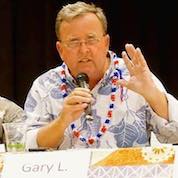
After the insurrection, accountability and reconciliation – Honolulu Star/Advertiser by Gary Hooser

President Donald Trump lied, and people died. This is the unvarnished truth. He and his enablers and those who participated in acts of violence, must be held accountable.

The unsettling and dangerous situation that occurred inside our nation’s Capitol on Jan. 6, is pressing heavily upon all of us. Urged on by words from the president of the United States, a mix of domestic terrorists, political zealots and narcissistic hooligans stormed the seat of our Republic. Death, destruction and fear was their objective, and they were successful in achieving that outcome.

The threat and specter of continued violence hangs like a dark and ominous cloud. What can and should be done now?

From a distance, separated both literally and figuratively from the halls and chambers of government power and authority — the answer for most of us is to simply hold on.

We must hold on, remain aware, and keep our personal safety a priority during the coming weeks. Then, when the storm passes as it surely will, we must seek a path that demands both accountability and de-escalation.

Accountability and consequences are the first order of business. Those who broke the law, regardless of their title or position, must be brought to justice. Those enablers who maneuvered intentionally in the political grey areas of ethics and integrity, must also pay a price of public exposure, censure and condemnation.

Ultimately we must move past accountability and consequences, and through the anger and divisiveness. Both in our local communities and at the national level, we must begin a conversation soon that starts the healing and de-escalates the hate and animosity.

The cynics of course will say that it can’t be done. And for the fringe, the bigots and the zealots, it indeed may be impossible. But for the vast majority of us, we can and we must move soon to rebuild relationships and restart conversations.

There is no shortage of common ground and that’s where our focus must turn.

We need to create jobs. Good jobs that pay a living wage. We need to rebuild our public infrastructure, protect our natural environment and ensure that all communities have clean water to drink. Quality health care and a quality education must be available for all regardless of income or station in life. And supporting all of this, we must have ethical, transparent, and a truly representative inclusive government that is held accountable by honest and open elections.

To pay for our public and societal needs, we must have a tax structure that is fair and equitable. Those who extract more from the public commons, those who waste more, consume more and pollute more, should pay more. And yes, those who have more should also pay more.

Microsoft’s Bill Gates himself stated recently on CNN, “ … the government should require people in my position to pay significantly higher taxes.” Fellow billionaire Warren Buffett said similarly on CNBC, “The wealthy are definitely undertaxed relative to the general population.”

Yes, there is much common ground. While the strategies and tactics to achieve these common goals and objectives may differ, most will agree as to where we ultimately want to go as a society.

The coming weeks will be difficult and challenging. President Trump and others must be held accountable. Those in positions of leadership and power must know that their words and actions have consequences. And the people must know that laws are for everyone, regardless of your wealth, race or title.

But then, after those who brought this grave harm to our Republic are held accountable, we must move on. We must move on to build a more just society where a diversity of people break bread and share ideas, where justice and equality is the norm and where bigotry and violence are an unacceptable aberration.

by Gary Hooser
Published in the Honolulu Star/Advertiser
January 18, 2021

https://www.staradvertiser.com/2021/01/18/editorial/island-voices/column-after-the-insurrection-accountability-and-reconciliation/

Posted in Uncategorized | Leave a comment

My granddaughter Isabella is crossing her fingers and hoping House Speaker Scott Saiki will do the right thing, and that you will offer him some encouragement!

If you believe as I do, that anyone who works 40 hours a week deserves a wage sufficient to provide a dry safe place to live and 3 meals a day, please Click Here to send Speaker Saiki an email, asking him to support an increase in Hawaii’s minimum wage.

Pandemic or no pandemic, minimum wage workers in 27 different states and dozens of cities and counties will be receiving a raise this year, AND many require automatic annual adjustments tied to the cost of living.

But here in Hawaii, unless House Speaker Scott Saiki takes action soon, our frontline workers will get nothing and remain stuck at $10.10 per hour in a state where it costs $17 simply to survive.

Despite having a legislature dominated by Democrats, and a Democratic Party that has made increasing the minimum wage a top priority, Hawaii’s legislative leadership has refused to give minimum wage workers any raise at all.

$17 per hour by 2026, with annual cost of living increases, should be our target.

In 2019, Governor Ige publicly supported a $15 minimum wage. The Hawaii Senate actually passed such a bill that was subsequently gutted by the House and killed in Conference Committee. Standing in the way of its passage seems always to be the House.

Thus, if a minimum wage increase is to occur in 2021 it must have the support of Speaker of the House, Scott Saiki.

Speaker Saiki and his leadership team tightly control everything in the Hawaii State House of Representatives; every committee assignment, every bill that gets scheduled for a hearing, and whether or not a bill ever goes to a floor vote. He even controls who gets what office and parking space.

If Speaker Saiki wants to pass a bill increasing Hawaii’s minimum wage, it will happen. If he opposes an increase, then no increase will be passed and frontline workers will get nothing.

While he will publicly demur and say that he only expresses the will of the “majority” – that is shibai. The “House majority” has repeatedly indicated their strong support for at least a $15 minimum wage. Clearly, either the Speaker or the “majority” is being less than forthright when expressing their intentions.

Hawaii has the highest cost of living in the entire United States. The pandemic has exposed more than ever before the injustice put upon our most essential workers who are paid the equivalent of starvation wages.

The reality of any wage increase passed by the legislature in 2021 is that it would not likely go into effect until 2022, and be phased in slowly over a 4 or 5 year time period.

To those who claim economic calamity will occur if the minimum wage is increased, the historical evidence and research indicate this is absolutely not the case. Read this excellent Hawaii report. And from a federal perspective here is additional comprehensive easy to read information.

It’s important. Please email today and before January 22 if possible. Click here to send Speaker Saiki an email, and if you are a minimum wage worker or earn less than $15 per hour, please tell your story about why increasing the minimum wage is important to you.

Mahalo to all for taking the time to take action on this very important issue.

Sincerely,

Gary Hooser
My granddaughter Isabella, crossing her fingers and hoping you will send an email to Speaker Saiki, and that he will do the right thing and support increasing Hawaii’s minimum wage 🙂

Posted in Uncategorized | Leave a comment

Bigotry and Violence Have No Place Here

The images of recent violence and the storming of the Capitol in Washington D.C. are everywhere and impossible to avoid. Unfortunately and very sadly, threats of future and imminent violence have also arrived even here in Hawaii.

My hope is that we are better than that. I hope and yes I pray that here in the land of aloha, cooler heads will prevail.

Truthfully, I cannot imagine our community devolving into the mob we saw in action just a few days ago. However, as is true of every community, we also have sprinkled throughout the islands, our own share of zealots, hooligans, and would-be insurgents.

Therefore we must during the coming days be vigilant in our pursuit of genuine civic engagement, and push back against any and all conversation or actions that advocate violence.

All of us, regardless of political orientation and regardless of who we supported in the recent elections, must be united in opposition to violence and bigotry.

Free speech is a cherished and valued right we all are entitled to. However, during these times when the tinder is so dry, I encourage all to just stay home. Exercise your free speech in a responsible manner on your keyboard if you must, but please resist adding sparks or fuel to the fire.

We cannot allow the thugs and the bigots to yank our chains and goad us into accommodating their goal of violent confrontation.

Our conversation must turn soon to solving the common problems and challenges the vast majority of us agree on.

Supporting small businesses and creating jobs, good jobs that pay a living wage is a priority for most. We need to protect our natural environment. Our children deserve a quality education. To pay for our public and societal needs, we must have a tax structure that is fair and equitable. And we must have ethical, transparent, and inclusive government leadership.

Most of us will profess to support these fundamental goals and there are many others that we share as well. Reasonable people with good intentions may differ on “how to get there,” but most will agree as to where we ultimately want to go.

We must chart a path at least in our immediate community, through the national anger and divisiveness. Remember, whether you have staked out ground on the left, the right, or in the middle – we are all related.

Coming together starts at home and in our own neighborhoods and communities. We must model the values we want to see in the world and we must strive to accept a diversity of opinion based on sound information, offered by reasonable people with good intentions.

I believe that good people, ethical people of high integrity, can look at the same facts and the same circumstances and come to different conclusions.

But to be absolutely clear – there is no room, no space, and no forgiveness for bigotry and violence. None. We do not agree to disagree on these points.

And those who cross the line must be held accountable.

Gary Hooser
Policy & Politics

*Thoughtful Opinion
*Fact-Based Issue Analysis
*Action Alerts!
*Timely/Local Political News

Stay Informed
Sign-Up Now For Regular Email Updates
http://www.garyhooser.com/#four
Hawaii Legislative Session Begins January 20th

Posted in Uncategorized | 2 Comments

2020 – A ride like no other

It’s been a roller-coaster of a year, and from small kid time until today – I have never liked roller-coasters. Whether it be at the E.K. Fernandez Show’s weekend carnival or at Disneyland, roller-coasters were never my cup of tea. Thank goodness this one seems to be winding to a close. While still a long way from being over, at least the ride seems to have slowed somewhat, the twists and turns have leveled out, and the end of the craziness seems to be approaching.

2020 has been a double-stress-whammy with the virus threatening our health, and political discord threatening our Democracy.

Fortunately, this extraordinary year is coming to a close on both of these fronts.  Many good things of a positive and hopeful nature are happening now, “as we speak” (or as we Zoom which may be the case).

The people have spoken and voted. Through a clear and unequivocal majority, Joe Biden has won the election to be President of the United States. I am hopeful and confident that the minority who supported the other candidate and the majority that prevailed, will both now tone down the divisive rhetoric and turn their common energy and attention toward creating a more positive future for all.

Let’s find our common ground, and then leverage it.

While the pandemic continues to rage across the planet, we are ending the year with multiple vaccines being distributed to our most vulnerable and most at-risk populations. Within a few short months, by spring or early summer, the majority of us will have had the opportunity to be vaccinated and thus protected from the virus. I’m not sure what the death knell of a pandemic drawing its final breath sounds like, but I think we’re starting to hear it.

When it’s my turn, you can be sure I will be rolling up my sleeve without hesitation. As a child, I was vaccinated for measles, mumps, and other illnesses. As an adult now in the prime of my life I have also been vaccinated for flu and pneumonia. These are the choices I’ve made for myself and my family, and I’m hopeful that a great majority in our community will do the same.

It’s a trifecta of good news really. We have a new President, multiple new vaccines, and finally, the COVID Economic Stimulus package has been approved and the checks are literally in the mail!

Did you hear that?  Am pretty sure I heard my mother at this very moment shouting out from her home on the continent, a hearty “Praise the Lord!”

And not a moment too soon. People are hurting bad.

It’s all fine and dandy to be happy about a new President and the unveiling of new vaccines, but when you can’t afford rent, you’ve been unemployed now for months, or your business is crashing down around you – the political bickering is exacerbating and the extra money is needed now.. 

Another strong dose of good news coming out of Governor Ige’s office is his announcement that the public-worker furloughs are being postponed indefinitely. 

It’s good to end the year with hope and positivity. While we still have a ways to go, it looks like this roller-coaster may very well be ending soon and there is in fact light at the end of the tunnel. 

Best wishes to all.  Please do what you can and reach out to help those less fortunate. Say hello to your neighbors, find someone of the opposite political persuasion and talk about food, or the weather, or the children or grandchildren. Tell your friends and family how much you appreciate them. 

Stay safe. Don’t let your guard down, please.  Not yet.

Posted in Uncategorized | Leave a comment

Hawaii legislators should act boldly in the upcoming session – as published in Civil Beat

Please take a moment to click through and read my piece published in Civil Beat today! I would normally publish it also in its entirety here on my blog, but Civil Beat is requiring “exclusivity” and is asking that I request that people visit their most excellent news website to read the piece. So am happy to comply and appreciate Civil Beat being willing to share my thoughts with their readers.

Hawaii’s Legislators Should Act Boldly In The Upcoming Session

Posted in Uncategorized | 2 Comments

E Pluribus Unum by Glenn Shockley – gh note – a good and thoughtful read. I encourage all to take the time to do so.

This was sent to me recently by an acquaintance who encouraged me to read it and kept encouraging me to read it until I did. And when I did, I was glad that I did. Please take some quiet time to read and think about this…the historical context is important.  I thought it well worth the read…which is why I post it here.

E Pluribus Unum by Glenn Shockley

Disagreements and the ability to express them lie at the heart of Democracy. Because this is the case, it is difficult to imagine a system of government that espouses disagreement to be able to exist. The eternal question regarding the development of governments is why do they exist at all? Why do people get together to live when it would be so much easier to live alone and make their own decisions without the bothersome process of consulting with others for their approval?

There are a thousand books that are written on this subject so this document will not bore the reader with the complexities of the answer to this query. Suffice it to say that people through the ages have found it convenient to get together to form societies because they have found that there is safety in numbers and that, with the establishment of rules, the possibility of societies to exist comes to be. The safety that society provides is not from wild animals or other natural disaster, but from the many oppressing the individual either physically or in any other imaginable manner. Numbers of people have always made the difference in the establishment of society. In the past, the larger the number, the more likely one group could overcome another group. Wars have been a constant throughout history. In ancient history, the larger number of a group fighting a smaller group would always prevail. (Thermopoli) It is only in recent history that the smaller group could prevail because of the development of technology.

What are the hindrances that confront society that prevent it from advancing to its highest achievable level? When the founders of the United States first contemplated forming our union they constructed a document called the Articles of Confederation.

That document emphasized individualism and decried federalism. The emphasis on individual power was evident throughout the document and exemplified the rugged individualism it sought as its highest goal. This concept did not only apply to the individual citizen but was elevated to the individual states decrying federalism making individual states the source of power in the union of the states. The concept of individual power and authority was huge in the construct of this nation. Individualism and the strength of individual rights superseded the concept of union and the values that society could bring. The concept of the “commons” and the “common good” was overshadowed by the concerns for self and individual liberties. The feeling of self and concern for self-preservation dissuaded many from considering the impact that such considerations would have on the social state that this country was striving to be.

Concentration on the individual and individual rights seemed to work prior to the American Revolution. It also seemed to work during the American Revolution but after the war, a huge problem arose when it became obvious that the union could not pay its bills. The union tried going around to the individual states to ask them for help in paying the bills that the union incurred during the war. Naturally none of the states in the union volunteered to help. During the war, the individual states continued to tax their citizens during the four years of the war so when the patriots who fought the war returned home, they found themselves in a financial bind. The federal government, which promised them pay for fighting those four years in the war, thought it was only proper to supplant the money lost by those patriots through farming and the like, found that they could not do so. Because of the principle of individual states being sovereign, the federal government could not raise the funds to pay its debts which included the salaries for the American patriots who sacrificed their time, blood and in some cases their lives for the country. They did not possess the taxing authority to do so because the several states saw this authority as an infringement on their individual state powers. Because of a man named Daniel Shays, a man who led four thousand other patriots in a rebellion after the Revolutionary war against the United States because the United States reneged on their promise to pay their salaries for their service to this country, George Washington and the other founding fathers recognized that the non-payment of those salaries to those patriots was an egregious wrong, yet they were unable to correct that wrong because the Federal Government did not have the capacity to tax, therefore, did not have the revenues to satisfy the debt that they owed to those men.

It must have been fresh in the minds of the founding fathers that these men were not merely flag saluters, or men who brazenly wrap themselves in the flag feigning patriotism or that stood at attention when the flag was in view again feigning patriotism. These men who were actual patriots who pledged their lives, fortunes and sacred honor to this country. That is the definition of a patriot direct from the Declaration of Independence. Those men went to war and many of them died or were wounded in the war. They shed their life’s blood for this country. They gave up the livelihood that their farms produced for four years, so that this country could exist.

Their solemn oaths to this country could not be cast off as though they were nothing. They risked all of their personal well-being for the good of the commons. Our founding fathers could not ignore their sacrifice nor slough off those men’s contribution to this country. The result of the Shay’s rebellion was the construction of the Constitution of the United States and the discarding of the Articles of Confederation that ruled this country at its inception. There was no more individualism. There was no more individual state autonomy. It cannot be overstated how difficult this change was. The Federalist papers took 6 chapters (16 – 22) to convince the American people to accept the concept of a “more perfect union”. Most Americans did not want their individualism challenged.

They could only understand that their individual selves were being threatened by the concept of the commons or the common good. It is understandable that they could not see beyond themselves. The eternal question, “Am I my brothers’ keeper?” was difficult to explain in the face of individualism. The concept of the “commons” and union was foreign. The explanation “union” was an admirable goal of social society that needed to be brought to the attention of the American psyche and needed an educational program for the American people to understand how the application of the concept of “union” would be of major benefit to Americans. That is why the Federalist papers were written. “We the people of the United States, in order to form a more perfect union, establish justice, insure domestic tranquility, provide for the common defense, promote the general welfare, and secure the blessings of liberty to ourselves and our posterity do ordain and establish this Constitution for the United States of America.” Each and every reason for the establishment of the Constitution is a social reason and a recognition that the commons as a concept lies at the foundation of any country or society. There is no promotion of the individual and individual causes because it was recognized that the individual has a natural inclination to take care of himself. Greed and selfishness are natural to man. The individual does not have an inclination to take care of the commons. Therein lies the problem that the founders recognized that needed solution. Citizens of the United States had to understand that the country needed to actually unite if there was to be a country. They needed to focus on the commons, not the individual. The result of the construction of the Constitution has led to over 200 years of prosperity for the United States. That miracle remains today only because the understanding of the citizens, that social goals need more attention than individual ones. Taking care of the commons has provided the stability that this country needs to progress towards the preservation of the “blessings of liberty to ourselves and our posterity” and to continue the experiment in democracy that the United States represents to the world.

This country cannot be taken by any external enemy. That notion has been tested repeatedly throughout the history of this country. World wars have threatened this nation, economic catastrophes have done the same, but through it all, this country has persevered and in each instance come out stronger than when the threat initiated. However, when internal divisions arise, our country has suffered its greatest test of unity. In 1860, a war ensued when United States citizens could not overcome their differences. “We hold these truths to be self-evident, that all men are created equal…” was challenged as a principle construct upon which this nation was established. A segment of our population had built an economic engine that required slavery for its existence. Without slavery, that engine could not exist. Slavery violated one of our precious founding principles. Because we could not all agree to that founding principle in 1860, this nation went through a civil war that took over 600,000 lives of its citizens. The residue of hate of that war remains to this day. From 1865 to 1896, this country went through a period euphemistically called “reconstruction”, where there was supposed to be “malice towards none”. The section of the country that was vanquished in that war never felt that “malice towards none” was ever achieved as a goal of the conquering side. Too many profiteers of that war made it impossible for the winning side to secure from the vanquished a requisite reconciliation that would heal the wounds of the nation that the war had inflicted upon the body politic. Monetary collapses worsened the prospects for reconciliation in the 1870’s and the worsening situation came to a head in 1896. A blond blue eyed man named Homer Plessy bought a first class rail road ticket to travel in Louisiana. His problem was that despite his Caucasian appearance, the black porter on that train perceived that he was partially black and refused to permit him to take a seat in the first class section of the train. In fact, he was sent back to the cattle car where all black people traveled in those days.

Homer took his case to the Supreme Court of the United States. That court attempted to reconcile the matter by trying to avoid a confrontation of either side in Plessey v Ferguson. That case established the doctrine of “separate but equal”, a legal position that certified segregation. No citizen of the United States could be denied accommodations for which he has paid for so if first class seating were available to whites, then there had to be first class accommodations available to blacks. This blatant disregard of the “equality” founding principle lasted for 58 years. Via judicial review, a process requiring a unanimous decision, Plessey was overturned in 1954 in a case called Brown v the Board of Education of Topeka Kansas. In that case, the Supreme Court ruled the obvious, in that during the 58 years that Plessey was the law of the land, the principle of “separate but equal” was never implemented outside of the court house. White society never provided separate but equal facilities in any of its daily living standards. Not only was that the case, but, the concept of segregation of the races violated the principle of equality of men, another founding principle that this country was built on, making whites superior to blacks and all other races.

Judicial review was conceived in the 1803 case called Marbury v Madison which gave the Supreme Court the power to determine what is and what is not, Constitutional. It was predicated on the finding that any law that violated any of the founding principles of this country egregiously, or otherwise, would be so very easily recognized that any Supreme Court would find that matter unconstitutional and do so unanimously. That is what happened to Plessy. It violated the principle of equality, egregiously, and was struck down via a unanimous vote. There was a problem with the rendering of that decision. It did not change the minds of those who supported segregation, despite the fact that it violated that founding principle. The question then was, how does the Supreme Court get citizens to comply in sprit to its rulings despite the disagreement that they may have with that decision? That problem remains to this day. It is the source of all of the discontent among our populace today. The simple answer to this problem is that there must be an agreement among all citizens that those founding principles must be taken to heart by all. It must be recognized by all that those principles protect us both individually and collectively from the tyranny that would result if we ignored those principles. Without respect for those principles, we do not have a society. Without society, there will be no domestic tranquility and without domestic tranquility each and every life in this country is threatened. The rule of the mob becomes the order of the day. We, then, will have no country and society is destroyed. There is no current remedy for the defiance of our founding principles among our people. The destruction of this country and the waste of the sacrifices that those who came before us, those who sacrificed their lives, their fortunes, and their sacred honor to preserve this nation for us to enjoy, cannot be tolerated merely because we cannot learn to get along and learn to respect the politics of others. Is the destruction of this country such a wonderful goal that getting our own way must be the preeminent exercise of what we consider to be an individual’s inalienable right to express his opinion and coerce others to follow that opinion? Hopefully not. The patriotic society disdains that notion. We join together in society to work together in this country to achieve societal goals, not kowtow to those who want to destroy the will of the majority to impose their monarchy upon the rest of us. We know that majorities are fleeting; I hope, and that one election may elevate one candidate to victory but that elevation is temporary. The natural reaction of the loser in that race should be to reach out to the electorate with a platform that appeals to the majority in the next election. That is not happening in our present electoral process. The loser in that election is trying to impose his monarchical desire to rule forever, as a divine right, never mind the fact that he not only lost the popular vote by 7 million but he lost the electoral vote by double digits. Is not this country predicated on majority rule? Does this country now tolerate a monarchy?

At the core of the problem that we are experiencing today is the age old question of “Are we our brother’s keeper?” The short answer is that in a society, we are all our brothers’ keepers. The major problem that we are experiencing today is that no one wants to be his brothers’ keeper. At present, we are totally engulfed in selfishness, greed, and self-aggrandizement. Our economic system; capitalism, tears us away from the tie that binds society together. One of the major posits of that economic system is that each person is responsible for himself, ie. Personal responsibility. The problem that faces us is that we have carried the concept of personal responsibility beyond the intent of its original meaning. Personal responsibility is not intended to tear society apart. Personal responsibility is ascribed to the notion that each member of a society has an obligation to care for himself, provide for himself, and pursue the work ethic.

Raw individualism, a notion of the wild, living in the wild without society, seems to have taken over the psyche of those that are living in polite society today. It is an anachronism. Society demands that concern for others be the norm of the day. This concept is identified in the Constitution of the United States where, in the entirety of the Preamble, it speaks of unity, the commons such as the common defense, social welfare, justice, which is a social concept, insuring domestic tranquility, which in and of itself projects social discourse because there must be more than one party to have tranquility between parties, and looks forward to the future in terms of our posterity which eschews individualism, and promotes socialism and the concept of the commons.

Our Declaration of Independence, our only founding document, tells us what the purpose of government is. Besides taking care of the needs of the commons, the primary purpose of government is to protect and guarantee the civil rights of its citizens. While the Declaration of Independence does not posit the existence of society, it assumes that society is the basic structure that humans have constructed to use to provide the benefits that we find convenient to live together with remembering that the previous governing structure was a monarchy and that document notes how the previous societal structure; monarchy, oppressed the people that existed in that political structure. Of course there is the question of whether man is social or not. It is indisputable that he is. The very fact that the Constitution speaks of “posterity” tells us that man is a sexual being, making him a social construct. The fact that man has developed language to communicate with others supports the social character of man. Additionally, man longs for human contact and that contact extends beyond his family. There is no other option than to acknowledge that man is indeed social. Because that is the case, any notion that man is to return to the wild to exercise his natural rights; that of murder, robbery, rape, greed, and pillage, must be discarded. We are constrained by the interests of others in society for safety, peace, and tolerance. There is no such thing as opting out of society and pursuing one’s own natural dictates as a result. Man is social because he wants to be social. There is not another option.

As man finds himself in the predicament of having to get along with his fellow man, skills in toleration, negotiation, compromise and understanding become the governing characteristics in social discourse. There can be no “my way or the highway” position on any issue. There must be a respect for the rights of others in our society. The definition of what is a “right” was not left to the imagination of the different factions in our government nor from the different perspectives or different points of view that are the trademark of societies. The rights of man were defined by Thomas Paine, one of our founding fathers, and he explained that the rights of man must conform to two components: 1). Rights, to be legitimate, must be able to be claimed by all of the citizens of a state universally, and 2). The rights of one person cannot infringe upon the rights of others in the society. If a claimed right does infringe upon the rights of others, then it is not a legal right in this country. These conditions were outlined in his work entitled “The Rights of Man”, a work that needs to be read by every American citizen. This work is as important to understand as is the Constitution of the United States for every American. In the United States today, certain religious groups claim that their freedoms are infringed upon by the behavior of non-believers. They claim that their freedom of religion is compromised and infringed upon because non-believers practice homosexuality, engage in homo-sexual marriage, have abortions and practice birth control. According to Thomas Paine and his definition of what a right is, these religious groups are wrong because a right cannot exist if it infringes upon the rights of others. In our legal system, sexual preference, the practice of birth control, and the acquisition of an abortion are civil rights that cannot be suppressed or oppressed by another’s religious beliefs. If a religion can dictate to non-believers how they are to live their lives, then that religious group must understand that other religions (or those that do not believe in any religion, may demand that they follow other dictates and those religious individuals may not like the dictates of those other opinions. It is dangerous, then, to coerce one’s religious beliefs on another.

Tolerance is the primary lesson that Thomas Paine is trying to teach the America people. The right to religious exercise is enshrined in the first amendment to our Constitution because many of our founders started this country to escape religious persecution, religious bigotry and religious oppression. Therefore, if a religious dogma states that abortion is a sin, then those that adhere to that dogma have a religious right never to get an abortion. No one can coerce them to get an abortion. That is religious freedom. If a religious dogma states that homosexual sex and homosexual sexual unions are a sin, then those that adhere to that dogma cannot be forced into homosexual acts. That is religious freedom. If a religious dogma states that birth control is a sin, then those that adhere to that dogma cannot be coerced into using birth control. That is religious freedom. What is not religious freedom is the forcing of non-believers to stop their right to abortion, to stop their right to homosexual relationships, and to stop their exercise of birth control. That is the definition of religious suppression and oppression; the exact acts that our founders sought to prevent in the establishment of the first amendment to the Bill of Rights in the Constitution.

In times past, there have been discussions in this country as to what civil rights actually exist. These discussions arise precisely because of the adversarial nature of the law. When trying to establish a social entity, there will always be disputes about who has the right to exercise a right and who must yield to that exercise. The previous discussion about religion is an example of the adversarial nature of the law.

There are those who insist that the only rights that do exist for the citizens in this country are those that are enumerated in the Bill of Rights. During the famous confirmation hearings for the appointment of Judge Robert Bork to the Supreme Court of the United States, the question arose about other rights that may exist beyond those that are enumerated. Judge Bork insisted that no other rights exist outside of those that are enumerated. James Madison, the author of the Bill of Rights, understood that every right that can be possible for our citizens to exercise could not possibly be recorded in a finite document. He felt those rights are infinite. As a result he included the ninth amendment to the Bill of Rights that made sure that non enumerated rights were all reserved to the citizens of this country. Judge Bork said that he could not read and interpret the ninth amendment because it was like an inkblot that over shadowed the meaning of the text. He made the famous statement that reading the ninth amendment is therefore impossible. What Judge Bork failed to realize, was that the Constitution was not an academic exercise to be pored over by lawyers and college law professors. The Constitution was intended to be read and understood by the everyday American citizens to guide them through everyday life. There is no question that all of the rights of our citizens were not included in the Bill of Rights. The unalienable rights to life, liberty and the pursuit of happiness declared in the Declaration of Independence are not in the Bill of Rights. The right to marry is not in that document.

The right to form families, establish homes and raise children are not included in that document. The right to travel is not included. The right to vote is not included. The right to run for office is not included. These are among a myriad of rights that are obvious to the common citizen but seem to be incomprehensible to an academic like Judge Bork, hence, the statement that the common citizen is more cognizant of the meaning of the Constitution, and that is the way it should be.

At issue, then, is, “what is glue that binds our country together?” The answer to that question is the sole key to how we are to proceed if we wish to remain the United States of America. Our pledge of Allegiance speaks to liberty and justice for all. Other sources identify truth, justice and the American cause as the glue that holds us together. One of the great conservative minds in American history, Russell Kirk, who was confounded by the news that American soldiers did not know what they were fighting for in the Korean War, took it upon himself to try to explain what it was to those soldiers that they were fighting for. He wrote a small book called “The American Cause.” That book focused on the founding ideals and principles that made America the preeminent democracy in the world. Those principles include equality, the rights to life, liberty, and the pursuit of happiness, government instituted at the consent of the governed, and that a government that is long established not be changed upon the whim of a few. All of these principles emanate from our founding document, The Declaration of Independence. While there are a myriad of problems that we acknowledge do exist that tend to rend us from each other, our founding principles have always bound us together as a people because we know that other forms of government have failed in protecting our rights as men. The last pronouncement in our founding document is that we all have a duty to throw off government that devolves into despotism and fails to protect our civil rights. The question that all Americans need to answer today is “Have we arrived at that position now?” The distrust that pervades our politics; the political discourse between Democrats and Republicans, has tended to treat the other political party as an enemy of the United States rather than just those that hold differing opinions about how to govern. Americans need to be reminded about the value of the government that we have used for over 200 years. We no longer think in terms of negotiation to arrive at an amenable compromise, we have devolved to calling the other side “stupid” when they do not accede to our political decisions. We have come to the fork in the road that says “my way or the highway” and refuse to accept the possibility that the other perspectives on any issue may have legitimacy in the solution of our perceived political problems.

It needs to be noted at this point that our government has not failed to protect our civil rights. It is illegitimate, as a result, to over throw that government. Too many patriots have sacrificed too much blood to give us the government we currently enjoy. Americans need to recognize and appreciate what they have. It must be remembered that majority rule is one of the enigmatic features of our governing process and that majorities are not permanent. Losers in any election must work to change their platforms to attract the majority to their perspective. The solution for the rending of our nation is to reinforce and reinstate the skills of tolerance, the skills of negotiation, the skills of compromise and the skills of understanding the other point of view. There must be a revival of mind, soul, and spirit to the founding principles that we all hold and for which there is no substitute. We need to understand that there are many perspectives on each issue. We need to forge those perspectives together. From many, one. E Pluribus Unum.

Posted in Uncategorized | 4 Comments

2021 strategy for change, request for help

After many conversations with advocates and friends across the archipelago and across the entire “issue spectrum,” the Pono Hawaii Initiative (PHI), will be embarking on a new more aggressive “strategy for change” in 2021.

In short, we will be proactively engaging in direct communication with the constituents of key policymakers who are preventing progressive public policy initiatives from moving forward.

This will be done via targeted social media and “district-specific” direct mail.

As is too often the case, individual legislators who occupy key positions, block or kill important initiatives by refusing to schedule an item for a hearing and/or avoiding an actual vote by utilizing the committee strategy of bill deferral.

Legislators are most sensitive to those constituents who live and vote in their district. Our goal is to deliver compelling messages directly to these constituents via targeted social media and direct mail. The intent of the messaging will be to educate these constituents on the issue and motivate them to contact their legislators directly.

If a legislator is blocking a discussion on an important issue by refusing to schedule it for a public hearing or killing initiatives without a public vote – their constituents deserve to be informed of this in a timely manner. Likewise, if a legislator is pushing to reduce worker rights, cut social services or weaken environmental protections – their constituents deserve to know this as well.

Purchasing targeted social media is relatively inexpensive and a budget of only $500-$1,000 focused on one issue and one or two zip codes will go a long way. To design, print, and mail a targeted post-card to a legislative district cost $3,500 to $5,000 but mailers have a longer shelf life, can hold more information, and are guaranteed to reach every single home in the district.

To make this happen, we need your help. Our goal is to raise $36,000 via online contributions prior to January 1. If you can help today with an online contribution it would be hugely appreciated. Whether the amount is $20, $200, or $2,000 all are welcome and much needed. https://secure.everyaction.com/5LWqPJUnuU-BFdjqy9ccbQ2

Or visit: https://ponohawaiiinitiative.org

Because PHI is a 501c4 nonprofit involved in education, advocacy and in electoral politics – contributions are NOT Tax Deductible. It goes without saying that we are hopeful that the impact of constituent outreach made in 2021 surrounding issues, will carry over to the elections of 2022.

PHI runs on a very tight budget. During the end of the year, the budget is inevitably even tighter, so your help today and prior to January first is important. Contributions may be made online or by mail at:Pono Hawaii Initiative, P.O. Box 871, Honolulu, HI 96808.
https://secure.everyaction.com/5LWqPJUnuU-BFdjqy9ccbQ2

In the interest of full transparency: The entire 2020 annual PHI budget was approximately $42,000. The majority of funds are used for communications, research, admin support, legal, software, email support, and travel (pre-Covid inter-island). As the Executive Director, I was paid approximately $17,000 by PHI during this past year. I love what I do and am thankful for the opportunity to be able to do this work.

Many of you have given in the past to PHI, and also have made contributions to our endorsed candidates and related causes – Please know your help is valuable and deeply appreciated.

PHI will continue its aggressive advocacy in support of positive progressive legislation at the State and County levels during the coming year. To increase the effectiveness and strength of our collective voices, your help, and active participation is essential.

To all who offer help and support in so many ways, please know that my door is always open should you wish to talk or collaborate on projects of mutual interest. Of course “my door is always open” is a metaphor for “call, text, email or Zoom anytime” 😉

Sincerely,

Gary Hooser – http://www.garyhooser.com
Executive Director
Pono Hawaii Initiative

Budget Note: The target amount to be raised, $36,000 will be allocated as follows: $10,000 toward PHI’s basic first-quarter expenses and $26,000 for the target communications described above – ($10,000 for a strong and targeted social media push and $16,000 for at least 4 targeted district mailers).

Posted in Uncategorized | Leave a comment

The devil’s been down to Georgia, and now it’s time for the angels!

We are only two U.S. Senate seats away from breaking the gridlock “do nothing” status quo in Washington. January 5, 2021 is the magic day. It’s possible, that if we all push very hard over the next few weeks, we can on that day send U.S. Senator Mitch McConnell and his regressive majority packing. If we pull together, focus on Georgia and help elect Democrats Jon Ossoff and Raphael Warnock, systemic change for the better will be at our fingertips.

A Democratic in the White House and a Democratic majority in the U.S. House and Senate opens the door for expanded health care protections, a phased-in $15 federal minimum wage, a massive job-creating Green New Deal that will rebuild long-neglected public infrastructure and drive innovation, and much more. Please join me today in helping these two exceptional candidates win in Georgia by donating online to eachhttps://warnockforgeorgia.com and https://electjon.com

Posted in Uncategorized | Leave a comment

Crickets from Legislative Leadership on Furloughs

As labor unions and progressives take turns pounding on Governor Ige for his decision to furlough public workers, Hawaii’s legislative leaders watch safely and ever so quietly on the sidelines.

House Speaker Saiki, House Finance Chair Sylvia Luke, Senate President Kouchi, and Senate Ways and Means Chair Donovan Dela Cruz could fix the problem if they wanted to.

But yet they stay quiet, hiding in the politically safe space wedged between support and opposition. Like so often is the case, they straddle the middle ground while wringing their hands and bemoaning the situation.

One would think that someone at the top in the House or Senate would have said by now, “Not on my watch.” But instead, all we get are crickets.

The legislature has both the responsibility and the legal authority to change the tax laws and raise the funds needed to protect these workers and the valuable services they provide.

The reality is they should have called for a special session months ago in anticipation of the budget and other emergency needs brought about by COVID.

Fortunately, some individual legislators have begun to speak out opposing the proposed furloughs and the accompanying austerity mindset. House/Senate leadership however has remained silent preferring it seems to watch the Governor twist in the wind, sidestepping their responsibility and framing the issue as one that’s between the governor and the unions.

If our legislative leadership continues to remain silent, they are as much to blame for the furloughs as the governor. If they support and value public workers, they should say so, and announce now their willingness to increase revenue and avoid furloughs.

Cutting valuable public services to balance the budget is a bad idea. Anyone thinking this can be accomplished without negative tangible impacts to health, environment, and education is fooling themselves.

We are talking about the men and women who protect our health and environment, process our permits, clean our parks, pave our roads, and provide essential social services to the neediest in our community.

Teachers are included in these furloughs. Teachers are already woefully underpaid. We ask them to put themselves in COVID high-risk situations teaching our keiki in person. Then we ask them to learn a whole new way of teaching electronically. Because of their dedication and commitment, they do it all and more, and now this is how we show our appreciation?

Our children need more teachers in the classroom, not less. Our economy depends on government civil service workers to process professional and construction permits and applications. Health and environmental protection require people to do the testing and reviews needed to ensure safety.

The convenient sound-bite of “Everyone must be willing to sacrifice a little,” ignores the fact that when public workers are furloughed that “sacrifice” is magnified and reverberates through all sectors of society as necessary services are reduced or eliminated.

Cutting the days on the job by approximately 10% means a reduction in services by an equal amount. As we exit the pandemic, we need our government services infrastructure more than ever to be up to full speed or better.

There are MANY ways to raise the revenue needed, but all require legislative action and cannot be accomplished by the governor alone.

For starters, here are 8 different funding options from the Hawaii Budget and Policy Center that could easily close the gap in funding being used to justify public employee furloughs. (https://www.hibudget.org/blog/eight-progressive-ways-to-raise-revenue-hawaii-covid-19) These new funding sources total over $600 million and none of these funding options significantly impact middle or low-income local residents.

In addition to these 8, there are many more possible funding sources that could be added to the list, not the least of which are cannabis and the Hawaii Tourism Authority.

The legalization of cannabis for responsible adult use generates $300 million annually in tax revenue for Colorado. For Hawaii’s legislative leadership to continue delaying what most believe is inevitable is beyond comprehension.

The $100 million budget of the Hawaii Tourism Authority (HTA) must also be put on the chopping block. State Funds derived from the transient accommodations tax (TAT) should be used to support public services and public workers. The Hawaii Tourism Authority provides many valuable services, however, tourism marketing money should come directly from the industry that benefits. #defundHTA

The Governor cannot make any of these 10 ideas a reality on his own. He doesn’t have the power to actually introduce and pass legislation. Only the legislature can do this.

While awaiting the implementation of these various revenue measures, the Federal Reserve is an available source for super low-interest borrowing of up to $2.13 billion.

The 2021 legislative session will soon be upon us. Unfortunately, legislative leaders are already telegraphing a fear-driven “austerity mindset” indicating that “tightening the belt” is in order. While the rich on Wall Street get richer and local real estate booms with prices at an all-time high – our legislative leadership tells the rest of us to suck it up and tighten our belts.

There are many paths to increased abundance for all of us and our State Legislature needs to begin thinking with that goal in mind. The time of the pandemic will soon pass and the pent-up demand will cause our economy to come roaring back.

We need our legislative leaders to rise to the occasion and start putting working people, public and private, first on the agenda.

Posted in Uncategorized | 1 Comment

Essentials On Winning A Local Election

Seems so obvious but to my friends who are thinking about running for election, please remember that elections are decided by the people who show up at the polls.

According to the Office of Elections, there were 832,466 Hawaii residents registered to vote in 2020. 579,165 or 69.6% of those people actually voted.

What do those 579,165 voters actually look like?

According to national statistics, the most reliable voter is over 65 years old with 64% of them voting on a regular basis. Those 45 to 64 years vote 55% of the time.

In the middle of the voting pack, are predictably those also in the middle of the age groups: Those 35 to 44 years old have a voting rate of 44%.

The least reliable voter is 18 to 24 years old, with only 30% of them taking the time to show up on election day. The millennials in the 25 to 34-year-old group are at 37%.

*source U.S. News and World Report (link)
https://money.usnews.com/money/retirement/aging/articles/why-older-citizens-are-more-likely-to-vote

Ok. We know now that a majority of people who vote are not young people. But what else do we know about the people that vote?

The U.S. Census Bureau says that “eligible voters” in Hawaii are:

* 40.0% Asian, 27.5% White, 19.1% two or more races, 9.2% Native Hawaiian or Pacific Islander, 8.8% Hispanic or Latino, 2.1% Black or African American,, 0.0% Native American or Alaska Native

Source: Slacker (link) https://nptelegraph.com/news/voter-demographics-of-every-state/collection_f38c7a0a-6009-59a8-99b3-d8781fbb9a67.html#1

The conclusion, which of course every person who holds elective office already knows, is that older voters of Asian descent are a critically important voting group in almost every district in the State of Hawaii.

A greater more important conclusion is that in general, no candidate can win election with only a narrow “base,” whether it be by “issue” or age, ethnic or other demographic – as no base is large enough (by definition 50% plus one voter). The exception to the rule is when there is a “crowded primary” with no clear front-runner, but that anomaly is for a future discussion.

Many candidates are often focused on a “single-issue” or perhaps a handful of issues. They are passionate about and perhaps even an expert on “their issues”, but often “their issues” and those issues most important to the district in which they hope to be elected, are different. The candidate may lay awake at night thinking about environmental protection, while the voters in their district may only think about the horrendous traffic they have to face the next morning.

For candidates, the challenge is always about expanding their base, and the first step is understanding the demographics of the district. The second is stepping out of one’s comfort zone and engaging with people who are not your “natural constituent” or from the same demographic group.

The only real way for a candidate to expand their reach into the variety of voting blocks necessary to win most elections in Hawaii is to reach out and engage in face-to-face conversations. While in the time of COVID this has been a challenge, during a normal election this translates to ole fashion door-to-door campaigning.

When a candidate knocks on a door, introduces themselves and actually LISTENS to a voter, the impact is huge. When a candidate comes back a second time and actually remembers the voter’s name and the issue that is important to them, he or she will most certainly gain the support and vote of that person.

A thoughtful, long-term and persistent door-to-door campaign can overcome all obstacles. If a candidate is authentic in their passion to serve, demonstrates basic competence on the issues, and is willing to actually get out in the community and connect with people outside their own bubble – they can win.

Final election tip of the day: Do not fall into the trap of thinking aggressive use of social media is going to get you elected, or that it reaches “everybody” because it won’t, and it doesn’t.

According to Pew Research 2019 data:
Only 70% of Americans use social media to connect with one another, engage with news content, share information and entertain themselves.
Only 40% of those over 65 years old use social media regularly

Source: https://www.pewresearch.org/internet/fact-sheet/social-media/

Posted in Uncategorized | Leave a comment