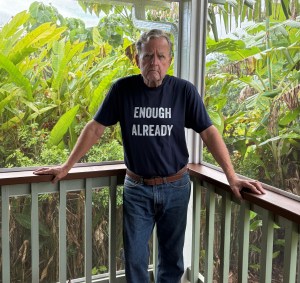
Community wins big against Syngenta and BLNR at Hawai’i Supreme Court

Uncle Loui Cabebe is smiling down upon us, of that I have no doubt. As a member of Ke Kauhulu O Mana and a plaintiff in our communities recent huge win at the Hawai’i Supreme Court, his legacy of caring and protection of the aina – lives on.

He spoke for all of us when he said in 2018 shortly after the initial legal action was filed, “We are the ones feeling the impacts from corporate agriculture. We are the ones who are hurting. We can see the damage that is being done to our land and to endangered birds and marine life. The burden should be on the companies to prove that their activities are safe.”

The Hawai’i Supreme Court just said Uncle Loui was right AND the Board of Land and Natural Resources (BLNR) failed to do its job protecting our communities health and natural environment.

Mahalo Uncle Loui and to all the Plaintiffs – Ke Kauhulu o Mānā, Punohu Kekaualua III, Hawai’i Alliance for Progressive Action (HAPA), Surfrider Foundation, and Koholā Leo.

Mahalo also to the excellent legal team of Lance Collins and Bianca Isaki who persisted through thick and thin…all the way to the Hawai’i Supreme Court – and won!

Mahalo plenty and especially and hugely our Hawai’i Supreme Court, led by Chief Justice Mark E. Recktenwald.

Hawai’i is extremely fortunate to still have in place a judicial branch of government we can have faith and confidence in.

My hope is that in the future, our government agencies and elected leaders will listen closer to the words of those who live, work, and raise their families near these lands.

“For generations, our ʻāina has been exploited and contaminated by corporate practices. The impact is not just on the land, but on our families. Our keiki are forced to live with obstacles created by environmental injustice—burdens that should never have been theirs to carry.” Punohu Kekaualua III, Aloha ʻĀina and Cultural Practitioner, Plaintiff

Hawai’i Revised Statutes HRS 343 says that actions involving state conservation lands MUST undergo an environmental review to disclose potential environmental and health impacts.

The “action” in this case was a proposed lease by Syngenta of State conservation lands adjacent to a sensitive shoreline area.

Syngenta is one of the largest agrochemical companies in the world. It’s a Chinese owned conglomerate, headquartered in Switzerland that develops and sells genetically modified seeds, AND manufactures and sells highly toxic pesticides/herbicides.

Many of the pesticides and genetically modified products Syngenta (and affiliates) develop, use, and sell in Hawai’i are illegal to develop, use or sell in Switzerland where the company is based.

These companies spray dangerous chemicals in fields, along roads, and next to schools and residential areas here in Hawai’i, that are forbidden by law to use in their own country.

Syngenta’s federal permits to conduct experimental genetic modification research, marked “not for release into the natural environment” are NEVER reviewed by the State.

The Court found the BLNR failed to follow proper procedures when it exempted Syngenta’s Hawai’i operations (now Hartung Brothers) from environmental review, and thus the potential environmental impacts of such activities were never disclosed or analyzed.

YES, this is a big win for our community, YES when the revocable permit is renewed or a new lease entered into an environmental assessment at the minimum will be required, and YES this sets precedent for other cases.

Full disclosure: I was Board President when HAPA joined this legal action against the BLNR and Syngenta. Prior to that, I was a member of the Kauaʻi County Council and fought tooth and nail against Syngenta during the Bill 2491 saga.

So yes, I’m totally biased and doing cartwheels at the moment.

Tomorrow we huddle to figure out next steps, but today we celebrate.

Gary Hooser

Posted in Uncategorized | 1 Comment

Fighting Trump’s Army – We need your help on this one. Actually we need everyones help.

I’m getting tons of calls and email asking me what action needs to be taken with regards to the Pōhakuloa situation and related issues.

There are multiple groups, organizations, and individuals, at this very moment coalescing around this very question.

The momentum is palpable.

You can help today by making a simple phone call to Governor Green and your district State Senator and Representative. You’ll probably get staff or voicemail but that’s ok – your message will be delivered and that’s what counts.

If you live on Hawai’i Island your County Council testimony for the upcoming September 3rd hearing, is also critically important.

As you know Trump’s Army is trying to force their way into a new agreement with the State that will allow the continued bombing of Pōhakuloa.

I wrote about this recently – Trump’s army is threatening to take Hawai’i lands by force.

Please join me and others across the islands and take these two actions.

1) Hawai’i County Residents, PLEASE SUBMIT TESTIMONY AND SHOW UP Wednesday September 3, 9:00AM @ Hilo Council Chambers – 25 Aupuni St, Hilo (# 1401) in STRONG SUPPORT of Resolution 234 25

Written testimony must be sent to counciltestimony@hawaiicounty.gov prior to Tuesday Sep. 2.

Please copy individual council-members:

Heather Kimball: Heather.Kimball@hawaiicounty.gov
Jennifer Kagiwada: jennifer.kagiwada@hawaiicounty.gov
Dennis “Fresh” Onishi: dennis.onishi@hawaiicounty.gov
Ashley Kierkiewicz: ashley.kierkiewicz@hawaiicounty.gov
Matt Kaneali’i-Kleinfelder:
matt.kanealii-kleinfelder@hawaiicounty.gov
James Hustace: james.hustace@hawaiicounty.gov
Michelle Galimba: michelle.galimba@hawaiicounty.gov
Rebecca Villegas: rebecca.villegas@hawaiicounty.gov
Dr. Holeka Inaba: holeka.inaba@hawaiicounty.gov

To provide oral testimony via Zoom, call (808) 961-8255 or councilremotetestimony@hawaiicounty.gov by 12PM, Tues., Sept 2.

2) Regardless of the island you call home – Call Governor Josh Green 808-586-0034 (if busy call East Hawai’i gov. liaison: 
808-974-6262) and YOUR DISTRICT SENATOR AND REPRESENTATIVE.

Please deliver to them (you’ll most likely get staff or voicemail) a polite and professional message in support of Hawai’i County Council Resolution 234 25 and let them know about your opposition to the continued bombing of Pōhakuloa.

Here’s an easy way to – Find Your Legislator

Below are key points you might consider sharing.

Aloha Governor and State Legislators,

My name is (fill in the blank), I’m a resident of (fill in the blank) County and I’m calling today to share my concerns and opposition to the continued bombing at Pōhakuloa and related issues.

Please respect the residents of Hawai’i County and support/honor Hawai’i County Council Resolution 234 25

Please say NO to the US Army and their request to “fast-track” the process and avoid compliance with Hawai’i law.

End the live fire and bombing at Pōhakuloa; Protect air, water, and sacred lands. No lease. No land swap. No land sale.

Please insist on compliance with State law HRS343 and require FULL DISCLOSURE of environmental, health, and cultural impacts.

Please honor Article XI of the State Constitution and PROTECT the public trust.

Thank you Governor/Senator/Representative for listening, please let me know at your earliest convenience where you stand on this important issue – (leave name and email and/or phone).

We must make the Governor and our Legislators aware of how we feel about this critically important issue AND we must do it before September 3.

AND Hawai’i County residents must send in their testimony by September 2, and show up in person at the Hilo Council Chambers on September 3.

As you have no doubt figured out by now, September 3 is an important day. We need all of us to step up now to make sure that day is a good one.

Sincerely,
Gary Hooser
Just a regular guy trying my best to navigate through these convoluted and dangerous times in which we are now living.

Posted in Uncategorized | Leave a comment

Trump’s army is threatening to take Hawai’i lands by force.

My father was a career Navy man. He retired after 30 years as a Chief Boatswain’s Mate, serving for decades on the USS Bon Homme Richard.

I was literally born into the U. S. military and grew up moving from one military base to another, from California, to the Philippines, to Japan, Alaska, and finally to Ford Island, Hawai’i. I am proud of my father’s service and believe without question we need a strong military.

But enough is enough.

Here in Hawai’i, the U.S. military controls over 220,000 acres including the land under Pearl Harbor Naval Base, Hickam Airforce Base, Kaneohe Marine Corp Base, Fort Shafter, Schofield Barracks, Wheeler Army Air Field, Pōhakuloa, Kahuku, Kawailoa-Poamoho, Makua, Pacific Missile Range Facility, and numerous other military offices.

The United States is the largest exporter of weapons worldwide, with more military bases in more countries than any other.

The U.S. spends more money on “defense” than any other country on the planet, approximately $916 billion per year – more than the combined defense budgets of China, Russia, India, Saudi Arabia, United Kingdom, Germany, Ukraine, France, and Japan. (Source: Peterson Foundation, rated unbiased and non-partisan)

It’s WAY past time for a reset.

This is where thinking globally and acting locally gets real.

We can and we MUST stop the cycle of aggression, and expand instead our efforts toward peace, reconciliation, and diplomacy.

Support for American troops, belief in the importance of national security, and rejection of the endless expansion of the U.S. war machine are values that can, and MUST, co-exist.

We can maintain a strong defense AND we can exercise our right to say enough is enough.

It’s time for us here in Hawai’i to step up, do what is right, and set the example for others to follow.

It’s time we say NO to the renewing of land leases at Pōhakuloa, Kahuku, Kawailoa-Poamoho, and Makua. It’s time to refuse expansion at PMRF Barking Sands and say NO to the bombing of Kaʻula Island.

Imagine it.

Imagine the people of Hawai’i saying firmly and clearly, NO to the U.S. military’s expansion in our islands, and YES to being a center of global peace — a Geneva of the Pacific.

Imagine Hawai’i taking the lead and embracing a Hoʻoponopono-centered approach to global peace, led by those whose ancestors came first to these lands.

Think of the message this would send around the world.

According to numerous media reports, Army Secretary Daniel P. Driscoll has been communicating regularly with Hawai’i Governor Josh Green. The messaging from both men is aligned along the same track: the State of Hawai’i must agree to allow the Army to continue bombing Pōhakuloa or the Army will take the land by force, via eminent domain.

The Army is threatening to take the lands at Pōhakuloa regardless of what the people of Hawai’i want. They are refusing to comply with State law HRS 343, which requires them to provide full disclosure of environmental, health, and cultural impacts that will occur.

Wow. Think about THAT headline: “TRUMP’S ARMY ATTEMPTS TO TAKE HAWAI’I LANDS BY FORCE.”

Think about the people of Hawai’i standing together and saying NO to the U.S. military.

Think about the people all over the globe who might be inspired to do the same.

This is what it means to think globally and act locally.

THIS is what should concern Trump, Hegseth, and Driscoll et al.

Gary Hooser
No titles, no presumptions, just tired of all the killing

Posted in Uncategorized | 9 Comments

Sending out a huge mahalo to the Hawaiʻi County Council – Pōhakuloa Resolution passes with unanimous vote!

The Hawaiʻi Island County Council Policy Committee on Environmental and Natural Resource Management voted 8 to 0 to pass the Pōhakuloa Resolution 234-25!

Resolution 234-25 states in part:

Be it resolved by the Council of the County of Hawaiʻi that it hereby urges the State of Hawaiʻi to ensure the health and safety of Hawaiʻi Island Residents by:

Requesting the U.S. military to immediately cease all bombing and desecration at PTA (Pōhakuloa). Rejecting land swaps and lease renewals unless stipulations are established to address comprehensive cleanup, restoration, and bioremediation at PTA: and

Conducting a full Ka Pa aka analysis of PTA to ensure the protection of Native Hawaiian cultural practices and resources.

Please reach out now, TODAY and give a huge MAHALO to:

Rebecca Villegas – Primary Sponsor of Res 234-25
rvillegas@hawaiicounty.gov

Council Chair Dr. Holeka Goro Inaba
holeka.inaba@hawaiicounty.gov

Jennifer “Jenn” Kagiwada
jennifer.kagiwada@hawaiicounty.gov

Dennis “Fresh” Onishi
dennis.onishi@hawaiicounty.gov

Ashley Kierkiewicz
ashley.kierkiewicz@hawaii.county.gov

Matt Kanealii-Kleinfelder
matt.kanealii-kleinfelder@hawaiicounty.gov

Michelle Galimba
michelle.galimba@hawaiicounty.gov

James E. Hustace
james.hustace@hawaiicounty.gov

Councilmember Heather Kimball was excused/absent and thus did not vote or participate in this meeting. Please reach out to encourage her to also support this Resolution during the upcoming final Council vote. heather.kimball@hawaiicounty.gov

Sending out a huge mahalo also to each and every one of the many community organizations and approximately 400 people who offered testimony in support (versus the 2 testifiers in opposition).

There will be one more Hawaiʻi Council vote on September 3 – so please continue to remain vigilant, share the news with family and friends, and encourage them to show up one more time on September 3 in Hilo!

It’s interesting that no member of the Governor’s office and no representative of the U.S. Army attended this meeting of Hawaiʻi Island County Council Policy Committee on Environmental and Natural Resource Management nor offered any testimony whatsoever on Pōhakuloa Resolution 234-25.

WUWT?

This of course is where I pivot —- Please read on…it’s important that you are fully informed.

Posted in Uncategorized | Leave a comment

It’s in Hawaiʻi County where the rubber meets the road on Pōhakuloa

While the Pōhakuloa lease extension and related issues are of huge importance to all Hawaiʻi, it’s in Hawaiʻi County where the rubber meets the road.

It is the people and the lands of Hawaiʻi County where the most direct impacts will be. This is where the guns are fired and the bombs exploded. It’s in this community where depleted uranium and other toxic chemicals lie buried in the dirt, sometimes blowing far and wide in the dust. This is where the fires burn at night, where valuable cultural resources are being trampled upon, and where endangered species are at risk.

And yet, at a Hawaiʻi County Council Committee meeting held specifically to discuss Pōhakuloa, neither the Army nor the Governor sends a representative to listen or to share the Army or State perspective?

Army Secretary Dan Driscoll was recently quoted in the media expounding upon his deep respect for Hawaiʻi, the Hawaiian culture, and the importance of preserving and protecting our natural environment.

He then also makes clear that the Army is having “near daily discussions with the governor’s team” with a goal of securing an agreement with the State in 60 days.

They both say they are committed to following the lawful process and ensuring the community has an opportunity to provide input.

But the truth is both the Governor and the Army have already agreed to break the law and are negotiating now on the terms of the law-breaking.

Hawaiʻi law HRS343 says any action proposed on state lands and or within conservation district lands must complete an environmental assessment and/or environmental impact statement (EIS).

The Board of Land and Natural Resources (BLNR) has voted to reject the Army’s environmental impact statements, citing numerous flaws and inadequacies.

These lands thus cannot be legally leased to the Army until they comply with HRS343.

Governor Green did an extensive television interview on August 19th in which he said clearly that the Army intends to force the issue under the guise of national security and so the best option for the state is to negotiate a lease with the best terms possible.

Translation: The U.S. Army doesn’t give a rip about Hawaiʻi law, Hawaiian culture or lands, or what the people of Hawaiʻi County or what anyone, anywhere in Hawaiʻi has to say.

AND the Governor of the State of Hawaiʻi believing he has no other options available, is willing to break the law if the lawbreaker pays enough money to make it worthwhile.

AND neither one is particularly concerned or cares enough to even show up and engage with the community which is most impacted.

AND the Army and the Governor says we should trust them, and that we have no other choice anyway.

Trust them to use the land responsibly in any way shape or form they desire. Trust that they will clean up and repair the damage caused to the natural environment. Trust that they will honor and protect cultural artifacts and endangered species now on these lands.

Yes, trust them and I’ve got a bridge to sell you too.

An environmental impact statement (EIS) by definition is essentially a disclosure document. The purpose of an EIS is to disclose impacts of the proposed land lease, including direct impacts, indirect impacts, and cumulative impacts. Also included would normally be “proposed mitigation” of negative impacts.

The potential and likely impacts of the Army’s planned use of Pōhakuloa must be disclosed and properly analyzed prior to the State entering into any agreement.

It’s simply not possible to draft a credible, responsible, or legal land lease without the proper completion of an environmental impact statement (EIS).

We must say no to the U.S. Army, AND we must call (808) 586-0034 and encourage Governor Green to reconsider his support of fast-tracking this important decision. We must also insist that the Governor comply with State law HRS343 and the State Constitution Article XI.

Note: Article XI of our constitution says clearly “the State and its political subdivisions” which makes County government equally responsible…

Mahalo again to Hawaiʻi County for stepping up to fulfill this responsibility.

Article XI

Section 1.  For the benefit of present and future generations, the State and its political subdivisions shall conserve and protect Hawaii’s natural beauty and all natural resources, including land, water, air, minerals and energy sources, and shall promote the development and utilization of these resources in a manner consistent with their conservation and in furtherance of the self-sufficiency of the State.

All public natural resources are held in trust by the State for the benefit of the people.

Gary Hooser
Former Director Office of Environmental Quality Control (OEQC)…among other things

Posted in Uncategorized | 11 Comments

Kouchi/Kawakami -A Convoluted, Complicated, Confusing Political Conundrum

The Hawaiʻi/Kauaʻi political landscape just got more interesting, more confusing, and much more complicated.

Senator Kouchi’s announcement (Civil Beat – Kouchi’s Running After All) that he is definitely running for reelection in 2026 and will NOT be retiring – presents a bit of a conundrum for Mayor Kawakami’s own campaign for that same Senate seat.

The facts seem pretty straightforward.

The Friends of Derek Kawakami official Campaign Spending Commission “Organizational Report”, signed by the candidate and his treasurer clearly states – Office Sought: Senate District 8.

On September 10, 2024 the Kawakami campaign filed a “Notice of Fundraiser” for an event at the Honolulu Pacific Club declaring the “office sought” as State Senate District 8 (Kauaʻi).

At that event and in the days preceding and following, the Friends of Derek Kawakami campaign raised approximately $250,000 from people, businesses, and organizations who made generous contributions in support of his newly launched effort to run for the Kauaʻi State Senate.

The top contributor was Oahu based AHE Group LLC who gave $10,000. An additional $4,000 was also donated to the campaign by Joelle Chiu identified on the campaign spending report as “Real Estate Developer” – AHE Group.

The top expense listed in his campaign finance report for his Kauaʻi Senate campaign was approximately $3,133 for hotel, air travel, car rental, and food expense for a “talk story event” held on Maui.

Campaign spending reports are fascinating.

On September 19, 2024 Kauaʻi Now reported, “The campaign office for Kauaʻi Mayor Derek S.K. Kawakami has confirmed the mayor intends to run for Hawaiʻi Senate District 8 in 2026, with the support of the current seat holder, Senate President Ron Kouchi.”

But then on June 6 Civil Beat reported, “The Senate campaign declaration Kawakami made last September in order to raise funds for his political future, to comply with state campaign finance law, appears to be a placeholder. He said he would not oppose Kouchi, who has helped him fundraise for the Senate but has not indicated any plans to retire.”

A placeholder? Can a candidate declare they are running for a specific political office, and raise money ostensibly to support a campaign for that office – when they don’t really intend to run for election to that office at all, and are only using it as a “placeholder”?

To sort through the confusion I went straight to the campaign law.

Caveat: I am not a lawyer (but did serve in a lawmaking role for 16 years).

HRS §11-384 – says a “candidate who receives contributions for an election but fails to file nomination papers for that election shall return residual funds to the contributors…” AND a “candidate who withdraws or ceases to be a candidate for the election…shall return residual funds…”.

To be absolutely clear I am not implying any wrongdoing by the Kawakami campaign – merely pointing out their conundrum.

Since he’s already stated publicly he would never run against Senator Kouchi for the Senate seat, Mayor Kawakami must now find another political office to “seek” and amend his official campaign organizational report.

His choices are Kauaʻi Council, State Representative, Lieutenant Governor, Governor or the U.S. House of Representatives CD2.

I presume his campaign must now notify the existing donors who donated money to his Senate race and offer them the option of a refund, and/or repurposing of their prior contribution to whatever new seat he now chooses to run for.

It will be interesting to see how this whole thing shakes out.

In the meantime, I’m hoping Kauaʻi Mayor Kawakami will make his final year as our top government executive a great one!

Gary Hooser
Former Kauaʻi State Senator 😉

Posted in Uncategorized | Leave a comment

Can you call Governor Green now? You’ll either speak to a receptionist or get voice mail…so it’s an easy call

Please take a moment to read this article by Kevin Knodell in the Honolulu StarAd today entitled “Army chief vows to respect Hawaiʻi culture and environment, but 60-day timeline is questioned.”

It made me want to throw up.

To better understand my visceral gut reaction please read also – The Army Is Not Our Neighbor by Ethan Mckown.  He describes the truth much more eloquently.

In the StarAdv piece, the United States Army Secretary Dan Driscoll speaks at great length of his deep respect for Hawaiʻi, the Hawaiian culture, and the importance of preserving and protecting our natural environment.

He then says we need to wrap all this up and cut a deal on Pōhakuloa Training Area (PTA) within 60 days, saying the Army is having “near daily discussions with the governor’s team”.

In other words, “Damn the torpedo’s (and the troublesome, pain in the ōkole, time consuming public input) full speed ahead.”

According to the article, “The Governor also shares the Secretary’s optimism about an expedited timeline and is moving forward in that spirit.”

Then of course they hold hands and throw in the warm and fuzzy caveat, “…both the Governor and the Secretary are committed to following the lawful process and ensuring that the community has an opportunity to provide input.”

If they’re “committed to following the lawful process”, they should just follow the lawful process and not attempt to jam this through in a totally unrealistic and arbitrary 60 days.

It’s disgusting, and it’s definitely not what democracy looks like.

The state Board of Land and Natural Resources (BLNR) voted to reject the Army’s environmental impact statements, citing numerous flaws and inadequacies.

Clearly the Army is seeking ways to cut a deal in private, while providing lip service to valid community, cultural, and environmental concerns.

Kahoʻolawe remains contaminated 35 years after the U.S. Military stopped the bombing and desecration there. The U.S. Navy continues to dodge, delay, and obfuscate responsibility for Red Hill and the contamination of drinking water on Oʻahu. Decades of live fire exercises and other military training activities at Pōhakuloa, Mākua, Kahuku and other locations in Hawaiʻi will likewise take billions of dollars and a generation or more to clean up and restore.

It’s important to remember the Commander in Chief is Donald Trump who’s backed by the “warrior ethos” testosterone fueled Secretary of Defense Pete Hegseth.

These guys see the U.S. constitution, the democratic process, community input, and transparency as obstacles that get in their way.

Recently they announced an expanded Hawaiʻi role in the future development of missile systems utilizing technologies in space, air, and on the ground.This clearly points to expansion of the Pacific Missile Range Facility (PMRF) on Kauaʻi.

President Trump has also instructed the U.S. Military to eliminate policies that support diversity, equity, and inclusion. Recently it was announced that some soldiers who have served honorably, with perfect records and impeccable job performance – would be terminated and discharged from military service without retirement benefits – because of their gender identity.

We are at a pivotal moment in time. 

We must say no to the U.S. Army, and we must call Governor Green TODAY and ask him to reconsider his support of fast-tracking this important decision. 

Everyone – regardless of the island you call home – Call Governor Green today (808) 586-0034, Sunday and you’ll get voice mail – just leave a short message (polite and professional please) – No fast-tracking of Pōhakuloa. Stop the bombing. No lease extensions. No land swaps or sales. Protect the public trust.

UPDATE – I’ve got good news and bad news. The Governor’s voicemail box is now full. Please try back later after his office has had a chance to check and clear the messages.

If you are a resident of Hawaiʻi Island please submit written testimony TODAY to your Hawaiʻi County Council in support of Resolution 234-25 TODAY – prior to Monday August 18th @ noon counciltestimony@hawaiicounty.gov 

All Hawaiʻi must stand together on this one.

The message can be short and the action requested straight-forward:

End the live fire and bombing at Pōhakuloa; Protect air, water, and sacred lands. No lease. No land swap. No land sale. Protect the public trust.

Hawai’i County Residents
Please show up in person if you can!

Tuesday, Aug 19, 11am – West Hawai‘i Civic Center, 74 5044 Ane Keohokālole Highway, Kailua Kona. In-person testimony is available in both Kona and Hilo.

You can also request to testify via Zoom  councilremotetestimony@hawaiicounty.gov 

For more information, to read the Resolution and easy testimony guidelines, talking points and tips – visit HULIPAC .

Many of you have asked me “What can we do to make a difference?” Well here it is…a valuable opportunity to think globally and act locally.

So please just do it. Make the call to Governor Green and if you are a Hawaiʻi County resident – submit testimony and show up in person on Tuesday.

Sincerely,
Gary Hooser
A wearer of many hats…today it’s about action…
Breaking…Ethan Mckown just put out this excellent MUST READ piece that easily explains  “The Army’s Imminent Land Grab”

Posted in Uncategorized | Leave a comment

Breaking in Honolulu Star-Advertiser -Army chief vows to respect Hawaii culture and environment, but 60-day timeline is questioned

Note to readers: Below is a cut and paste from today’s Honolulu Star Advertiser – well written piece by Kevin Knodell. Later today I will be posting my own “follow-up” thoughts to this and a related call to action.

Army chief vows to respect Hawaii culture and environment, but 60-day timeline is questioned

Secretary of the Army Dan Driscoll has a vision for soldiers in the Pacific, and part of it centers on renegotiating leases for Hawaii lands the service has trained on for decades that expire in 2029.
Driscoll recently embarked on a tour of the Pacific that took him to Hawaii and Guam, as well as a stop in Australia to watch the multinational exercise Talisman Sabre.

While in Hawaii late last month, he met with soldiers and observed training. He also met twice with Gov. Josh Green to talk about the Army’s land negotiations for leases that it obtained in 1964 for a mere $1.

Now back at the Pentagon, Driscoll said it’s “too much risk” for the Army to wait until the leases end in 2029.

“It’s hard to overstate how important Hawaii and that training area are for us … . We are talking about needing to bring clarity and conclusion to this topic in the coming, let’s say, 60 days,” Driscoll said in an Aug. 6 phone interview. “What we are seeing from the threats in the Indo-Pacific, and what we are seeing with how and where we need our soldiers to be positioned for that threat, has made the United States Army absolutely convinced that this is one of our very top priorities.”

The Army has said that on Oahu, it prefers to renew only 450 acres at Kahuku and not pursue lease renewals on any state land in Makua Valley or the Kawailoa-Poamoho Training Area — a roughly 93% reduction. But the Army maintains large swaths of federal land on Oahu and also seeks to continue using a state-owned parcel on Hawaii island that connects the federal lands making up its massive Pohakuloa Training Area.

The state Board of Land and Natural Resources recently voted to reject the Army’s environmental impact statements for its proposals on both Oahu and at Pohakuloa, citing data gaps and a desire to see ongoing studies the Army is currently conducting included.

Driscoll said his office has had “near daily discussions with the governor’s team” to “figure out how can we, with the constraints that we all have — whether it’s a swap, land exchange or through a much more aggressive model — how can we push through these changes in a way that both respects the Hawaiian people, who have been incredible partners and an incredible community for so many generations of soldiers … (and) shows them the love and admiration that we have for them, while also acknowledging the battlefield reality that we must have this training land because it is so critically important to us. ”

‘A holistic solution’

Green’s office said in a statement that he “believes there is a shared commitment to finding solutions that both honor Hawaii’s communities and support the operational needs of our Armed Forces. The Governor also shares the Secretary’s optimism about an expedited timeline and is moving forward in that spirit. At the same time, both the Governor and the Secretary are committed to following the lawful process and ensuring that the community has an opportunity to provide input.”

But former BLNR Chair William Aila Jr. said that concluding negotiations within 60 days is “impossible.”

“I don’t think this guy understands what the history and what the current feeling is in Hawaii with regards to military lands,” he said, adding “it doesn’t work that fast.”

Aila explained that only BLNR — and not the governor — has the authority to sign any agreement for a land swap or trade. And based on its experiences with the previous cases involving environmental impact statements, the board “is not ready to even consider something like that … . There will need to be a lot of community engagement.”

During his U.S. Senate confirmation hearing, Driscoll told Sen. Mazie Hirono, D-Hawaii, that he would work with her office on the leases and would listen to community groups.

“I have been emphasizing how important it is that these negotiations occur in a way that is very respectful to the Native Hawaiian community, so they are very apprised of the fact that we can’t have another situation like Red Hill … . So they are aware of the need to be very sensitive and respectful,” said Hirono, a member of the Senate Armed Services Committee. “The main thing is it’s got to get done, and I think it needs to get done in a way that is respectful to our community and that will restore their faith in how the military operates.”

Under President Donald Trump, the federal government has made moves to gut environmental and cultural programs. Defense Secretary Pete Hegseth has vowed to eliminate “woke” military programs and personnel that don’t “directly contribute to lethality.”

In Hawaii, there has been concern that this stance might hamper environmental cleanups and protection of Hawaiian cultural sites.

But Driscoll insisted that respect for both culture and environment are critical in Hawaii. He said that soldiers and local leaders stressed that to him when he visited.

“A lot of the environmental issues that are so acute to a place like Hawaii, it’s easy if you don’t live there to not appreciate how important and impactful those kinds of topics can be,” he said. “We realize that we can have a disproportionate toll on that community if we’re not thoughtful. And so what we are trying to do, and what we’re trying to work with the governor on, is a holistic solution that will … try to mitigate a lot of the negative externalities that can come from hosting that many soldiers and our training.”

Driscoll added, “We will try to make things whole with a lot of our spending, whether that’s helping improve roadways or whether that’s drainage or looking out for environmental kind of protection issues. We are very acutely aware of how important that is, and are not trying to sidestep them.”

Healani Sonoda-Pale of the group Ka Lahui Hawai‘i said she’s concerned about a rushed process and “backroom deals,” advising “it would not be in the best interest of the Army to do this.”

“There’s so much at stake here: Hawaiian cultural artifacts, iwi kupuna, very important ecosystems for endangered and threatened species (and) the water,” Sonoda-Pale said. “They need to just do the work and do their due diligence. We have the time, the money and the ability to do it.”

New tactics, weapons

Hawaii offers what military leaders say is a unique training and testing ground closer to the realities of what soldiers would actually face during a potential conflict in the Pacific, where tensions are boiling.

China has been locked in a series of disputes over territorial and navigation rights with neighboring countries, including the Philippines. Chinese vessels have regularly shot water cannons at Filipino boats and occasionally rammed them, raising concerns of clashes turning deadly. The U.S. and the Philippines have a mutual defense treaty.

The Chinese military has also stepped up maneuvers around Taiwan, a self-ruled island democracy that Beijing regards as a rogue province. Chinese leader Xi Jinping has reportedly instructed his military commanders to have their forces capable of invading Taiwan by 2027, though some analysts believe that order is more symbolic, as 2027 marks the 100th anniversary of the founding of the Chinese People’s Liberation Army.

Accordingly, Driscoll said, “what we are doing as an Army is we are focused on creating an Army that is using China as our pacing threat and a conflict in (the Pacific) theater as the pacing conflict to build toward, but with an acute awareness that any human being that has thought that they would with a crystal ball know where the next conflict was going to unfold has, throughout history, typically been proven wrong. And so we want an Army that stands by, and stands ready, to deploy anywhere in the world.”

While in Hawaii, Driscoll, a former infantry officer, joined soldiers in training at the 25th Infantry Division’s jungle warfare school near Wahiawa. He said “my core takeaway was, as far as I know, we just don’t have any other land that looks like what our Hawaiian training facilities look like.”

Army leaders are working to quickly overhaul their forces as they watch how conflicts around the globe are unfolding. They want to train and test new tactics and weapons in Hawaii.

“The Army exists within a Pentagon and a bureaucracy that for 30 or 40 years hasn’t really optimized outcomes for soldiers,” Driscoll said. “What that practically means is a lot of the equipment we are buying, a lot of the training we are forced to do, and a lot of the tools that we have, are not preparing us for this kind of inflection point that we’re at with modern warfare.

“If you look at Ukraine and Russia and what’s going on in Israel, I think this speed with which you can make decisions, the speed with which you can update your equipment, your ability to survive in these kind of very complicated electromagnetic areas requires nimbleness. And our current structure is exactly the opposite of that.”

‘Building out that force’

In Hawaii, the Army has made the lands it currently occupies part of its Joint Pacific Multinational Readiness Center, a series of training ranges and exercises aimed at bringing together American troops and their allies from around the world.

“I think what we are learning as a nation is that the strongest defense for us, particularly in a place like the Indo-Pacific, is through strong allies and partners who we have developed meaningful, lasting relationships built on trust and shared experience,” Driscoll said. “Having shared systematic agreements to the exchange of information requires a lot of work on the front end, and requires that we are prepared for things like island-hopping in the Pacific. The battle scenarios out there require coordination that you just don’t need in other parts of the world.”

When foreign diplomats and military leaders have come to Hawaii, U.S. officials hosting them have often highlighted Hawaii’s cultural diversity as a demonstration of America’s connection to the Pacific and Asia. U.S. leaders have often tapped American troops and personnel from immigrant family backgrounds who speak languages from the region to help out during visits and when they go to other countries in the region.

However, soon after taking on leadership of the Pentagon, Hegseth told troops in an address that “the single dumbest phrase in military history is ‘our diversity is our strength.’ I think our strength is our unity, our strength is our shared purpose, regardless of our background.”

Hegseth ordered a “digital refresh” of content on military websites that included removing any content deemed “woke” or promoting diversity, equity and inclusion.

His order initially encompassed pages related to Asian American and Pacific Islander veterans, including one devoted to the 442nd Regimental Combat Team, a highly decorated World War II unit made up of nisei troops, about two thirds of them from Hawaii. Content related to Japanese American intelligence troops that helped U.S. forces translate enemy communications and interrogate prisoners also initially was scrubbed.

Those deletions prompted a major backlash in Hawaii from residents, local leaders and veterans groups. The Army has since restored some of the content.

“I’ve tried to take away as many things as I possibly can that separate us and our soldiers from each other,” Driscoll said.

He said his views on diversity were shaped in part by experiences attending college, where he encountered language around diversity that he described as “some pretty Orwellian speak, and much of it seemed to be this performative human exercise in avoiding substantive interactions.”

But Driscoll also said that “undoubtedly, as we have attempted to return to a model of what I would call more transparent, rational, clear conversation and empowering people to have a shared experience, I think there were some instances where — in that reset — we took down things that we did not, in hindsight, intend to.”

He said that having an Army that has people with grounded knowledge of the world’s languages and cultures is still critical, especially in the Pacific and Asia.

“You want a variety of experiences, you want a variety of backgrounds, you want a variety of talents to be mixed together,” Driscoll said. “That balance will come from the actual people who are building out that force, helping us innovate, manning the lines and making up our platoons around the world. And so I think that never before has it been more important to have (that) kind of talent.”

Posted in Uncategorized | 1 Comment

The 2026 Hawaii Ballot will contain the following races

Here’s a list of all races that will be on the Hawaii ballot in 2026 AND all incumbents currently in these positions. Please let me know if you notice any errors or typos…am doing the best I can but it’s a lot of data.

Please also check out this excellent “Office of Elections” resource listing seats open and qualifications needed to run.

And for the most recent bank balances in each and every incumbents campaign spending bank account – I’ve got that ranking here also…Following The Money

U.S. Senate Seats will not be on the 2026 ballot
Senator Brian Schatz will be up for reelection in 2028
Senator Mazie Hirono will be up for reelection in 2030

In 2026 the Hawaii Ballot will contain the following races

U.S. Representative District I – incumbent Rep. Ed Case up for reelection
U.S. Representative District II – incumbent Rep. Jill Tokuda up for reelection

Governor
Josh Green up for reelection

Lieutenant Governor
Sylvia Luke up for reelection

State Senate – seats and incumbents up for reelection
District 2 Joy A. San Buenaventura – Puna
District 5 Troy Hashimoto – Maui – Wailuku, Kahului
District 8 Ronald Kouchi – Kauai
District 9 Stanley Chang – Hawaii Kai
District 10 Les Ihara – Palolo, St. Louis Heights
District 11 Carol Fukunaga – Manoa, Makiki
District 13 Karl Rhoads – Nuuanu
District 14 Donna Kim – Kalihi, Ft. Shafter
District 15 Glenn Wakai – Foster Village, Salt Lake
District 17 Donovan Dela Cruz – Wahiawa, Mililani
District 20 Kurt Fevella – Ewa Beach
District 21 Mike Gabbard – Kapolei
District 25 Chris Lee – Kailua, Waimanalo

State Representative
All 51 Districts are up for reelection – see a complete list of incumbents and districts here.

Office of Hawaiian Affairs Trustee – up for reelection
Maui Resident Trustee – Carmen Hulu Lindsey
Oahu Resident Trustee – Kalei Akaka
At-Large Trustee (3 seats)
Keoni Souza
Brickwood M. Galuteria
John D. Waiheʻe IV

County of Hawaii
Mayor Kimo Alameda is not up for reelection until 2028
Councilmembers – 9 total are all up for election
6 incumbents plus 3 termed out
Incumbents

Heather L. Kimball District 1 – North Hilo, Hāmākua, and Portion of Waimea

Jennifer “Jenn” Kagiwada District 2 – Hilo, portions of South Hilo

Dennis “Fresh” Onishi District 3 – Portion of South Hilo and Portion of Kea’au

Ashley Kierkiewicz TERMED OUT District 4 – Lower Puna, Pāhoa

Matt Kanealii-Kleinfelder TERMED OUT District 5 -Upper Puna and portions of Keaʻau

Michelle Galimba District 6 – Kāʻu, portions of South Kona, Volcano

Rebecca Villegas TERMED OUT District 7 – Portion of Kona and South Kona

Dr. Holeka Goro Inaba District 8 – North Kona

James E. Hustace District 9 – Kohala, portions of Waimea

County of Maui
Mayor – Incumbent Richard T. Bissen, Jr. is up for reelection
Councilmembers – 9 total
No incumbents are termed out and all are up for reelection
Incumbents

Chair – Alice L. Lee – Wailuku-Waiheʻe-Waikapū

Vice Chair – Yuki Lei Sugimura – Upcountry

Tasha Kama – Kahului

Thomas Cook – South Maui

Gabe Johnson – Lānaʻi

Tamara Paltin – West Maui

Keani Rawlins-Fernandez – Molokai

Shane Sinenci – East Maui

Nohelani Uʻu-Hodgins – Makawao-Haʻikū-Pāʻia

County of Kauai
Mayor – No incumbent – open seat
Councilmembers – 7 total – all elected “at large” and no districts
There are 3 incumbents running for reelection and 4 “open” seats
Incumbents

Arryl Kaneshiro

Fern Holland

Addison Bulosan

Felicia Cowden TERMED OUT

KipuKai Kualii TERMED OUT

Bernard Carvalho – RUNNING FOR MAYOR

Mel Rapozo – RUNNING FOR MAYOR

City and County of Honolulu
Mayor Rick Blangiardi is up for reelection in 2028
Councilmembers – No incumbents are termed out.
Incumbents

Matt Weyer – II – Waikele, Village Park, Royal Kunia, Wahiawā, Mokulē‘ia, Waialua, Hale‘iwa, Pūpūkea, Sunset Beach, Kahuku, Lā‘ie, Hau‘ula, Punalu‘u, Kahana, Ka‘a‘awa, Kualoa, Waiāhole, and Kahalu‘u

Tommy Waters, Chair – IV – Hawai’i Kai, Kuli‘ou‘ou, Niu Valley, ‘Āina Haina, Wailupe, Wai‘alae Iki, Kalani Valley, Kāhala, Wilhemina Rise, Kaimukī, Kapahulu,
Diamond Head, and Waikīkī

Tyler Dos Santos-Tam – VI -Portions of Kakaʻako, Downtown Honolulu, Punchbowl, Papakolea, Pauoa Valley, Nu‘uanu, Iwilei, Liliha, ‘Ālewa Heights, Kalihi and Kalihi Valley

Val Aquino Okimoto – VIII – Portions of ‘Aiea, Waimalu, Newtown, Pearl City, Seaview, Crestview, Waipi‘o Gentry, Koa Ridge, Mililani Town, and Mililani Mauka.

Posted in Uncategorized | Leave a comment

Following the money – From top to bottom – Every Single State and County Incumbent

For those who are serious about their policy and politics, the most recent Campaign Spending Reports through June 30, 2025 as posted on August 10, 2025 can be found at: https://csc.hawaii.gov/CFSPublic/menu/

I encourage folks to review the data within the reports, which reveals the names of every campaign donor that contributes $100 or more AND the campaign expenses – in some detail.

Civil Beat recently posted some updates as well. Data Dive: Campaign Donations Plummeted During Legislative Session

Below is a “top to bottom” ranking of the money available in campaign spending bank accounts – for every incumbent politician in every State and County political office in Hawaii, including Office of Hawaiian Affairs. I’ll be digging deeper into this…in the future and if/when I find stuff that stands out or especially interesting…I’ll let you know!

Gov. Green, Josh $1,627,076.55
Sen. Dela Cruz, Donovan $1,191,107.26
L.G. Luke, Sylvia $563,565.69
Sen. Keohokalole, Jarrett $274,424.23
Kauai Mayor Kawakami, Derek $250,380.81
Hon Council Waters, Tommy $234,879.03
Sen. Kim, Donna $200,752.55
Sen. Hashimoto, Troy $199,246.42
Rep. Matayoshi, Scot $192,716.42
Sen. DeCoite, Lynn $178,528.12
Sen. Moriwaki, Sharon $139,180.38
Sen. Rhoads, Karl $136,263.32
Sen. Aquino, Henry $135,888.82
Hon CC Dos Santos-Tam, Tyler $135,075.02
Hon CC Nishimoto, Scott $135,034.34
Rep. Yamashita, Kyle $122,308.48
Hon. Mayory Blangiardi, Rick $119,573.49
Sen. San Buenaventura, Joy $115,432.69
Sen. Chang, Stanley $113,907.43
Rep. Kitagawa, Lisa $110,391.36
Sen. Wakai, Glenn $108,390.75
Sen. Kidani, Michelle $104,252.78
Speaker Rep. Nakamura, Nadine $99,403.15
Sen. Elefante, Brandon $98,236.00
Hon CC Okimoto, Val $89,497.26
Rep. Woodson, Justin $82,688.05
Maui CC Sugimura, Yuki $82,450.59
Kauai CC Kaneshiro, Arryl $77,007.59
Rep. Tarnas, David $75,458.62
Rep. Lowen, Nicole $69,898.51
Sen. Inouye, Lorraine $64,707.88
Sen. Kanuha, Dru $64,541.61
Maui CC Uu-Hodgins, Nohelani $64,239.37
Rep. Ilagan, Greggor $64,272.47
Rep. Holt, Daniel $64,165.72
Sen. Richards, Herbert $62,962.59
Hon CC Weyer, Matt $62,412.64
Rep. Takenouchi, Jenna $60,352.91
Pres. Sen. Kouchi, Ron $60,318.87
Rep. Takayama, Gregg $58,803.25
Rep. Todd, Christopher $57,784.94
Rep. Tam, Adrian $54,397.52
Sen. Gabbard, Mike $53,050.53
Hon CC Kiaaina, Esther $52,342.59
Rep. Ichiyama, Linda $51,489.08
Sen. Fevella, Kurt $50,353.45
HI CC Kierkiewicz, Ashley $47,775.42
Rep. Hashem, Mark $45,579.25
OHA At Large Galuteria, Brickwood $44,889.00
Rep. Chun, Cory $44,193.10
Rep. Sayama, Jackson $43,460.87
K. Mayor Cand. Rapozo, Melvin $41,661.51
Rep. Garrett, Andrew $40,484.73
Rep. Miyake, Tyson $40,012.36
Rep. Matsumoto, Lauren $37,529.45
Rep. Kahaloa, Kirstin $33,373.08
Hon CC Tulba, Augusto $32,289.44
Hon CC Tupola, Andria $29,227.37
Hon CC Cordero, Radiant $28,474.48
Maui CC Paltin, Tamara $27,801.77
Rep. Garcia, Diamond $26,634.66
Maui CC Lee, Alice $26,405.02
Rep. Lee Loy, Susan $25,798.55
Sen. Lee, Christopher $23,986.75
Rep. Kong, Samuel $23,686.12
Rep. Lamosao, Rachele $22,350.55
Rep. Evslin, Luke $21,273.41
Rep. Pierick, Elijah $20,748.29
Kauai CC Kualii, KipuKai $20,049.34
Rep. Kila, Darius $19,318.97
Rep. Poepoe, Mahinamalamalama $18,753.61
Rep. Morikawa, Daynette $16,710.66
Maui CC Kama, Natalie $14,846.90
Rep. Amato, Terez $14,545.93
Rep. Hussey, Ikaika $14,327.46
Maui CC Rawlins-Fernandez, Keani $13,789.43
Rep. Lee, Michael $13,496.83
Rep. Shimizu, Garner $13,337.96
K. Mayor Cand. Carvalho, Bernard $13,298.09
Rep. Kusch, Matthias $12,840.42
HI CC Inaba, Holeka $12,620.28
Rep. Iwamoto, Kim Coco $8,944.51
Rep. La Chica, Mae Patricia $8,416.69
Rep. Alcos, David $8,067.68
HI CC Kagiwada, Jennifer $7,944.62
Rep. Olds, Ikaika $7,061.69
Kauai CC Holland, Fern $6,401.73
Sen. DeCorte, Samantha $6,028.19
HI CC Hustace, James $5,925.12
Maui Mayor Bissen, Richard $5,105.77
OHA Maui Lindsey, Carmen $4,897.00
HI CC Villegas, Rebecca $4,598.33
Rep. Marten, Lisa $4,471.18
OHA at large Akina, William $4,220.53
HI CC Kanealii-Kleinfelder, Matthew $3,673.22
HI CC. Galimba, Michelle $3,560.52
Rep. Perruso, Amy $3,505.79
Rep. Templo, Shirley $2,991.50
Rep. Gedeon, Joe $2,805.01
OHA, Oahu Akaka, Kalei $2,782.34
Sen. Awa, Brenton $2,721.78
Rep. Belatti, Della $2,483.68
Kauai CC Bulosan, Addison $2,340.93
Maui CC Sinenci, Shane $1,868.95
BI Mayor Alameda, Kimo $1,428.02
Rep. Grandinetti, Tina $472.78
Maui CC Johnson, Gabriel $351.14
Rep. Cochran, Elle $308.58
HI CC Kimball, Heather $103.39
OHA Chair Kahele, Kaiali’i. $100.00
Rep. Kapela, Jeanne $0.73
Maui CC Cook, Thomas $-292.15
Rep. Reyes Oda, Julie $-385.06
OHA, Molokai Lanai Alapa, Luana $-1,702.99
OHA Kauai, Ahuna, Daniel $-2,486.65
Rep. Muraoka, Chris $-5,991.59
Kauai CC Cowden, Felicia $-6,990.93
Rep. Quinlan, Sean $-8,050.44
Rep. Souza, Kanani $-8,139.77
Sen. McKelvey, Angus $-9,054.44
OHA At Large Waihee, John Jr. $-21,258.80
HI CC Onishi, Dennis $-23,885.03
Sen. Ihara, Les $-25,370.04
OHA at large Souza, Keoni $-64,400.76
Sen. Fukunaga, Carol $-67,773.43

Note: I’m assuming (but will be digging deeper) that many/most of “negative” balances are due to candidate loaning themselves money to run their own campaign.

Gary Hooser

Posted in Uncategorized | Leave a comment