Choosing the best from the rest –

Deciding on who to vote for and or who to endorse involves examining the totality of the circumstances surrounding the individuals who are running, the office they are running for, and the general circumstances and political landscape.

All are imperfect and compete with other imperfect individuals to be elected to public office.

Most candidates are good on some issues and bad or not so good on others. Similarly, each candidate has a unique personality, unique life experiences, and look at the world through their own unique life lens.

When attempting to decide between two or more candidates, it’s natural and necessary to determine where each stands on the important issues of the day.

Most of us have “litmus test” issues. Bigotry is a big one for me. I would never vote for a bigot.

Marriage equality, abortion rights, gun control, the right for all workers to earn a living wage, universal health care, TMT, demilitarization, the separation of church and state, and climate change are all issues that I believe “my candidate” should be strong on.

But what if my choice was between these two candidates?

Candidate A was solid on every single one of these issues except TMT and was also weak on universal health care.

Candidate B was similarly not good on the TMT and universal health care issues but was also a bigot who opposed gun control and marriage equality and did not believe climate change was real.

Is voting for candidate A, voting for the “lesser of two evils”?

Let’s say you decide to vote for neither. You leave your ballot blank and candidate B wins by one vote.

Will our community be better or worse off because you failed to vote for candidate A?

Is this a win?

I don’t think so.

gh

Read also: Which Candidates Should Be Supported?

Posted in Uncategorized | Leave a comment

I’ve finally come to a decision on the Hawaiʻi Lieutenant Governor’s race

Sherry Menor is a very nice person whom I have known for years. We’ve interacted since my time serving in the Senate, normally on opposite sides of the issues. She has always been pleasant and professional but we each see the world through a different lens. She spends year after year, session after legislative session – pushing back against environmental and worker protection laws and helping her bosses at the Hawaiʻi Chamber of Commerce to maximize their profits.

I’ve spent those same years fighting hard to increase environmental protections and worker rights and benefits.

Former Honolulu Council Chair Ikaika Anderson, I do not know well so I have been asking people who live in his Council district about him. The answers I’m getting are not positive ones. As further evidence of a disconnect between Anderson and his immediate constituents, 46% of the 2016 voters left their ballots blank even though he was unopposed. His was the only name on the ballot for that Council seat and 46% of the voters chose not to put an X next to his name. It’s not uncommon for 15% to 20% of voters to leave their ballots blank on unopposed races, but 46% certainly means something is seriously not right.

There’s something else there that makes it impossible for me to vote for Ikaika Anderson. I’m not quite sure what it is, but it may be related to his irritating TV ad claims of achievement and endless experience, combined with those pesky blank votes.

Representative Sylvia Luke is or was probably the most powerful woman in Hawaiʻi politics. Almost every single bill that passed through the State House was subject to her review and veto power if she did not like it. As Chair of the powerful House Finance Committee, she wielded her power in a quiet, competent, and somewhat muted manner – from the publics perspective. But among those who had matters before her committee, a hesitancy to cross her and the fear of retaliation are front and center realities.

According to Civil Beat Luke has spent an eyeopening $951,000 in the L.G.’s race during the first six months of this year. You will not find Sylvia Luke being a strong advocate for banning fundraising during the legislative session, that is for sure.

Money and power and business as usual are the thoughts that come to my mind when considering whether or not to cast my L.G. vote for Sylvia Luke. I just can’t do it.

So, yes…I’m voting for Keith Amemiya to be the next Hawaiʻi Lieutenant Governor. While it’s true he’s the only candidate left standing, there is more to it than that. His issue platform aligns with mine, he brings new and positive energy to the table, and for whatever reason – I trust the guy.

To be clear I am not making this decision lightly. I’ve been doing my homework, looking into his background, reviewing the various campaign websites, and calling friends who work in the political world.

The answers I’ve gotten from others, and the ultimate conclusion I’ve come to can be summed up in three sentences:

Voting for Menor and the Chamber of Commerce is a nonstarter.
Anderson and Luke represent money, power, and politics as usual – pick your poison.
Amemiya offers new energy, a fresh perspective, and hope for the future.
That’s plenty enough reason for my vote.

Sincerely,
Gary Hooser
Read also:
Why I’m Supporting Kai Kahele Over Josh Green

Sergio Alcubilla For Congress – the little engine that could

Why Choose Sergio Alcubilla Over Blue-Dog Ed Case

Note to all the other candidates running for this office who are not on the above list: To win, you must start earlier and run a real campaign. You may be a great candidate for the office but I don’t know who you are, and you certainly have not convinced me that I should vote for you, or include you in the discussion. To win you must figure out a way to “get on the radar”. Campaigns are hard, winning against better-known and better-financed candidates is hard. It may mean starting out lower on the political food chain. #justsayin

Posted in Uncategorized | 9 Comments

Kaua`i – Counting Votes For Affordable Housing

The lack of affordable housing is cited as the #1 issue by just about every candidate on the ballot in the Primary Election scheduled for August 13. 

We have more people living in the bushes, alongside the roadways, and under our bridges – than ever before.

The cost of housing is also higher than it’s ever been.

People are hurting. Bad kine.

Kaua`i Councilmember Luke Evslin and Council Vice-Chair Mason Chock have introduced Resolution No. 2022-22 proposing to amend the Kaua’i County Charter, and earmark a minimum of two percent (2%) of County real property tax revenues to the Housing Development Fund for the purpose of affordable housing. Read the entire notice for Resolution No. 2022-22 here.

When ultimately passed by voters, this will ensure that the creation of affordable housing for local residents will be a top priority for Kaua’i County. Because the measure creates a dedicated annual funding source, the County will significantly increase its ability to compete for State and Federal housing funds and to leverage the dedicated funding via long-term bonds. 

The two Councilmembers have also introduced Bill 2872 to amend the “Residential Investor” and “Vacation Rental” tax rate classifications to incentivize long-term rentals and to shift some of the financial burden toward those most capable of paying, and away from owner-occupied homes and long-term rentals. Bill 2872 does not increase property taxes but only creates a broader tax structure that could support the funding of affordable housing and other vital services. Read the entire notice for Bill No. 2872 here.  

These measures represent significant steps Kaua`i County can and must take toward alleviating our existing affordable housing crisis. Both the City and County of Honolulu, and Maui County have created similar funding mechanisms dedicated to increasing their affordable housing inventories.

The Public Hearing for both is Wednesday, July 20 in the Council Chambers at 8:30am and is perhaps the most important public meeting of the year. My hope is that Kaua`i residents will show up to testify in person AND that they will submit testimony in writing to counciltestimony@kauai.gov (late testimony is better than no testimony).

The actual vote will not occur until the August 3 Council meeting. However, it’s important to know where each Councilmember stands on the issue, earlier rather than later.

Vote counting #101:

Obviously the sponsors, Councilmembers Luke and Chock are in strong support.

Based on his past public statements and prior vote on the issue it’s clear that Councilmember KipuKai Kualiʻi is also in strong support.

Similarly, it should be obvious to anyone observing the previous Council meeting where this was discussed, that Council Chair Arryl Kaneshiro and Councilmember Bill DeCosta are strongly opposed. The Chair is a genuine budget hawk and prefers not to make a long-term budget commitment for affordable housing. DeCosta’s opposition seems based on a fear that people from the mainland will somehow cut in line ahead of true local residents. 

Councilmember Bernard Carvalho and Councilmember Felicia Cowden both have spoken and voted in support but the clarity of their position, whether grounded in style or substance, sometimes appears muted.

It takes 5 votes to pass and while the preliminary vote count on this looks to be 5 in support and 2 opposed, the ultimate vote of August 3 is the one that matters.

All 7 Councilmembers need to hear from the community on this.

If passed by the Council, Resolution 2022-22 will be placed on the November Ballot for Kaua`i voters to decide whether or not the creation of more affordable housing for local residents and a much-needed dedicated funding source – should be a top priority or not.

The August 13 Primary Election occurs just 10 days after the Council votes on these two issues. While I normally encourage people to vote early, in this case, I’m thinking about waiting to cast mine. #justsayin

Posted in Uncategorized | 4 Comments

Money talks. Listen, learn, and decide for yourself who you think should be Hawaii’s next governor.

The clarity of the choices and the distinctions between the candidates could not be any more lucid. Kai is our guy.

Breaking – Today’s Civil Beat
Lt. Gov. Josh Green has spent $2.65 million. 27% of his contributions larger than $100 were from out of state.

Cayetano reported spending more than $2.25 million – loaning her own campaign $1.52 million so far. 9% of Cayetano’s donations of more than $100 were from out of state

U.S. Rep. Kai Kahele’s report shows he has spent about $178,000 on the election so far. None of Kahele’s donations of more than $100 were from out of state. *Actually his policy is to not accept donations of more than $100.

According to Civil Beat: “Kahele’s initial filing on June 20 made it clear he is backed by much of the progressive wing of the Democrats at the Legislature, with donors who included Reps. Tina Wildberger, Chris Todd and Amy Perruso and Sen. Laura Acasio.

His small-donor supporters also included familiar names from the left wing of state and local politics such as Kyle Kajihiro, Will Caron, Shannon Rudolph, Bart Dame and former state Sen. Gary Hooser. Former state Democratic Party Chair Stephanie Ohigashi was also among his donors.

Kahele also drew support from some well-known environmental advocates including Marti Townsend, Nelson Ho, Josh Stanbro and David Henkin.”

The Civil Beat article also reports: “He (Green) had more than $629,000 in cash on hand as of June 30, while Cayetano had slightly more than $56,000 on hand. Kahele had about $40,450 in cash on hand.”

Kai is our guy. The recent campaign spending reports prove it. But because he is refusing the big money, us small money guys gotta keep spreading the word and giving what we can.

So if you have not yet made an online contribution to the campaign of $100 or less please do so TODAY. And if you have already maxed out and given the $100 directly to the campaign, please consider supporting the Kai Kahele for Governor Grassroots Community Fund with an additional donation!

Information is per Civil Beat – today…breaking news.

Posted in Uncategorized | 1 Comment

Sergio Alcubilla and Ed Case – Update On Progress Made In 9 Short Months

The story of Sergio Alcubilla candidate for Congress in Hawaii’s CD1, reminds me of “The Little Engine That Could”.

I am guessing you have either read it to your children or perhaps when you were a child remember it being read to you?

It’s a “Classic story of the little blue engine that comes to the rescue when the train taking supplies to the good children over the mountain breaks down.”

In a world where Nina Turner says “any ole blue won’t do” we know by now that Sergio is blue to the core, unlike his Blue-Dog opponent Congressman Ed Case who stopped in its tracks the “Build Back Better” plan – just as it was preparing to cross the mountain peak of Congressional approval.

The Build Back Better plan would have provided hearing, dental, and vision coverage to all Medicare recipients. It would have supported childcare for families in need, and it would have made possible a college education for every single high school graduate regardless of their ability to pay. All of this and much more was lost due to the action and inaction of Case and his Blue-Dog Caucus

The Hawaiʻi Democratic Party itself passed a Resolution saying that Case’s actions “do not reflect the values and principles” of the party.

According to Wikipedia, “In the tale, a long train must be pulled over a high mountain after its locomotive breaks down. Larger locomotives, treated anthropomorphically, are asked to pull the train; for various reasons they refuse. The request is sent to a small engine, who agrees to try. This small engine succeeds in pulling the train over the mountain while repeating the motto: “I-think-I-can”.”

With real-life imitating this classic tale, the whispers among Democratic Party stalwarts were rife at the time with speculation as to “who might step up” to run against Case? What Democrat who truly believed in the values of the Party was going to challenge him?

Not one of the “larger locomotives” was willing to take up the task. All the usual suspects, those with name recognition, those who had money or access to money, those with connections to the movers and shakers – not one of these larger locomotives was willing to move out of the comfort of their garage.

But Sergio Alcubilla, a graduate of Richardson School of Law, a public interest attorney with immigrant roots, a young family man with a keen sense of responsibility to do more for his community said, “I think I can” which translated quickly to “I know I can”.

9 months ago Sergio Alcubilla was virtually unknown in the world of Hawaiʻi politics. He had no previous campaign experience and unlike his well-funded opponent, his campaign account began at zero – with a firm commitment to reject large corporate campaign donations. Sergio’s campaign would be a people’s campaign, not one fueled and managed by insiders and big business.

He has worked tirelessly since that moment, knocking on countless doors, holding signs across the district, and building a diverse grassroots network of volunteers and supporters.

The hard work has paid off with the campaign garnering the endorsement of:
* Hawaiʻi State Teachers Association (watch/listen to @3.5 minute mark Sergio)
* ILWU, Local 142
* ILWU, International
* Unite Here, Local 5
* Hawaiʻi State AFL-CIO
* Our Revolution, Hawaiʻi
* Hawaiʻi 350.org
* Hawaiʻi Ports Maritime Council
* Inland-boatmen’s Union of the Pacific
* Americans for Democratic Action, Hawaiʻi Chapter
* Pono Hawaiʻi Initiative
* Seafarers International Union of North America
* Sailors Union of the Pacific
* Marine Firemen’s Union
* Hawaiʻi Nurses Association Local 50
* Blue America

*Sergio has also taken the Our Hawaiʻi Pledge, to stand with the people of Hawaiʻi and not corporate greed.

“The story of the little engine that could has been told and retold many times. The underlying theme is the same—a stranded train is unable to find an engine willing to take it over difficult terrain to its destination. Only the little engine is willing to try and, while repeating the mantra “I think I can, I think I can”, overcomes a seemingly impossible task.”

To go all the way, up and over the peak that is before him – Sergio needs your support. He needs you to spread the word, to volunteer, and he needs your financial support to fund TV ads during the crucial next few weeks.

Can you help today with an online contribution so Sergio can get the critical TV time needed prior to the ballots being mailed out on July 20th?

The cost of a single 30-second TV spot on the morning news is $300, and the late afternoon prime-time hour is $700. Any help you can offer today and before July 20th is especially needed. Can you by chance contribute 1 or 2 or 3 TV spots?

Whatever the contribution – all are welcome.

ReviewSergio’s background and issue priorities. Watch this short campaign video to get a true sense of who he is. Do your homework. I trust you will agree – Sergio Alcubilla is by far the best choice to serve us in Congress.

We can do this. I know we can.

Sincerely,
Gary Hooser http://www.garyhooser.com
Former Hawaiʻi State Senator

Sergio is a good man. If you haven’t figured it out already, read my blog: Why I’m Choosing Sergio Over Ed Case.

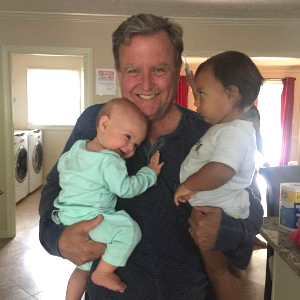
Why do I do this you might ask? Why use my time and my money small though it may be, to support Sergio? I’m holding two of the main answers right here, one in each arm.

Posted in Uncategorized | 9 Comments

Damning evidence the State discovered, and ignored

I’m flabbergasted to be reminded yet again of the State of Hawaii’s negligence with regard to pesticide contamination.

I was recently sent a legal paper by David M. Forman Director, Environmental Law Program William S. Richardson School of Law, University of Hawai‘i at Mānoa.

His paper dense though it may be (as legal papers tend to be) – has awakened in me the awareness, concern, and outrage that enveloped our collective community for several years – in our ongoing fight to increase the regulation of pesticides across the islands.

The below snippet is now stuck in my brain. To my knowledge, no state agency has ever taken this investigation any further. Where did the Roundup come from? What impacts is it having on health and the environment? What should be done to mitigate those impacts? Have residents and users of those streams been notified of the risk?

Professor Forman’s report states:

“During deliberations on a proposed county ordinance (referencing Kauai Bill 2491), the Branch Chief for the Hawai‘i State Pesticide Branch offered damning testimony:

“We looked into stream sediments specifically for glyphosate, for Roundup, and we found Roundup in all of the samples that we took. All in all, we found 20 herbicides, 11 insecticides, 6 fungicides, 7 locations with glyphosate but […] there are no EPA benchmarks for […] glyphosate. So we found stuff but, frankly, we don’t know what it means and […] we don’t know how to compare that to any kind of health standards.59”

I will repeat: “We looked into stream sediments specifically for glyphosate, for Roundup, and we found Roundup in all of the samples that we took.”

IN EVERY SINGLE STREAM THEY TESTED THEY FOUND GLYPHOSATE IN THE SEDIMENTS. THEY FOUND 20 HERBICIDES, 11 INSECTICIDES, AND 6 FUNGICIDES – IN 7 DIFFERENT STREAMS. NOT ONE SINGLE STREAM TESTED WAS FREE OF PESTICIDE CONTAMINATION.

To my knowledge, the State of Hawaii took no further action to test these streams further or explore why or how this happened, or mitigate or inform the public.

.

Posted in Uncategorized | 2 Comments

On Kai Kahele…

In response to those who have reached out and asked about my thoughts on the latest Kahele campaign developments:

I agree, that losing the opportunity for public matching funds is not good news but my response…once I got past the disappointment…was to just double down.

Today my wife Claudette decided that she would match the donation of $100 I made about one month ago…and I’m reaching out to other friends encouraging them to also contribute $100 as her “match” and keep the “match” going.

Please at this particular point in time, today, give what you can – but no more than $100. And keep the conversation and the matching process going by reaching out to 3 of your friends!

We can do this. We have only a few hours before Kai will take the stage on PBS Air Date: Thursday, Jul 7, 2022, 7:30 PM – alongside his competitors. We need to show him now, with a flood of new online donations, before he steps up on that stage – that we’ve got his back.

Yes…he has an uphill battle but in my opinion, Kai Kahele is still by far the best choice to be Hawaii’s next governor.

The failure to file a form on time = the failure to qualify for key public benefits. How many times have we heard this story?

Congressman Kahele could easily have thrown someone under the bus for the error but he has accepted full responsibility. As a true leader should do.

Campaigns, especially low-budget people-powered campaigns, often are managed and run by volunteers who may not be familiar with all of the forms, and all of the boxes to be checked.

They do the best they can but sometimes the ball gets dropped. In this case, the dropped ball was a very large one. I’m sure there is no shortage of people feeling very awful about this and what role they may or may not have played.

The candidate is ultimately responsible for everything but must spend the vast majority of their time “on the streets” meeting people face-to-face. They must trust those helping them and delegate the day-to-day tasks of campaign administration.

A ball was dropped, responsibility was accepted – it’s time to move on and prove that we as a community can elect the leaders we want and deserve – without their big money, big favors, and the pay-to-play corruption too many see as “just the way things are done”.

Yes…I am all in for Kai Kahele and ask that you join me. Today. Now. Before he takes the stage on PBS tonight at 7:30 pm. Give online whatever you feel comfortable with. But no more than $100 – because Hawaiʻi is not for sale.

*If you have already not done so, you might find interesting my blog piece: Why I’m Supporting Kai Kahele Over Josh Green

Posted in Uncategorized | 2 Comments

Who controls government in Hawaiʻi ?

Who really controls government here in Hawaiʻi?  Who picks and chooses our elected leaders? Who decides who wins and who loses?

There’s really no mystery, no black box, no secret formula, and for sure there is no conspiracy. It’s all very simple and basic really – our government is controlled by the people who show up to vote.

There’s no magic to it all. The people who show up win.

49% of the votes in 2020 were literally left on the kitchen table. 388,058 legally registered voters who each received a ballot in the mail did not even bother to open the envelope, check a few boxes, and put it back in the mail so their votes would be counted.

David Ige defeated Colleen Hanabusa for Governor in the 2018 primary election by only 16,941 votes. In that election, 454,827 registered voters failed to show up.

Governor Ige’s election was not the result of a conspiracy. He won because more people showed up to vote for him than those that showed up to vote for his opponent. Sure, the various interest groups (unions, business, progressives, conservatives, etc) all conspired with their members and networks – encouraging them to vote for their endorsed candidate. But there was no pre-ordained or manipulated outcome controlled by Bill Gates, George Soros, or the Koch Brothers.

Yes, “big money” does exert an inappropriate amount of influence on our elections and should be controlled, minimized, and removed from the process.

Though Democrats dominate the electoral scene, the Democratic Party is not in charge. Read my 09/21/21 blog piece The Myth Of Democrats Controlling Politics And Government In Hawaiʻi.

The real culprit to be blamed for the dysfunctions within our government and political systems – are those people who don’t show up.

It’s called civic engagement and it requires a personal investment in time, energy, and yes, sometimes money as well.

I get it. We are all busy. According to a Hawaii Community Foundation survey, 70% of us struggle financially to just pay our basic bills. We have children, grandchildren, and parents to care for, and once in a while, we might like to go to the beach or read a book.

But is opening an envelope and checking a few boxes every two years too much to ask?

Please don’t complain about a lack of choices. From the mainstream to the extreme, there are a ton of choices.

For the people to win, for our children and grandchildren to win – we just gotta do a little bit of homework, Google around a bit, and then walk from our kitchen table to our mailbox twice – once in the primary and again in the general.

Those whose main interest is preserving the status quo are retirees’, establishment corporate interests, and organized labor – these folks vote. Low-income working people, the poor and underserved, the young, and the disenfranchised – typically do not vote.

This is why we have the government we have.

It’s not really that complicated.

Posted in Uncategorized | 1 Comment

Time sensitive: 5 reforms that will make a difference

On June 29th at 2pm the Hawaiʻi Commission To Improve Standards Of Conduct (CISC) is scheduled to discuss recommendations on campaign finance reform.

Will you join me in sending an email to StandardsofConduct@capitol.hawaii.gov in support of the below 5 recommendations?

If your email does not arrive in time for the 2pm meeting, not to worry – please send it anyway.

Do we need more evidence of the need? I think not. We have elected officials and big-money campaign donors under indictment. We have two state legislators who have pleaded guilty to accepting bribes. We have obscenely high campaign account balances, approaching $ 1 million held by some legislators. And we have as a regular occurrence legislators fundraising directly from special interests poised to benefit from the votes of those same legislators.

My hope is that the CISC will embrace and recommend to the incoming 2023 legislature and to our new governor all 5 of the below reforms:

*The full public funding for all State and County elections in Hawaii.

*Banning the solicitation or acceptance of campaign donations during the legislative session.

*Reducing the cap on campaign donations from from $6,000, $4,000 and $2,000 to $100, $100, and $100. Montana caps their maximum donation for state legislative races at $180 per election.

*Banning contributions from corporations and unions as 21 other states now do.

*Limit candidate campaign war chests. This is done in Alaska where candidates can only carry forward a small portion of their campaign account from one election to the next. This law was upheld by the Alaska Supreme Court which noted that when a candidate who is unopposed raises money and squirrels it away for a future election, they are effectively circumventing donation limits for that future election.

All 5 are important, but the reform that makes all other reforms possible is the public funding of elections. Ban and limit big-money special interests and replace it with public funds to be used to elect public servants beholden only to the public.

The State of Maine has such a program and it has proven to be a huge success.

Essentially, candidates for public office in Maine who wish to participate in the program must gather X number of signatures and $5 donations, which qualifies them then for public funding sufficient to run a credible campaign. The number of signatures and $5 donations is intended to prove the candidate is legitimate and varies depending on the race (gubernatorial, state senate or house, or county/city positions).

According to the National Council of State Legislatures (NCSL): “Today, 14 states provide some form of public financing option for campaigns…The two main types of programs states offer for public financing of elections are the clean elections programs offered in states such as Maine, Arizona, and Connecticut, and programs that provide a candidate with matching funds for each qualifying contribution they receive.

The “clean election states” offer full funding for the campaign, and the matching funds’ programs provide a candidate with a portion of the funds needed to run the campaign.”

Hawaii presently has a program that provides some matching funds. While this program is utilized by some candidates in some races, it is significantly underutilized, underfunded, and in general falls far short of the Maine “Clean Elections” model.

In Maine, over 60% of all legislators and 75% of democratic legislators participate in this program. In the Connecticut 2014 elections, both the Republican and Democratic candidates for governor and all the winning candidates for the six major statewide offices used their public funding system, as did 83.4% of the candidates from both parties who won seats in the state senate and the general assembly.

Arizona’s Clean Election system is largely financed by special surcharges on legal fines or penalties, such as parking tickets, speeding tickets and other civil law violations. Connecticut’s Clean Elections program avoids using taxpayer funding by deriving its money from general state revenues generated by abandoned property and unclaimed financial accounts. Maine funds its program through a general budget appropriation.

There is no question that special interest money has a corrupting influence on politics and government. There is no question that those entities who have the ability to supply the money have a significantly greater amount of influence on government policymakers.

And there is no question that the Commission To Improve Standards Of Conduct (CISC) is in a position to greatly influence the future of democracy in Hawaii. Please email them today and encourage them to do so: StandardsofConduct@capitol.hawaii.gov

Posted in Uncategorized | Leave a comment

The Impudence Of 4 Hawaiʻi Senators

Did you read the latest on the impudence, arrogance, tone-deafness, or at the minimum very bad judgment surrounding 4 Senators and the notorious Hu Honua project? “Hu Honua Lobbyist Hosted Fundraiser For Senators Who Were Key To Energy Bill

Maybe you also read about the arrest of still yet another high-level elected official and his even higher-powered friends, who allegedly exchanged campaign contributions for political favors? “Keith Kaneshiro Charges Detail Abuse Of Power, Bribery And Conspiracy

The rules of the game must be changed. Hawaiʻi needs a complete overhaul of our campaign finance, ethics, and lobbyist regulations.

If you would like to help fight back and help change those rules, please join online the Our Hawaiʻi volunteer training tomorrow June 23.

Only by changing the rules, and getting rid of the corrupting influence of money in politics, do we have a chance to create the democracy we deserve.

We need publicly funded elections.

Voters deserve the right to vote on the issue of term limits for state legislators.

But seriously folks – do any of you really expect those who are now in power to take any meaningful action to restrict their own power?

Yes, there are a few and I can name them on one hand (well maybe on both hands if I include the House and the Senate and the various County Councils).

But a majority of those now in power will certainly never vote to make it easier for other candidates to run against them. Nor will they pass a bill to give you and me the power to vote for term limits.

We are now at a moment in time when the opportunity for systemic change is knocking. And we must seize that moment.

We have high-quality candidates at all levels – federal, state, and county, who are uniting around a powerful message that service in elective office is not for sale. (see a partial list of who have signed the “Our Hawaii” pledge below).

Gubernatorial candidate Kai Kahele has made campaign finance reform and getting money out of politics his #1 priority. Vicky Cayetano also has stated emphatically her support. Josh Green? Err…not so much.

Read each of their positions on this critically important issue here in Civil Beat “A Year Of Embarrassing Scandal May Help Hawaii Finally Reform Campaign Financing

Read my blog piece: “Why I am supporting Kahele over Green

CD1 Congressional candidate Sergio Alcubilla likewise has made a firm commitment to not accept corporate PAC money and to fight to get money out of politics. From his opponent Ed Case, all we hear are crickets. Read Civil Beat’s “Political Newcomer Sergio Alcubilla Is Seeking To Out US Rep Ed Case

There are many other highly qualified candidates who are likewise committed to getting rid of the pay-to-play curse that has infected our politics, including the below Pono Hawaiʻi Initiative endorsed candidates who have already stepped up and signed the “Our Hawaii” pledge:

Governor – Kaialiʻi Kahele

Congress – Sergio Alcubilla

State Senate – Laura Acasio, Walter Ritte

State House of Representatives – Kim Coco Iwamoto, Amy Perruso, Natalia Hussey-Burdick, Shannon Lopeka Matson, Kathy Feldman, Elle Cochran, and Jeanné Kapela

Honolulu Council – Ikaika Hussey

Kauai Council – Fern Ānuenue Holland

Maui Mayor – Kelly King

Maui Council – Jordan Hocker, Gabe Johnson, Keani Rawlins-Fernandez, Carol Lee Kamekona, Nara Boone, and Robin Knox

Is your favorite candidate on the list? If not, perhaps reach out to ask them why. Please also consider attending the Our Hawaiʻi volunteer training tomorrow June 23 .

The Our Hawaiʻi Pledge states in part:
“Turn down political bribes in any form and reject all campaign contributions more than $100 from corporate PACs and lobbyists, and the executives of luxury and out-of-state developers, major landowners, hotel conglomerates, energy monopolies, and military contractors.”

Read the entire pledge, and learn more about the “Our Hawaiʻi” movement. Watch the short but very compelling video .

We have a political status quo that is both corrupted and corrupting, AND we are at a unique point in time when we can do something about it.

Please – take action as if our local democracy depends on it, because it does.

Review the candidates endorsed by Pono HawaiʻiInitiative (PHI) and help them win. This is the home stretch, ballots will soon be hitting the mail.

We must vote out those in power now who have allowed our local government institutions to sink this low, AND we must support and vote for those incumbents and newcomers who have made a commitment to get money out of politics.

We don’t have a lot of time. Let’s do this. Our children, our grandchildren, and our planet – will thank us for it.

Sincerely,

Gary Hooser
Please encourage friends and networks to sign up for my email at https://policy-and-politics.mailchimpsites.com

Pono Hawaiʻi Initiative (PHI) pays for Mail Chimp but these are my words and my words alone. No candidate has given me permission nor approved my words nor is even aware of my words until I utter them on these pages 😉 No one pays me to write this stuff. I am not looking for a job and I have no issues, bills, resolutions, or anything at all pending before any government body that will benefit me. EXCEPT those that impact the future of my grandchildren and our planet.

Posted in Uncategorized | Leave a comment