Been on a bit of a walk-about…

It’s been over a month since I’ve posted anything here and there’s lots to catch up on.

Been traveling…on a bit of a “walk-about” – both literally (5 to 10 miles a day) and figuratively (lots of reflection, introspection, and contemplation)…

My daughter, Kelli-Rose Hooser Simmons, gave birth a few days ago to a beautiful little baby girl – “Harper Camille”…who is the 4th Hooser grandchild/moʻopuna. Though the birthing journey was a bit of a challenge, both daughter and granddaughter are healthy and doing well.

While traveling, I’ve been doing my best to keep up with email, text, and telephone – but it has been challenging doing 100% of my work on my phone. My goal it to begin a new chapter…do a bit of a “reset” and begin again writing and working and supporting and yes fighting 😉

Remember “Power concedes nothing without a demand. It never did and it never will. Find out just what any people will quietly submit to and you have found out the exact measure of injustice and wrong which will be imposed upon them, and these will continue till they are resisted with either words or blows, or with both. The limits of tyrants are prescribed by the endurance of those whom they oppress.”
― Frederick Douglass

During this past month, I’ve continued to write my weekly The Garden Island column and I also had a column published in the Honolulu StarAdvertiser.

In the coming days I will post those columns here as well. And…I will dig into the story and provide more details on my “walk-about” and those adventures of the recent 45 days or so.

Yours,

Gary Hooser

Posted in Uncategorized | 2 Comments

Bold, but flawed state emergency housing proclamation

Governor Green’s Emergency Housing Proclamation represents a bold opportunity for developers, for investors, bankers, contractors, and real estate investors moving here from the continent.

Local residents desperately in need of affordable housing are last in line.

The proclamation is bold, but flawed. While we want to trust the governor’s intent and believe those responsible for implementing that intent will do the right thing, it’s the actual language in the proclamation that matters.

There is no language in the proclamation stating that in return for receiving the benefits of certification, the housing being developed must be affordable.

There is language in the proclamation’s rules that states “The amount of affordable housing included in the project may affect the priority given to the project.”

The use of the word “may” rather than “shall” says it all. If the primary purpose is to increase affordable housing for local residents, the word “SHALL” would be there in all caps.

This isn’t just semantics. In the world of lawmaking the words may and shall have totally different meanings.

There’s no language to prevent the brand new homes from being sold or rented to those fresh off the plane.

There’s nothing to stop those brand new residents in five years, or after “any other unforeseeable occurrence” (see Rules section 2 page 2) to sell their new home for a profit, get back on the plane and go back from whence they came.

There are no requirements the homes be sold to “first time home-buyers”; no income requirements ensuring affordability; no price caps; and no prohibitions against “flipping” the property for a windfall profit.

There is a requirement that developers provide a project application, summary, over-view, check-list, describing the project and including any affordability components that may be included.

There’s a “working group,” which will “facilitate review” and “engage entities with key roles…” etc. The State Lead Housing Officer (LHO) will also chair the group, and can “determine that certain state or county projects may proceed without first being certified by the Build Beyond Barriers Working Group.”

The proclamation removes the existing authority of county council’s to review and approve 201-H affordable housing proposals and gives that power to a single appointed individual — the county planning director.

To put a point on it: The Emergency Housing Proclamation grants increased profit opportunities to developers, does not require housing affordability, and grants the authority to pick and choose which projects benefit — to a single individual appointed by the governor (with no requirement for Senate confirmation) and/or the county planning director.

It gets worse.

The proclamation suspends Chapter 92, the Hawaii Sunshine Law, which means the public will not know when the Build Beyond Barriers Working Group meets, nor what is on their agenda.

We’ve been told the intent is to keep the public informed and allow opportunities for meaningful participation, however suspension of the Sunshine Law means it’s all discretionary.

Sometimes they’ll let us know and let us talk, and other times if they’re in a hurry or just don’t want to deal with the public, they will not.

Other laws being suspended impact environmental protection, the procurement code, collective bargaining, the Land Use Commission, historic preservation, and many others.

I’m thinking the governor got some bad advice on this one.

My hope is he takes this back to the drawing board, consults with a broader range of stakeholders and rewrites it from top to bottom in the sunshine, putting forth true affordable housing as the only priority, and not throwing the environment and other important public values under the bus to get there.

Read the Emergency Housing Proclamation. https://tinyurl.com/bdfszdkn. Come to your own conclusions – then contact the Governor https://governor.hawaii.gov/contact-us/contact-the-governor/ .

Posted in Uncategorized | 3 Comments

2026 Kauaʻi elections – It’s fun to speculate

2024 will be a big year in national politics but locally on Kauaʻi it may be a bit “ho hum”. There’s no Governors race, no Mayors race, our 4 state legislative seats seem locked up, and movement on the Council will likely be minimal.

While 2024 may or may not provide much local excitement, 2026 is for sure going to be big.

In 2026, Kauaʻi will elect a new Mayor and more than likely at least 3 new Council Members. In addition the Governor and the Lieutenant Governor are both up for re-election. Also all 3 State House House and our single State Senate seat will be up.

Mayor Derek Kawakami will complete his final term as Mayor in 2026.

This of course begs the question: Who is the heir apparent? Who is most likely to run? Who has a chance of winning?

These questions turn quickly to the obvious: Who has run before? Who already has name recognition? Who among council members has consistently finished at the top of that voting pile?

The present Council Chair Mel Rapozo has already run for Mayor twice first in 2008 and then again in 2018. I’m guessing he’s thinking “third time’s a charm”.

Former Council Member Mason Chock received more votes than any other Council candidate in 2020 and 2018 prior to getting termed out and unable to run in 2022.

Most political observers would say both are strong potential candidates for Mayor in 2026. But who else? What other well known and respected community members are out there looking to “step up” to a higher level of service?

The obvious elephant in the room is whether or not former Mayor Bernard Carvalho will seek that office again. He is legally able to run as the Charter states “No person shall serve as mayor for more than two consecutive full terms.”

The Kauaʻi Council likewise has term limits supported by similar Charter language.

The interpretation of the Charter term limit provision is that if one “sits out” a term they can then run again.

Council members Felicia Cowden and KipuKai Kuali’i are also both “termed out” in 2026 (assuming they’re reelected in 2024).

Translation: It’s quite possible there will be at least 3 if not 4 “open seats” (no incumbent running) for the election to Kauaʻi County Council in 2026. Kuali’i and Cowden are not able to run and it’s highly likely that either Rapozo and/or Carvalho will leave the Council to run for Mayor. IMHO.

Who else might run for Mayor? Who will be running to fill those vacant Council seats? What will then former Mayor Kawakami do (he’s far to young to just sit on the sidelines and watch).

Assuming Carvalho runs, conventional wisdom is that he would be the front-runner. While his term on the Council has been uneventful, some would even say uninspiring – in the political world he seems to excel at making others smile.

Rapozo on the other hand is a true populist and knows how to fire up a crowd. If he should manage to follow through on some of his big ideas and table thumping speeches, I believe he could actually win.

Chock, is a guy that inspires trust and confidence and he’s able to step across lines, connect with a variety of perspectives, and build alliances. If he chooses to run, he also would be a formidable force at the ballot box. Or maybe he runs for election to get back on the Council? Or perhaps he’s had enough of politics and prefers working in the private or nonprofit sector -still doing solid community work but without the hassles of campaigns and elections?

Who will fill those 3 (at least) Council seats? That’s very hard to say and today there’s not enough room to say it – given my 630 word limit for this (The Garden Island) column 😉

Note to myself: Write something up similarly for each County – across the island chain. #itsfuntospeculate

Posted in Uncategorized | Leave a comment

Fundraising 101 – A real life, real time lesson

If you’re a regular reader and have the capacity to do so, making an online contribution to Pono Hawaiʻi Initiative today would be hugely helpful.

There, I said it.

Fundraising 101 – Rule #1 – You gotta ask.

It’s hard. Normally I wait way too long and keep thinking the money will just show up, perhaps fall from a nearby tree.

But the truth is, the money doesn’t just show up – You have to ask.

So I’m asking. On behalf of Pono Hawaiʻi Initiative – Are you able to help today, prior to August 1?

That’s rule #2 – The asking should not be just open-ended, but should be tied to a date and to a purpose which is rule #3.

While administrative costs for Pono Hawaiʻi Initiative (PHI) are minimal, we do have expenses that must be paid – accounting, travel between islands, incidental research, printing on occasion etc. When sufficient funding allows for it I will sometimes receive a small stipend that helps with the day-to-day expenses that I incur going about the business of being a full time advocate.

Rule #5 – Disclose anything that needs to be disclosed so the donor is fully informed
Note: For the record none of the contributions received via todays request will be used for lobbying or for the direct support or opposition of any candidate running for public office. Note2: While PHI is a 501c(4) nonprofit entity – contributions are not deductible as charitable contributions.

Rule #6 – Ask for a specific amount.

The formula. Ask. Ask for a specific amount, for a specific purpose, by a specific date.

Whether $10 or $1,000, any and all help is welcome and much needed. Our goal is to raise $8,000 between now and August 1, which will cover our core administrative costs through to the end of 2023. If you prefer mailing in a check: Pono Hawaiʻi Initiative, P.O. Box 871, Honolulu, HI 96808.

Rule #7 – Ask again and say thank you.

Please – If you can help Pono Hawaiʻi Initiative (PHI) with an online contribution, now is a good time. The cupboard is bare. We have administrative costs that must be paid and any amount from $10 to $1,000 before August 1 would be hugely appreciated, help us reach our $8,000 goal and take us to the end of the year.

Mahalo to all. Truly. Your support and your ongoing help is greatly appreciated.

Sincerely,
Gary Hooser
Executive Director
Pono Hawaiʻi Initiative

Posted in Uncategorized | Leave a comment

Campaigning 101 – Table of Contents…work in progress

If you are interested in running for election to public office in Hawaiʻi (or anywhere really), below is information intended to help guide you through the process. The information is based on my experience running myself in 10 elections – winning 6 and losing 4 AND based on many, many conversations with other candidates. Note: This is a work in progress which I will continue adding to…through at least until the actual elections of 2024. Each piece is about 700 words…so not long reads. My intent is to continue updating this including additional info on different related topics…until the end of the 2024 elections.

Campaigning 101 – Hawaiʻi Style

#1 – 2024 Candidates – first steps

#2 – The sometimes not so obvious basics

#3 – What’s the worst thing someone’s going to say about you?

#4 – Tips on winning – Who is actually voting?

#5 – The rough and tumble of policy and politics – self care

#6 – What makes a good candidate? Purple mohawks need not apply

#? – What campaigning 24/7 looks like 17 days out from election day

Fundraising basics: A real life, real time example

Copyright – 2023 Gary Hooser – Policy and Politics

Posted in Uncategorized | Leave a comment

Hawaiʻi Real Estate Development – The Play Book (unvarnished)

It was Tuesday July 11, 2023, and the room was packed. The issue at hand was a luxury residential development proposed for Kaua‘i’s south-side. The majority were in opposition, their attendance driven by deep concerns for Kaua‘i’s future. Most of those in support were, directly or indirectly, paid to be there.

It’s of course, all about the money. Those who have money want more of it, those without it mostly just want to have a decent life, and not have their homes and backyards screwed up.

The story is typical, and the same on every island. The landowner/developer, who already has money, wants more of it. He (it’s almost always a he) makes more money by selling luxury homes to other people with money (who are almost never from here, but do visit occasionally).

To maximize profits (la-di-da words for making even more money), during the permitting process the developer/owner seeks to reduce provisions requiring investments in infrastructure, affordable housing, parks, drainage, sewer, parking, public access, etc.

Greenwashing environmental reviews and minimizing historical and cultural impacts are also standard operating procedure.

They hire former government insiders (locals, preferably Hawaiians), so when negotiating with current government insiders, it’s all just friends talking with friends (let’s go down to Roy’s, knock back a few and sort this all out).

Once the owner/developer secures the required permits on the very best terms possible, they either “flip” the property to another faceless owner/developer, and/or they break ground and start construction.

The “how to make money in real estate” playbook then calls for the landowner/developer to go back to the various government agencies, plead hardship and unforeseen costs, and “seek further concessions.”

Out of one side of their mouth, they assure us they mean well, promise this time it will be better, and ask us to trust them yet again. Out of the other side, they not so subtly begin waving around words like, “If you guys cause us to lose money we are going to sue you and it won’t be pretty.”

The various government agencies (who in the back of their mind are afraid they may have neglected to cross some “t’s” and dot some “i’s”) then go to the county attorney (no, not the attorney who’s representing the owner/developer, that’s the former county attorney or former deputy county attorney). The real and current county attorney then advises the agency to be careful and do what they can to help the former county attorney and/or former deputy county attorney navigate the challenges (read — make more money for the owner/developer) and avoid a messy lawsuit.

Yes, unfortunately it’s all very predictable, and it’s why people in the room that day were so angry, sad and disillusioned.

The old-timers had seen it all before. They made no attempt to mask the disgust, the cynicism and anger in their voices.

Others spoke with passion describing the desecration, the deceit and the sordid history of the project — pleading with the planning commission to do the right thing.

It was the voice of a young kanaka woman testifying from deep within her heart about the ugly, historical and ongoing injustice of it all — that moved the room for many of us.

Fortunately, the planning commission voted in support of allowing community groups Save Koloa and Friends of Maha‘ulepu the right to intervene and deferred action on the owner/developers request.

For the community, it was a win. It’s a long way from being over, but on this day the community won. Mahalo to planning commissioners and staff.

Mahalo most of all to those in the room who took the time to show up.

Posted in Uncategorized | 4 Comments

Campaigning 101 #5 – The rough and tumble of policy and politics

Pay attention to “self care” is the message I hear over and over from other “good trouble-makers” in the community. The political environment can be toxic and the work is never-ending.

For a great majority of people on the planet, and for the planet itself, these are desperate times and the needs are great.

It makes it hard sometimes to relax in the easy chair and read a good book.

Take a break they tell me. Eat right and exercise. Love and stay close to family and friends. Engage and enroll others to step up. Choose your battles. Recognize you cannot do it all but every little bit you do, makes the world a better place. Leverage your skills, experience, and networks. Work smarter not harder. Appreciate yourself and be thankful for the gifts you have.

Good advice I think. Good rules to live by. Perhaps a good and reasonable path to self care.

In my experience, most who work in the world of policy and politics, whether as an advocate, a holder of political office, and/or as a candidate seeking election – do so out of a desire to help make the world a better place.

While “what that looks like” will differ across the spectrum from the far right to the far left – I believe most enter the political world driven by a sense of obligation and purpose.

The reality of the political environment in which the work occurs however can be brutal. There are multiple competing interests constantly at war.

There are competing factions among lawmakers, administrators with their own agenda, constituents in the district, and all of it occurring under that unrelenting public microscope.

Profit driven corporations seek greater profits, lower taxes, and fewer regulations. Those who prioritize environmental and social protections push hard to increase regulation and taxes to offset impacts.

Every single licensed profession wants to expand its territory while pushing back against those attempting to expand into their own area of work. The most famous example is the annual legislative push by psychologists attempting to expand their “prescriptive authority” into the domain now held by psychiatrists. A complex issue with no easy answer.

Every large landowner wants to increase so-called “entitlements”, up-zone their lands, and capitalize on government funded infrastructure.

Labor interests fight hard for increased worker pay and greater protections while employers push back to keep pay and benefits as low as possible.

Yes, politics is the art of compromise – but at the end of the day one must choose sides.

Every time any law is passed someones ox is gored and it goes without saying the ox is never ever pleased.

Those serving in public office must be prepared to fully engage and defend their positions and values. The alternative is to work in a state of fear and defeat, cowering always when the big dogs come knocking.

This work is not for the faint of heart. The stress can be formidable, and concerns about “self care” are real. I can tell you to suck it up, and you must. But I can and will also tell you to stop and smell the roses, get in the water, take a trip, eat right and exercise, and above all hug those you love. If you don’t care for yourself you won’t be able to care for others.

We must remember that policy and politics is a team sport that requires team-work. We need to malama those who truly serve our interest in public office. We must tell them both publicly and privately how much we appreciate the work they are doing, but we must step forward to help shoulder some of the work as well.

Gary Hooser
Sign up for my somewhat unconventional email newsletter (though it’s not really a newsletter but I don’t know what else to call it) – Policy & Politics at https://policy-and-politics.mailchimpsites.com

Posted in Uncategorized | Leave a comment

Ethical or unethical? You decide.

It’s common knowledge that some legislators use their title and position to help their friends and hurt their enemies (aka people who disagree with them).

They kill legislation for personal and/or political reasons — regardless of the public policy impact. Committee chairs insert conditions into bills after the vote, without public review or even the knowledge of committee members. And of course it’s well known that chairs will often kill bills without giving a reason or any notice whatsoever.

These are the worst kept secrets that virtually everyone knows about — custodians, journalists, legislative staff and probably every state employee who’s ever set foot in a conference room.

These unethical breaches of public trust go unchecked because top leadership ignores, supports, or initiates these actions — AND because most individual legislators accept it as “just the way it is.”

This is the way it is, the way it’s always been, the way it’s going to be. So why not just play the long game, keep your head down, and support those in power?

Why risk losing your committee assignment, money for your district, and maybe some extra little title that leadership has bestowed upon you? Why rock the boat, as Randy Roth recently urged in an opinion column (“‘Going along to get along’ leads to government corruption,” Island Voices, Star-Advertiser, June 29)?

Why speak out against unethical behavior when you see it?

Why indeed?

Maybe because it’s the right thing to do. Maybe because if you raise your hand and object in caucus, on the floor, or in committee, others might follow.

Maybe because the real work of the people cannot be properly addressed until we address the toxic environment in that big square building.

And maybe if the bad actors knew that you and others were going to call out their bad actions publicly, that might stop them.

What if you, or two or three of you, seven or eight or a dozen of you had a closed-door meeting with leadership and let it be known that if things did not change for the better very soon, you would no longer remain silent? What if you took your concerns to the floor, and if needed, even held a news conference?

What’s the worst that could happen?

Do you really think legislative leadership would take away money from your district schools, highways or housing in retribution? Are they really that evil and unprincipled? That’s even more reason for you to tell the world.

Yes, they could take away your committee chairmanship. But don’t they control the outcome of your bills anyway? Leadership controls who sits on your committee, what bills are referred to your committee, who sits on the final conference committee, and ultimately whether your bills will pass or fail anyway.

The committee chair title certainly has a ring to it, but it’s a charade when the outcome is controlled by a handful of politically unethical bullies at the top.

Fortunately there were strong rumblings of discontent this past legislative session. On the final budget vote, eight House representatives voted “no.” Not only did they have the courage to vote no, they stated why loud and clear. Some further articulated (read, shredded) in local media the sneaky, backdoor, out-of-the-sunshine manner in which those budget decisions had been made.

And you know what? The public loved it. The average person on the street is so sick and tired of it all that they leap for joy when a politician actually stands up and calls out the bad guys, bad process and bad outcomes.

The message to the others sitting on the sidelines playing the so-called long game: please step up. Now, more than ever, our community needs your independence and integrity.
Gary Hooser Island Voices – Honolulu StarAdvertiser 07/11/23

Please mahalo all eight Representatives who voted No!

Democrats
Della Au Belatti – repbelatti@capitol.hawaii.gov
Elle Cochran – repcochran@capitol.hawaii.gov
Sonny Ganaden – repganaden@capitol.hawaii.gov
Natalia Hussey-Burdick – rephusseyburdick@capitol.hawaii.gov
Jeanne Kapela – repkapela@capitol.hawaii.gov
Amy Perruso – repperruso@capitol.hawaii.gov

Read Rep Perruso’s thoughts “Hawaii Legislature Failed To Address UH Priorities”

Republicans
Elijah Pierick – reppierick@capitol.hawaii.gov
Kanani Souza – repsouza@capitol.hawaii.gov

2) If your own District House Representative is not on the list, please send them an email asking why, and encourage them to stand up and speak out against the behavior described above. Go to https://www.capitol.hawaii.gov/fyl/ plug in your home address and easily find the name and contact information for your district representative.

Read: Lawmakers End Session Amid Criticism Of The Budget And Use Of Surplus

3) Note the Senate has its own challenges. Contact your Senator and ask what actions they are taking to deal with this: Land And Power 2023: How One Influential Hawaii Senator Is Using Public Agencies To His Advantage https://www.civilbeat.org/2023/07/land-and-power-2023-how-one-influential-hawaii-senator-is-using-public-agencies-to-his-advantage/

Keep your email short, courteous, and professional. But send it! The main point is to let them know you’re aware and following what’s going on.

If you would like to sign up for my somewhat unconventional email newsletter (it’s not really a newsletter but I don’t know what else to call it) – Policy & Politics go to: https://policy-and-politics.mailchimpsites.com

Posted in Uncategorized | 1 Comment

Book draft – The story of Bill 2491 Chapter 2 – Big lies disguised as little lies – Doing the Homework

See Chapter 1- It all started in a living room

Chapter 2 – Big lies disguised as little lies – Doing the Homework

As I promised Sol and Fern, shortly after that first living room meeting I began “looking into it” – doing my basic homework on the industry. What companies were operating on Kauaʻi? How much land were they using? What were they growing? What pesticides, herbicides, and fungicides were they using, where were they using it, and how much were they using?

I soon discovered that there were four companies on Kauaʻi actively doing both experimental GMO research and “parent seed production”. This is when it became clear that these companies were not really “seed companies” as they called themselves, but in reality were “chemical companies” – they were four of the largest chemical companies on the planet. Their primary source of income and profits was developing, manufacturing, and selling chemicals – pesticides and the like.

BASF SE was a German multinational chemical company and the largest chemical producer in the world with sales of 72.3 billion US$ in 2020.

Syngenta was at the time a Swiss company and is now owned by Chinese conglomerate ChemChina/Sinopec, who also claims to be the largest chemical company in the world.

Dow AgroSciences – US-based and #3 in world chemical production.

Dupont/Pioneer – U.S. based chemical and hybrid seed company.

All four have since merged, changed their names, and or left Kauaʻi. Note: Monsanto closed its Kauaʻi operation in 2010 and thus was not an active player in the Bill 2491 saga.

As a newly elected member of the County Council, I decided to just cut to the chase, meet with the executives of the 4 Kauaʻi companies, express my concerns, and ask them directly many of the questions being asked by the community.

So I did. We met in a downstairs conference room at the historical county building on Rice street. I remember clearly it was a very cordial meeting where my questions were evaded and I was fed huge chunks of industry talking points.

The industry executives felt compelled to constantly reassure me they were good guys, doing good work, and their companies were an important part of our community (read economy).

When I asked what experimental GMO crops were being grown, they said they couldn’t tell me. Proprietary information – trade secrets they said.

Move along, nothing to see here – “The technology is safe, we are already highly regulated, and we are feeding the world” was the mantra repeated ad nauseam.

When I explained the community health concerns and asked what chemicals and pesticides were being used and in what quantities, I was told they could not tell me. Proprietary information – trade secrets they said.

In an effort to reassure me I suppose, they then told me the pesticides used by their companies were safe and were the same pesticides every other farmer uses.

The meeting closed, we shook hands, and the industry executives went home.

I know what gaslighting looks like. I had been in many a room before this with cocky executives attempting to pull the wool over the eyes of uninformed politicians. The messaging was clear. These were educated scientists. I was just an ignorant small town councilmember who knew nothing of the science, nor the importance of their work.

I rolled up my sleeves and immediately began making telephone calls.

The first person I called was Earth Justice (EJ) attorney Paul Achitoff who headed the Hawaiʻi Mid-Pacific office. As those young people did to me a few weeks prior, I now did to a friend and ally who had a wealth of experience in these matters.

“Paul, I need your help on this.” I said.

“Absolutely,” was his immediate response.

Next, I reached out to Andrew (Andy) Kimbrell head of the Center for Food Safety (CFS) with the same question. Andy’s response was an enthusiastic “Yes, let’s do this.” He then introduced me to his brother George and Sylvia Shih-Yau Wu, all top-flight attorneys with deep experience in the subject-matter and a steadfast commitment to fighting for health and justice.

These four highly qualified nationally recognized attorneys were joined on the ground by local Kauaʻi attorney Elif Beal who had become part of what were now our regular living room meetings. This illustrious group was then ultimately backed up at times by another half dozen outstanding lawyers including Teri Tico the former head of the Kauaʻi Bar Association, retired former Hawaiʻi Supreme Court Justice Steven Levinson, and Native Hawaiian Legal Corp attorney Alan Murakami.

Very quickly, my learning curve turned into a learning right angle heading straight up.

Paul from EJ and the attorneys from CFS began researching the legal precedent and assembling a list of what other states and localities have done.

I began a deep dive into all of it. I dove down into the history of Kauaʻi kids getting sick at Waimea Canyon Middle School, I discovered a “50,000 sea urchin die-off” that occurred on the coast near the fields.

The industry executives made a big deal about “reading and following the labels” and so I began reading pesticide labels. Some of these labels were 50 pages long with skulls and cross bones along-side paragraph after paragraph of instructions on how to apply the stuff without killing fish, wildlife, or humans.

These were not your mothers labels. This was not just the Miracle Grow you grab at the five and dime to throw on the rose bush you’ve been fighting with.

I requested the “Restricted Use Pesticides (RUP) sales records from the State Department of Agriculture (SDOA) for Kauaʻi. RUP’s can only be purchased and used by individuals who have a special license to do so. You can’t buy RUP’s at Walmart or Home Depot.

This was some bad, bad, nasty bad stuff. Much of it banned in other countries. The kind of stuff that you certainly don’t want to be using around children or pregnant women, or old people with pre-existing conditions, or anyone really.

I then contacted the State Department of Health (SDOH) seeking to review the Federal GMO permits that were supposed to be on file. I also reached out to the Department of Land and Natural Resources (DLNR) to check on the public land leases held by the companies.

After months of research, I knew for a fact what I had felt in my stomach the moment that first meeting was over. Those executives had lied to me.

They told me little lies that were actually big lies. These were the same lies the industry tells the world over and over again to reassure those who raise questions. They are feeding the world, they are highly regulated, the work being done and the chemicals being used are safe.

It’s absolutely categorically not true.

These companies are not feeding the world. The vast majority of corn grown by them is used for ethanol, high-fructose corn syrup, and cattle feed. They feed only diabetes, obesity, heart disease, and cars.

The GMO research being done is primarily centered around making crops “pesticide/herbicide resistant” thus allowing the chemical companies the opportunity to sell more chemicals. The so-called golden rice research announced decades ago is still nothing but a pipe dream – window dressing for the industry to trot out whenever they need to justify their claim of feeding the world. *see footnote explaining Golden Rice

A cursory review of their income statements and corporate balance sheets will show clearly that these international conglomerates make a majority of their money developing and selling industrial chemicals including highly toxic pesticides, herbicides, and fungicides.

The “this GMO research is safe” narrative runs contrary to the federal permit that says “not for release into the natural environment” and “not for human consumption”. They were/are ostensibly growing experimental “food crops” that you’re not allowed to eat. The companies are hopeful that ultimately the food crops they are experimenting with today will someday be approved as real food by the federal government.

AND these non edible food crops were/are being grown outdoors in open fields even though they are not approved for release into the environment.

What could possibly go wrong?

“The industry is already highly regulated” is also a false narrative. While on the surface it appears to be true, the truth is there’s just a facade of high regulation. No doubt there’s lots of paperwork, pages and pages of forms to fill out, and lots of fancy sounding government agencies managed by former industry executives – but there’s very little actual direct over-sight of the industry.

The industry tells the federal regulator “our proposed research is safe” and provides the regulator with documents explaining how they came to that conclusion. The regulator may or may not actually do an independent review before stamping the application “safe and approved” which is then filed away, never to be seen again. Essentially the industry is self-regulated both in the review of their initial research permit applications, and with regards to follow-up reporting requirements.

This is not hyperbole. After learning of a law requiring companies doing GMO research in Hawaiʻi to provide the Hawaiʻi State Department of Health (SDOH) with copies of their federal permits – I went searching for those same permits (federal permits on file with the state).

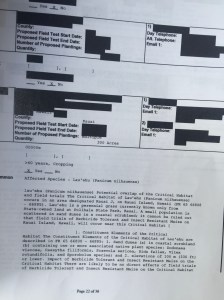
After making a few inquiries and a trip to Honolulu, I was directed to a room (more like a large closet) that contained several dozen unopened boxes, that further contained hundreds of unopened envelopes, that contained federal permits allowing these companies to grow experimental GMO crops in Hawaiʻi. So I did what should have been done by actual regulators, I opened the envelopes and actually read the (heavily redacted) permits. 

No one from the State Department of Health had ever even looked at these permits. They never even opened the envelopes. They just assumed the documentation was there and was done correctly. 

It seems, the Hawaiʻi law doesn’t actually require any permit review, but merely requires the industry to provide a copy of the permit. And, if anyone actually opened the envelope, they would find a heavily redacted document difficult and sometimes impossible to decipher.

Highly regulated? I’m not sure by what definition that could be true.

Except when there were incidents such as when field workers suffered pesticide poisoning and it made the headlines, no representative of the EPA or the FDA or any federal organization charged with regulating this industry ever comes to Kauaʻi.

Many of the pesticides used by these companies are banned in other countries around the world. The toxic herbicide atrazine which was used widely in the corn fields all over Kauaʻi has been banned for the past 20 years in 31 countries including Switzerland, where it was first patented and where Syngenta is/was headquartered.

That’s right. Syngenta was using a toxic chemical by the ton Kauaʻi which they were prohibited by law from using in their own country.

Upon further digging I found numerous scientific studies showing that atrazine contamination is ubiquitous in European and North American surface waters, and has been detected in more than 800 drinking water systems in 19 states at levels exceeding health-protective guidelines.

These company executives looked me in the eye and told me they were only using what every other farmer was using, and it was all safe.

Yes, another big lie disguised as a little one. What they meant to say is that they only use what every other chemical company growing experimental GMO corn uses. After finally obtaining the data from the Hawaiʻi Department of Agriculture it became clear that most regular farmers growing real food to eat use only a tiny fraction of the pesticides used by these companies, both in terms of variety and quantity used.

The more I dug, the more I said to myself “wow” I can’t believe this, and the more motivated I became to find out what else was being hidden from my community.

When reporting back to our growing citizen “GMO living-room working group” the outrage and the determination to do something just kept building.

It became ludicrous at times with countless “Can’t make this stuff up” moments.

I once witnessed an industry official who actually said out-loud and on camera, “Well, it’s almost like the real thing” when discussing GMO tomato’s.

On a whim I checked with the County Finance Department and discovered that two of these billion dollar chemical companies were not paying their Kauai property taxes. In addition, because these large wealthy transnational corporations transfer their end products to related subsidiaries outside of Hawaiʻi, and some also benefit from Enterprise Zone and other General Excise Tax (GET) exemptions, they consequently pay zero GET tax on the products they produce and sell. *See footnote on GET

I started looking at the land ownership records and found about half the land used for GMO production on Kauai was leased from the State. These were publicly owned State lands that were former Hawaiian Kingdom Crown Lands.

The use of State lands require compliance with Hawaii’s environmental review law Chapter 343HRS, yet no documentation demonstrating compliance exists.
See footnote3

Using publicly owned lands that abut a pristine coast line, growing experimental genetically modified organisms outside of a greenhouse, openly spraying a wide array of restricted and non restricted pesticides on a mass scale next to neighborhoods, schools, and parks – most defnately have impacts on health and environment.

These impacts have never been reviewed, evaluated or even measured. There are direct impacts, secondary impacts and cumulative impacts but we don’t know what those impacts are – and the companies in question won’t even give us the information needed to make a proper evaluation.

It was time to start writing a bill.

I called Paul Achitoff again and after a long discussion we agreed, “Let’s start with disclosure. They’re telling us it’s safe so why would they not be willing to tell us what they are growing and spraying? This is a reasonable ask. In any case, until we know exactly what they are doing, it’s impossible to study the health and environmental impacts so we must have disclosure.”

And so it began. And as disturbing as the information that had already been discovered was, in the weeks and months ahead it would only get worse.

DRAFT – Chapter 3 – Writing The Bill

So the process of bill writing began.

Working with Paul Achitoff of Earth Justice (EJ) and the Center for Food Safety (CFS) we started drafting a bill that would hopefully become a County ordinance requiring the agrochemical industry to disclose what pesticides they were using, and what experimental crops they were growing in Kauai County.

The purpose of course was to ultimately protect the health of residents and the islands natural environment. But first, we needed the data.

One of the first questions to be answered was: Did the County even have the legal authority to pass such an ordinance?

Our legal research concluded there was no state or federal law prohibiting the county from doing so and no court had ever ruled on the question. We found also that federal law explicitly gave states the right to regulate pesticides, and counties were also allowed to “further regulate” unless prohibited by the state from doing so.

This legal principle is called “preemption”. It’s important and we’ll come back to it later.
Our legal team said, there was nothing in the law or in any court decision telling us we couldn’t do it, and so we should go for it.

So legally we were good to go (or so we thought at the time), so we went.

Politically we knew passing such an ordinance would be an uphill battle but we really had no idea that this would end up without exaggeration being the battle of a lifetime.

At the time I personally had no idea of the storm that was to come, but I did know enough to understand the coming discussion must be limited to only these large companies if possible.

I had enough experience in drafting and passing laws at both the county and state level to know the bill had to be narrow in scope and avoid impacting every single gardener, small farmer, and occasional user of regular “over-the -counter” pesticides.

We had to focus only on the big guys and most egregious users of the most nasty and dangerous of the chemicals. If the bill was too broad and impacted too many small users, the public opposition would be swift and insurmountable.

So we kept it narrow targeting only the largest users of Restricted Use Pesticides (RUP’s) and included a component that required disclosure of any experimental food crops, not approved for release into the environment.

Kaboom. We were good to go (or so I thought). We had the makings of a bill that if passed into law would yield valuable information leading to the next steps limiting or eliminating those uses and/or impacts.

I took the draft to Fern for her thoughts and hopefully, her approval.

She was gentle yet ruthless in her dismissal. This will never fly she said.“Woefully inadequate and miles away from what the people want, which is to kick those fucking companies off our island.” are the words I remember.

My response was to try my best to explain that we did not possess the legal authority to kick those fucking companies off our island, nor would we likely have the political support for such an action.
Kauai is a small community and these companies were major employers of hundreds of local residents.

Even if we had the legal authority or figured out a way to make it happen, there was no way we could get the 5 council votes needed to pass such a bill and over-ride the inevitable mayoral veto.

Kicking them off the island was never going to happen and we needed to focus on what we can do, I told her as gently as I could.

“I got it, but we need more” was her response, “If you want to motivate young people, if you want the room packed with people testifying in support, we need more.”

“Ok, I get it…what if we add pesticide-free buffer zones around schools, parks, and houses…does that work?” I said.

“That’s better but still not enough” she said, “Can’t we just get rid of the GMO stuff altogether? Like ban it from the islands?”

“I’ll check with the lawyers” I said “but I’m pretty sure federal law won’t let us ban the growing of GMO’s. Maybe however we can put into place regulations that say experimental food crops, those not approved for release into the environment – can only be grown in green houses or similar indoor facilities.”

“I think we’re getting somewhere now” she responded.

So I went back to work, huddled again with the lawyers, worked on the words, reviewed draft after draft, definition after definition – trying each time to be increasingly clear on what the bill proposed to accomplish and who would be impacted. The EJ and CFS attorneys researched what similar legislation had been passed in other municipalities around the United States, looking for language and ideas that had worked elsewhere.

There was no shortage of examples of pesticide regulation occurring in other counties and municipalities around the country including buffer zones and disclosure, but when it came to the GMO segment, there was slim pickings. It seemed no county anywhere where the industry was established had managed to regulate them as we proposed to do.

After countless conversation among legal, and scientific experts the final (or so we thought) bill draft was ready. I called Fern and Sol and suggested we convene our “working group” that had started out as a simple conversation in that Wailua living room a few months earlier.

I remember clearly that night. There were about 7 of us in the room. I passed out copies of the proposed bill gave everyone a few minutes to review it, provided a brief overview, and then asked if there were any questions. One young man, a surfer by the name of Makai, raised his hand and asked quickly, “Is this going to keep them from crossing the river?”

He was referring to the Wailua River and the fact that 100% of the existing fields were located on the Southside of that waterway. To the north (where most of the folks in that room lived), from the Wailua River to Hanalei Bay were thousands of acres of agricultural land mostly used for cattle grazing.

“No” I said, “Nothing in this bill will keep them from expanding to other agricultural lands north of the river, should they choose to do so.”

“Well that’s fucked” was his response which was then echoed around the room.

All the work. All the effort, that had gone into this measure, and the results and draft I had put on the table, still fell short for those who had started this conversation in the first place.

It still wasn’t good enough.

I was pretty much devastated. The meeting ended soon after that moment, and I went home and poured my heart out to Claudette.

“So…what are you going to do?” she said…as she has done so many other times in our 40 years of marriage when I found myself in similar seemingly intractable situations.

“I’ll think about it” I said “I’ll figure it out.”

So I did.

I went back to the drawing board. I spoke to the attorneys, and I met and spoke at length with my (now deceased) colleague Councilmember Tim Bynum who had agreed to co-sponsor and co-introduce the bill with me. I spoke to Fern, Sol, Elif Beal, and others. I wracked my brain.

Then “the penny dropped”. While we did not have the legal authority or likely the political support to kick them fucking out or ban their operations, we likely did have the legal authority and possibly the political support to pass a “temporary moratorium” on any future expansion – subject to the industry proving it was safe via an environmental impact statement.

It sounded reasonable enough – Include a provision in the bill that prohibited expansion until the health and environmental impact of the industries operation on Kauai was fully known and the public was fully informed. It would likely be politically acceptable because it let the companies continue doing what they were doing, did not shut them down, and thus did not impact jobs – but prevented their expansion until the EIS was completed and accepted which would likely take years to complete.

If passed, the measure as it was now written, would in fact keep them from crossing the river.

Kaboom. We had a bill. There were 6 key component and each if necessary could stand on its own.

* Disclosure of Restricted Use Pesticides
* Disclosure of experimental GMO growing
* Pesticide buffer-zones around schools, hospitals and houses
* Banning of out-door growing of experimental GMO food crops
* A moratorium on the industries expansion until completion of an environmental impact statement.
* A “permitting requirement” requiring county permits for restricted pesticide use and experimental GMO crops – paid for by the companies themselves via permitting fees.

Up until this point the process had been done on the “down low”. We had not wanted to alert the industry ahead of time as we knew they would immediately go on the attack.

Councilmember Bynum and I huddled to discuss strategy and consulted yet again and again with our friends at Earth Justice, The Center for Food Safety, and others that now included attorneys connected to The Native Hawaiian Legal Corporation and experts affiliated with the national Pesticide Action Network.

Fern Holland, Sol Kahn, and Elif Beal were joined by Andrea Brower and Phoebe Ng and many many others who began brainstorming community based outreach and action. Fern and Sol connected further with Dustin Barca a well known surfer and MMA fighter who had been actively and very publicly fighting to kick out the GMO industry from Hawaii.

Separate from the discussions surrounding the proposed bill were growing/festering community concerns about the health of west-side residents and in general the overwhelming presence of the GMO industry on the island and through-out the state of Hawaii. A group of west-siders led by long time resident Klayton Kubo had filed suit against Dupont/Pioneer claiming both negative health impacts and property damage that was occurring from the pervasive pesticide laden red dust blowing in from the nearby fields.

The people on the ground were basically mad as hell and were not going to take it anymore.

The final draft of our proposed county ordinance was formally submitted to the Council and scheduled for its initial hearing on June 26, 2013. It was forever after referred to as Bill 2491.

It was game on.

A copy of the original bill 2491 draft submitted to the Council on this day is here: http://kauai.granicus.com/MetaViewer.php?view_id=2&clip_id=1085&meta_id=49075

Read: The Truth About Bill 2491 https://garyhooser.blog/2013/07/20/the-truth-about-bill-2491-relating-to-pesticides-and-genetically-modified-organisms/

* Note – as earlier mentioned this writing is only a rough draft and will be fully edited once I have written the whole thing…your feed back and comments are welcome!

Unopened boxes containing federal GMO permits plus copies of the permit, once I opened the box and started reading:

*Footnote1: Golden Rice a genetically modified variety of rice containing large amounts of the orange or red plant pigment betacarotene, a substance important in the human diet as a precursor of vitamin A. It has been under development for decades but never approved for human consumption.

Footnote2: The Hawaii General Excise Tax is a state tax applied to wholesaling, retailing, farming, services, construction contracting, rental of personal or real property, business interest income, and royalties.

Footnote3: HRS 343 is Hawaii’s environmental impact statement law that requires an environmental review of any development on public lands and/or on the coast line.


Posted in Uncategorized | Leave a comment

Campaigning 101 #3 – What’s the worst thing someone’s going to say about you?

Anyone thinking about becoming a candidate for election to public office needs to answer the question: What’s the worst thing someone’s going to say about you?

Unless of course you are a certain 2024 presidential candidate, now under multiple indictments, and who was found liable for sexually abusing a woman in a luxury department store dressing room.

Local candidates however, running for election to local State Legislative and County Council seats, must indeed answer the question.

Much of the criticism will be personal. You talk too much. You’re too “full of yourself”. Another common and sometimes painful dig is “You’re not from here”.

Next in line will be those times you got way behind paying your rent, electric, water, or the yard guy. Or 30 years ago you perhaps got behind in your taxes (raising my hand here). Some of you have had messy divorces and/or bankruptcies to deal with. I’ve come to believe that everyone has something in their closet they might not be the most proud of.

Most of the above is relatively inconsequential – so long as it’s history and the lessons were learned.

However, some of the bad stuff people say about you will be…well bad. Perhaps it’s an old DUI (or two), or you were arrested some years ago for a “youthful indiscretion” – drug use, shoplifting, or trespassing. Maybe once you had a tad too much to drink – someone pushed you, you pushed them back, the police were called, you pushed the police…you went to jail.

Stuff happens. Humans are imperfect and candidates are human. So long as you’ve learned the lessons none of this should prevent you from being elected to public office. Most people believe in redemption and are willing to forgive and forget the past IF the candidate has proven through their more recent life choices they have indeed changed their ways.

The two key words here are “past” and “redemption”. There’s no statute of limitations that make negative political impacts of bad choices go away, but obviously the further in the past the better. The redemption must be genuine, the candidate must acknowledge the error of their ways, and have stopped completely the activity that drove the bad choices (often drugs and alcohol).

For State legislative and County Council races, negative “hit pieces” focusing on a candidates past are relatively rare. At this level of politics, the “hits” are more likely to come in the form of “whisper campaigns” not as direct mailers or paid advertisements.

However, for those at the top of the political food chain, Mayor, Governor, and Congress – all bets are off. You could be a veritable angel of a candidate (thought I’ve never actually seen one), and the opposition will just make stuff up, pour money on it, and bury you with it.

But again, this kind of negative campaigning historically only happens on the big money races that threaten directly big money interests.

Candidates must first and foremost do “opposition research” – on themselves. They must anticipate what the forthcoming hits might look like, and “inoculate” those closest to the campaign and ultimately the voters in the community.

30 years ago my small Kauaʻi publishing company fell way behind in its taxes. The tax office “waived” penalties and interest and offered a payment plan allowing us to repay 100% of the taxes owed – which we did.

Now when someone says “Gary didn’t pay his taxes”, you know that Gary did actually pay his taxes. He paid them late, but he paid them. Like lots of small businesses just starting out, Gary struggled, Gary got behind, but Gary persevered and caught up, built a successful business, and paid 100% of his taxes.

Inoculation is complete. You now know and are prepared to respond should anyone say to you, “I heard Gary didn’t pay his taxes.”

As a candidate (which I am not), your closest supporters especially must not be taken by surprise when someone brings up negative stuff.

The formula again: Anticipate, fess up, and inoculate.

Yes I did it, I learned from it, I fixed it, and it all happened a long time ago.

Read also:

Campaign 101 – What makes someone a good candidate for public office? Purple Mohawks Need Not Apply

Campaigning 101 #1 – 2024 candidates – first steps

Campaigning 101 #2 The sometimes not so obvious basics

If you want it all – Sign up for my somewhat unconventional email newsletter (though it’s not really a newsletter but I don’t know what else to call it) – Policy & Politics at https://policy-and-politics.mailchimpsites.com

Posted in Uncategorized | 3 Comments