
“Military wants Hawaii to be a hub for Pacific arms manufacturing”By Kevin Knodell – Feb. 16, 2026
I encourage all to subscribe and read regularly the Honolulu StarAdvertiser –
Today, I’m cutting and pasting this especially important story – but every day of the week there are stories worth your time and the small amount of money a subscription costs.
Military wants Hawaii to be a hub for Pacific arms manufacturing
Feb. 16, 2026 By Kevin Knodell
As the U.S. military eyes China, it has big plans for arms manufacturing in the Pacific — and Hawaii sits at the center of its vision.
Commanders want to create a web of new supply chains across the region, working with both foreign allies and with local island companies to arm, equip and supply their forces.
Michael Cadenazzi, the assistant secretary of defense for industrial base policy, said “there’s an incredible mandate for the industrial base that is bipartisan and robust, and there are challenging topics that we have the resources and I think the authorities (to tackle).”
Last month at the annual Honolulu Defense Forum in Waikiki, Cadenazzi told an international audience of military leaders, diplomats, arms manufacturers and investors from around the world that “we need to hit the gas and accelerate production and delivery, speed and volume are the order of the day.”
While on island, Cadenazzi also visited the Honolulu Community College’s Advanced Manufacturing Program Facility — which has $12 million worth of machines funded by his office — and “The Forge,” a new facility at Schofield Barracks with on-site tools for 3D printing, casting and forging and the ability for what military officials call “rapid prototyping.”
Both opened their doors last year after years of planning and lobbying. Adm. Samuel Paparo, the Oahu-based commander of all U.S. forces in the Pacific, and Hawaii’s congressional delegation were major driving forces behind launching those programs and have been vocal about their desire to bring more development and manufacturing of arms and equipment into the Pacific.
“Adm. Paparo has been very clear that he wants to bring more capability forward to the theater, that he does not want to be wholly reliant upon things from (the continental U.S.) or from our allies overseas,” Cadenazzi told the Honolulu Star-Advertiser. “So he wants to go ahead and push capability to the island to make sure that it’s more robust and resilient, that we can solve problems faster.”
U.S. Sen. Mazie Hirono (D, Hawaii), who serves as the ranking member of the Senate Armed Services Readiness Subcommittee, played a central role in securing funding for many of these initiatives in Hawaii.
She said they “represent important partnerships between the military, the community, and the private sector, strengthening our readiness while creating good-paying jobs and expanding business opportunities here in our islands.”
But the push to develop Hawaii’s workforce with military funds comes as controversies around live-fire training, toxic exposure and other environmental impacts around the islands have put the military presence — and the infrastructure that supports it — under renewed local scrutiny.
Ramping up
Military leaders in Hawaii have been telling their troops they need be prepared to deploy in the event of a potential conflict in the Pacific as early as 2027. Chinese leader Xi Xinping reportedly has tasked the Chinese People’s Liberation Army, which marks the 100th anniversary of its founding next year, to be capable of launching an invasion of Taiwan by then.
The ongoing Russian invasion of Ukraine has challenged assumptions about 21st century warfare as both sides have innovated in real time using cheap, low-cost drones and other tech on the battlefield — including modifying or even manufacturing them on the front line with tools like 3D printers.
Lt. Gen. James Glynn, the top Marine officer in the Pacific, said he’d like to see that sort of capability spread across the Pacific to produce everything from munitions to food.
“On the grand end of it, in my view, there would be co-production facilities or additive manufacturing facilities that are the product of maybe public-private collaboration in other nations closest to where the requirement is needed,” Glynn said.
South Korean shipyards already have begun providing maintenance on U.S. Navy ships, and South Korean companies have also invested in aging American shipyards and pledged to help modernize them. Meanwhile, there are ongoing discussions between U.S. and Japanese officials on working together on missile production and other ventures.
“The Japanese have expressed an interest in growing their defense industrial base and expanding. They’re looking at more co-production capabilities and opportunities,” Cadenazzi said. “We see that going both ways, where there’s opportunities for Japanese (intellectual property) to be manu- factured in the U.S. and for us to go to bring more capabilities over. Those are active (discussions). We met with our Japanese counterparts here in Hawaii and previously in the states.”
To support these efforts, the military-run and funded Daniel K. Inouye Asia-Pacific Center for Security Studies in Waikiki recently launched its new Multinational Armaments Resilience Seminar (MARS). The program brings in fellows selected from countries across the Pacific and beyond — a mixture of military officers and other government officials involved in their respective countries’ arms acquisition programs.
The fellowship takes place over four non-consecutive weeks, with a one-week session in Washington, D.C., another two hosted in rotating countries in the region and the final weeklong session taking place in Hawaii.
‘Commercially oriented’
Last month a cohort of MARS fellows came to the islands. Among their stops in Hawaii was a visit to Oceanit, a downtown Honolulu science and engineering firm that tackles everything from energy, biomedical and space projects.
Oceanit also has developed nanotechnology used at the Pearl Harbor Naval Shipyard and has been working on a slew of other technologies in the defense sector, including new armor to protect satellites and helicopters.
For decades, U.S. military contracts have been largely dominated by a handful of corporations that have become known as “the primes,” notably Lockheed Martin, Northrup Grumman and General Dynamics.
But over the last decade, Silicon Valley-funded enterprises like Elon Musk’s SpaceX, Peter Thiel’s Palantir and the fast-growing Anduril — launched by virtual reality pioneer Palmer Luckey — have elbowed their way into the mix and raised their own profiles.
“I don’t think it’s any secret that the bulk of the defense top-line dollar goes to a select number of firms,” Cadenazzi said. “For the first time, we’ve had a large number of largely private equity, venture capital-based firms who’ve come in, who have offered capabilities at scale. They’ve offered to go ahead and invest. They’re doing things in a very different way.”
Oceanit founder and CEO Patrick Sullivan said that his company has been able to grow and thrive with projects in multiple industries — including defense — even though “abundant capital lives in places like Silicon Valley (and) does not live in Hawaii. It does not live in 95% of the U.S.”
But he insisted that Hawaii’s place as a unique cross-section of cultures makes it well positioned to be an innovation center.
Sullivan argued that Hawaii’s economy has become too dependent on tourism and that “we’ve lost our way in being innovators ourselves. We need to have confidence in ourselves. Kids in Hawaii don’t believe they have a future here because they’ve been taught that.”
The military’s push to more quickly field new equipment and tech also has opened the doors to many smaller companies as they pitch new drones, artificial intelligence programs and other tech.
Cadenazzi said the Pentagon seeks to “move our acquisition enterprise from a system dominated by a small number of large firms to a more dynamic, commercially oriented ecosystem that can scale at speed.”
Some in Hawaii see that as a potential new opening for local companies and entrepreneurs.
Jason Chung, vice president of the Chamber of Commerce Hawaii’s Military Affairs Council, said “this shift creates meaningful opportunities for Hawaii companies as the military increasingly recognizes that the industrial base can no longer be limited to large, centralized depots and manufacturers.”
“Instead, it must be distributed, modular and positioned at the point of need, especially in the Pacific, with Hawaii at its center,” Chung said. “Local firms that can adapt, integrate data files, and deliver fieldable capabilities in this environment will be in especially high demand.”
Investment
Political and business leaders in Hawaii have for years pushed for military spending in the islands to jump-start the economy.
The hope has been that an influx of defense dollars will create demand for the sort of high-paying tech jobs that many local graduates have been leaving home to pursue off-island. But the military is also facing renewed scrutiny in the islands.
The Honolulu Board of Water Supply is suing the Navy over fuel leaks and water contamination from its Red Hill fuel facility as cleanup and closure efforts there remain ongoing. In the aftermath of Red Hill, other controversies over other toxic exposures and live-fire training across the islands have reenergized local activists and political leaders that have fought the military presence.
“This is not who we are, nor is this what we want for our children,” said former Hawaii Senate majority leader Gary Hooser as he quoted a controversial speech Pentagon chief Pete Hegseth’s delivered last year, telling his generals and admirals he wants them to fight without “stupid rules of engagement” and to “intimidate, demoralize, hunt and kill.”
Hooser said any partnerships with the military in Hawaii “must be based on the foundational premise that the moral integrity of our community, and the health of our people and natural environment is not for sale or trade — not for jobs, not for funding of other projects, and certainly not for political favors.”
Military officials have touted contributions to the local economy as they go into negotiations with the state to renew leases on key parcels of state land they have used for training and weapons testing, most notably at the Army’s Pohakuloa Training Area on Hawaii island and the Navy’s Pacific Missile Range Facility on Kauai.
Commanders see these lands as especially critical as they seek to prepare troops and test out new armaments and tech for Pacific operations.
But last year the state Board of Land and Natural Resources rejected the Army’s Environmental Impact Assessments for proposed land retention on Hawaii island and on Oahu. This year state lawmakers will deliberate legislation championed by the Office of Hawaiian Affairs that would amend the state Constitution to ban military live-fire training on state-owned land altogether.
*************************************************
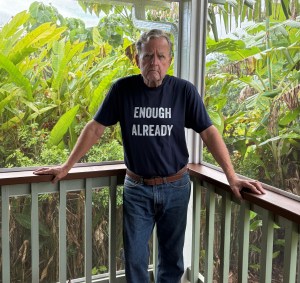


 GaryHooser's Blog
Hegseth’s “intimidate, demoralize, hunt and kill” remarks are antithetical to the spirit of Aloha. Manufacturing weapons in Hawaii won’t bring in high paying tech jobs, just more assembly line employment. It will mark us for destruction instead.
Yep…not sure what Senator Hirono and others are thinking. It seems that jobs and money are always the top considerations…without regard for other implications. My hope is they would focus on targeting education and healthcare jobs…and food and energy…there are many other industry sectors that also have large federal budgets attached.
Not even “assembly line employment” – assembly line AI robots.
No.
Sent from my T-Mobile 4G LTE Device
There is a belief that because we have an early missile alert system in place we don’t have to worry about a surprise nuclear attack. Even if we did survive the initial nuclear blast, what next. How long would it be before we start killing our neighbors for food and clean water? All shipping by ship and air will be gone. You won’t be able to get in your car and drive off to another state to escape this. In other words, we are all doomed if war should break out. Don’t make us a bigger target on the map that we already are.
Yes. A dystopian future we must keep from happening.
There are 25,000 Micronesians living in Hawaii today. Many are still suffering from the effects of the nuclear bombs that was tested during the forties and the fifties on their Pacific islands. The blast destroyed islands and the radiation caused sickness that still remains a problem even today. We don’t want the same thing happening to our Hawaiian paradise just because we’ve become a strong military outpost in the Pacific. War doesn’t care how beautiful a paradise you have. It only cares about death and destruction. Don’t let this happen here. Our lives depend on it.