
See Chapter 1- It all started in a living room
Chapter 2 – Big lies disguised as little lies – Doing the Homework
As I promised Sol and Fern, shortly after that first living room meeting I began “looking into it” – doing my basic homework on the industry. What companies were operating on Kauaʻi? How much land were they using? What were they growing? What pesticides, herbicides, and fungicides were they using, where were they using it, and how much were they using?
I soon discovered that there were four companies on Kauaʻi actively doing both experimental GMO research and “parent seed production”. This is when it became clear that these companies were not really “seed companies” as they called themselves, but in reality were “chemical companies” – they were four of the largest chemical companies on the planet. Their primary source of income and profits was developing, manufacturing, and selling chemicals – pesticides and the like.
BASF SE was a German multinational chemical company and the largest chemical producer in the world with sales of 72.3 billion US$ in 2020.
Syngenta was at the time a Swiss company and is now owned by Chinese conglomerate ChemChina/Sinopec, who also claims to be the largest chemical company in the world.
Dow AgroSciences – US-based and #3 in world chemical production.
Dupont/Pioneer – U.S. based chemical and hybrid seed company.
All four have since merged, changed their names, and or left Kauaʻi. Note: Monsanto closed its Kauaʻi operation in 2010 and thus was not an active player in the Bill 2491 saga.
As a newly elected member of the County Council, I decided to just cut to the chase, meet with the executives of the 4 Kauaʻi companies, express my concerns, and ask them directly many of the questions being asked by the community.
So I did. We met in a downstairs conference room at the historical county building on Rice street. I remember clearly it was a very cordial meeting where my questions were evaded and I was fed huge chunks of industry talking points.
The industry executives felt compelled to constantly reassure me they were good guys, doing good work, and their companies were an important part of our community (read economy).
When I asked what experimental GMO crops were being grown, they said they couldn’t tell me. Proprietary information – trade secrets they said.
Move along, nothing to see here – “The technology is safe, we are already highly regulated, and we are feeding the world” was the mantra repeated ad nauseam.
When I explained the community health concerns and asked what chemicals and pesticides were being used and in what quantities, I was told they could not tell me. Proprietary information – trade secrets they said.
In an effort to reassure me I suppose, they then told me the pesticides used by their companies were safe and were the same pesticides every other farmer uses.
The meeting closed, we shook hands, and the industry executives went home.
I know what gaslighting looks like. I had been in many a room before this with cocky executives attempting to pull the wool over the eyes of uninformed politicians. The messaging was clear. These were educated scientists. I was just an ignorant small town councilmember who knew nothing of the science, nor the importance of their work.
I rolled up my sleeves and immediately began making telephone calls.
The first person I called was Earth Justice (EJ) attorney Paul Achitoff who headed the Hawaiʻi Mid-Pacific office. As those young people did to me a few weeks prior, I now did to a friend and ally who had a wealth of experience in these matters.
“Paul, I need your help on this.” I said.
“Absolutely,” was his immediate response.
Next, I reached out to Andrew (Andy) Kimbrell head of the Center for Food Safety (CFS) with the same question. Andy’s response was an enthusiastic “Yes, let’s do this.” He then introduced me to his brother George and Sylvia Shih-Yau Wu, all top-flight attorneys with deep experience in the subject-matter and a steadfast commitment to fighting for health and justice.
These four highly qualified nationally recognized attorneys were joined on the ground by local Kauaʻi attorney Elif Beal who had become part of what were now our regular living room meetings. This illustrious group was then ultimately backed up at times by another half dozen outstanding lawyers including Teri Tico the former head of the Kauaʻi Bar Association, retired former Hawaiʻi Supreme Court Justice Steven Levinson, and Native Hawaiian Legal Corp attorney Alan Murakami.
Very quickly, my learning curve turned into a learning right angle heading straight up.
Paul from EJ and the attorneys from CFS began researching the legal precedent and assembling a list of what other states and localities have done.
I began a deep dive into all of it. I dove down into the history of Kauaʻi kids getting sick at Waimea Canyon Middle School, I discovered a “50,000 sea urchin die-off” that occurred on the coast near the fields.
The industry executives made a big deal about “reading and following the labels” and so I began reading pesticide labels. Some of these labels were 50 pages long with skulls and cross bones along-side paragraph after paragraph of instructions on how to apply the stuff without killing fish, wildlife, or humans.
These were not your mothers labels. This was not just the Miracle Grow you grab at the five and dime to throw on the rose bush you’ve been fighting with.
I requested the “Restricted Use Pesticides (RUP) sales records from the State Department of Agriculture (SDOA) for Kauaʻi. RUP’s can only be purchased and used by individuals who have a special license to do so. You can’t buy RUP’s at Walmart or Home Depot.
This was some bad, bad, nasty bad stuff. Much of it banned in other countries. The kind of stuff that you certainly don’t want to be using around children or pregnant women, or old people with pre-existing conditions, or anyone really.
I then contacted the State Department of Health (SDOH) seeking to review the Federal GMO permits that were supposed to be on file. I also reached out to the Department of Land and Natural Resources (DLNR) to check on the public land leases held by the companies.
After months of research, I knew for a fact what I had felt in my stomach the moment that first meeting was over. Those executives had lied to me.
They told me little lies that were actually big lies. These were the same lies the industry tells the world over and over again to reassure those who raise questions. They are feeding the world, they are highly regulated, the work being done and the chemicals being used are safe.
It’s absolutely categorically not true.
These companies are not feeding the world. The vast majority of corn grown by them is used for ethanol, high-fructose corn syrup, and cattle feed. They feed only diabetes, obesity, heart disease, and cars.
The GMO research being done is primarily centered around making crops “pesticide/herbicide resistant” thus allowing the chemical companies the opportunity to sell more chemicals. The so-called golden rice research announced decades ago is still nothing but a pipe dream – window dressing for the industry to trot out whenever they need to justify their claim of feeding the world. *see footnote explaining Golden Rice
A cursory review of their income statements and corporate balance sheets will show clearly that these international conglomerates make a majority of their money developing and selling industrial chemicals including highly toxic pesticides, herbicides, and fungicides.
The “this GMO research is safe” narrative runs contrary to the federal permit that says “not for release into the natural environment” and “not for human consumption”. They were/are ostensibly growing experimental “food crops” that you’re not allowed to eat. The companies are hopeful that ultimately the food crops they are experimenting with today will someday be approved as real food by the federal government.
AND these non edible food crops were/are being grown outdoors in open fields even though they are not approved for release into the environment.
What could possibly go wrong?
“The industry is already highly regulated” is also a false narrative. While on the surface it appears to be true, the truth is there’s just a facade of high regulation. No doubt there’s lots of paperwork, pages and pages of forms to fill out, and lots of fancy sounding government agencies managed by former industry executives – but there’s very little actual direct over-sight of the industry.
The industry tells the federal regulator “our proposed research is safe” and provides the regulator with documents explaining how they came to that conclusion. The regulator may or may not actually do an independent review before stamping the application “safe and approved” which is then filed away, never to be seen again. Essentially the industry is self-regulated both in the review of their initial research permit applications, and with regards to follow-up reporting requirements.
This is not hyperbole. After learning of a law requiring companies doing GMO research in Hawaiʻi to provide the Hawaiʻi State Department of Health (SDOH) with copies of their federal permits – I went searching for those same permits (federal permits on file with the state).
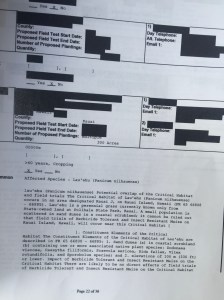
After making a few inquiries and a trip to Honolulu, I was directed to a room (more like a large closet) that contained several dozen unopened boxes, that further contained hundreds of unopened envelopes, that contained federal permits allowing these companies to grow experimental GMO crops in Hawaiʻi. So I did what should have been done by actual regulators, I opened the envelopes and actually read the (heavily redacted) permits.
No one from the State Department of Health had ever even looked at these permits. They never even opened the envelopes. They just assumed the documentation was there and was done correctly.
It seems, the Hawaiʻi law doesn’t actually require any permit review, but merely requires the industry to provide a copy of the permit. And, if anyone actually opened the envelope, they would find a heavily redacted document difficult and sometimes impossible to decipher.
Highly regulated? I’m not sure by what definition that could be true.
Except when there were incidents such as when field workers suffered pesticide poisoning and it made the headlines, no representative of the EPA or the FDA or any federal organization charged with regulating this industry ever comes to Kauaʻi.
Many of the pesticides used by these companies are banned in other countries around the world. The toxic herbicide atrazine which was used widely in the corn fields all over Kauaʻi has been banned for the past 20 years in 31 countries including Switzerland, where it was first patented and where Syngenta is/was headquartered.
That’s right. Syngenta was using a toxic chemical by the ton Kauaʻi which they were prohibited by law from using in their own country.
Upon further digging I found numerous scientific studies showing that atrazine contamination is ubiquitous in European and North American surface waters, and has been detected in more than 800 drinking water systems in 19 states at levels exceeding health-protective guidelines.
These company executives looked me in the eye and told me they were only using what every other farmer was using, and it was all safe.
Yes, another big lie disguised as a little one. What they meant to say is that they only use what every other chemical company growing experimental GMO corn uses. After finally obtaining the data from the Hawaiʻi Department of Agriculture it became clear that most regular farmers growing real food to eat use only a tiny fraction of the pesticides used by these companies, both in terms of variety and quantity used.
The more I dug, the more I said to myself “wow” I can’t believe this, and the more motivated I became to find out what else was being hidden from my community.
When reporting back to our growing citizen “GMO living-room working group” the outrage and the determination to do something just kept building.
It became ludicrous at times with countless “Can’t make this stuff up” moments.
I once witnessed an industry official who actually said out-loud and on camera, “Well, it’s almost like the real thing” when discussing GMO tomato’s.
On a whim I checked with the County Finance Department and discovered that two of these billion dollar chemical companies were not paying their Kauai property taxes. In addition, because these large wealthy transnational corporations transfer their end products to related subsidiaries outside of Hawaiʻi, and some also benefit from Enterprise Zone and other General Excise Tax (GET) exemptions, they consequently pay zero GET tax on the products they produce and sell. *See footnote on GET
I started looking at the land ownership records and found about half the land used for GMO production on Kauai was leased from the State. These were publicly owned State lands that were former Hawaiian Kingdom Crown Lands.
The use of State lands require compliance with Hawaii’s environmental review law Chapter 343HRS, yet no documentation demonstrating compliance exists.
See footnote3
Using publicly owned lands that abut a pristine coast line, growing experimental genetically modified organisms outside of a greenhouse, openly spraying a wide array of restricted and non restricted pesticides on a mass scale next to neighborhoods, schools, and parks – most defnately have impacts on health and environment.
These impacts have never been reviewed, evaluated or even measured. There are direct impacts, secondary impacts and cumulative impacts but we don’t know what those impacts are – and the companies in question won’t even give us the information needed to make a proper evaluation.
It was time to start writing a bill.
I called Paul Achitoff again and after a long discussion we agreed, “Let’s start with disclosure. They’re telling us it’s safe so why would they not be willing to tell us what they are growing and spraying? This is a reasonable ask. In any case, until we know exactly what they are doing, it’s impossible to study the health and environmental impacts so we must have disclosure.”
And so it began. And as disturbing as the information that had already been discovered was, in the weeks and months ahead it would only get worse.
DRAFT – Chapter 3 – Writing The Bill
So the process of bill writing began.
Working with Paul Achitoff of Earth Justice (EJ) and the Center for Food Safety (CFS) we started drafting a bill that would hopefully become a County ordinance requiring the agrochemical industry to disclose what pesticides they were using, and what experimental crops they were growing in Kauai County.
The purpose of course was to ultimately protect the health of residents and the islands natural environment. But first, we needed the data.
One of the first questions to be answered was: Did the County even have the legal authority to pass such an ordinance?
Our legal research concluded there was no state or federal law prohibiting the county from doing so and no court had ever ruled on the question. We found also that federal law explicitly gave states the right to regulate pesticides, and counties were also allowed to “further regulate” unless prohibited by the state from doing so.
This legal principle is called “preemption”. It’s important and we’ll come back to it later.
Our legal team said, there was nothing in the law or in any court decision telling us we couldn’t do it, and so we should go for it.
So legally we were good to go (or so we thought at the time), so we went.
Politically we knew passing such an ordinance would be an uphill battle but we really had no idea that this would end up without exaggeration being the battle of a lifetime.
At the time I personally had no idea of the storm that was to come, but I did know enough to understand the coming discussion must be limited to only these large companies if possible.
I had enough experience in drafting and passing laws at both the county and state level to know the bill had to be narrow in scope and avoid impacting every single gardener, small farmer, and occasional user of regular “over-the -counter” pesticides.
We had to focus only on the big guys and most egregious users of the most nasty and dangerous of the chemicals. If the bill was too broad and impacted too many small users, the public opposition would be swift and insurmountable.
So we kept it narrow targeting only the largest users of Restricted Use Pesticides (RUP’s) and included a component that required disclosure of any experimental food crops, not approved for release into the environment.
Kaboom. We were good to go (or so I thought). We had the makings of a bill that if passed into law would yield valuable information leading to the next steps limiting or eliminating those uses and/or impacts.
I took the draft to Fern for her thoughts and hopefully, her approval.
She was gentle yet ruthless in her dismissal. This will never fly she said.“Woefully inadequate and miles away from what the people want, which is to kick those fucking companies off our island.” are the words I remember.
My response was to try my best to explain that we did not possess the legal authority to kick those fucking companies off our island, nor would we likely have the political support for such an action.
Kauai is a small community and these companies were major employers of hundreds of local residents.
Even if we had the legal authority or figured out a way to make it happen, there was no way we could get the 5 council votes needed to pass such a bill and over-ride the inevitable mayoral veto.
Kicking them off the island was never going to happen and we needed to focus on what we can do, I told her as gently as I could.
“I got it, but we need more” was her response, “If you want to motivate young people, if you want the room packed with people testifying in support, we need more.”
“Ok, I get it…what if we add pesticide-free buffer zones around schools, parks, and houses…does that work?” I said.
“That’s better but still not enough” she said, “Can’t we just get rid of the GMO stuff altogether? Like ban it from the islands?”
“I’ll check with the lawyers” I said “but I’m pretty sure federal law won’t let us ban the growing of GMO’s. Maybe however we can put into place regulations that say experimental food crops, those not approved for release into the environment – can only be grown in green houses or similar indoor facilities.”
“I think we’re getting somewhere now” she responded.
So I went back to work, huddled again with the lawyers, worked on the words, reviewed draft after draft, definition after definition – trying each time to be increasingly clear on what the bill proposed to accomplish and who would be impacted. The EJ and CFS attorneys researched what similar legislation had been passed in other municipalities around the United States, looking for language and ideas that had worked elsewhere.
There was no shortage of examples of pesticide regulation occurring in other counties and municipalities around the country including buffer zones and disclosure, but when it came to the GMO segment, there was slim pickings. It seemed no county anywhere where the industry was established had managed to regulate them as we proposed to do.
After countless conversation among legal, and scientific experts the final (or so we thought) bill draft was ready. I called Fern and Sol and suggested we convene our “working group” that had started out as a simple conversation in that Wailua living room a few months earlier.
I remember clearly that night. There were about 7 of us in the room. I passed out copies of the proposed bill gave everyone a few minutes to review it, provided a brief overview, and then asked if there were any questions. One young man, a surfer by the name of Makai, raised his hand and asked quickly, “Is this going to keep them from crossing the river?”
He was referring to the Wailua River and the fact that 100% of the existing fields were located on the Southside of that waterway. To the north (where most of the folks in that room lived), from the Wailua River to Hanalei Bay were thousands of acres of agricultural land mostly used for cattle grazing.
“No” I said, “Nothing in this bill will keep them from expanding to other agricultural lands north of the river, should they choose to do so.”
“Well that’s fucked” was his response which was then echoed around the room.
All the work. All the effort, that had gone into this measure, and the results and draft I had put on the table, still fell short for those who had started this conversation in the first place.
It still wasn’t good enough.
I was pretty much devastated. The meeting ended soon after that moment, and I went home and poured my heart out to Claudette.
“So…what are you going to do?” she said…as she has done so many other times in our 40 years of marriage when I found myself in similar seemingly intractable situations.
“I’ll think about it” I said “I’ll figure it out.”
So I did.
I went back to the drawing board. I spoke to the attorneys, and I met and spoke at length with my (now deceased) colleague Councilmember Tim Bynum who had agreed to co-sponsor and co-introduce the bill with me. I spoke to Fern, Sol, Elif Beal, and others. I wracked my brain.
Then “the penny dropped”. While we did not have the legal authority or likely the political support to kick them fucking out or ban their operations, we likely did have the legal authority and possibly the political support to pass a “temporary moratorium” on any future expansion – subject to the industry proving it was safe via an environmental impact statement.
It sounded reasonable enough – Include a provision in the bill that prohibited expansion until the health and environmental impact of the industries operation on Kauai was fully known and the public was fully informed. It would likely be politically acceptable because it let the companies continue doing what they were doing, did not shut them down, and thus did not impact jobs – but prevented their expansion until the EIS was completed and accepted which would likely take years to complete.
If passed, the measure as it was now written, would in fact keep them from crossing the river.
Kaboom. We had a bill. There were 6 key component and each if necessary could stand on its own.
* Disclosure of Restricted Use Pesticides
* Disclosure of experimental GMO growing
* Pesticide buffer-zones around schools, hospitals and houses
* Banning of out-door growing of experimental GMO food crops
* A moratorium on the industries expansion until completion of an environmental impact statement.
* A “permitting requirement” requiring county permits for restricted pesticide use and experimental GMO crops – paid for by the companies themselves via permitting fees.
Up until this point the process had been done on the “down low”. We had not wanted to alert the industry ahead of time as we knew they would immediately go on the attack.
Councilmember Bynum and I huddled to discuss strategy and consulted yet again and again with our friends at Earth Justice, The Center for Food Safety, and others that now included attorneys connected to The Native Hawaiian Legal Corporation and experts affiliated with the national Pesticide Action Network.
Fern Holland, Sol Kahn, and Elif Beal were joined by Andrea Brower and Phoebe Ng and many many others who began brainstorming community based outreach and action. Fern and Sol connected further with Dustin Barca a well known surfer and MMA fighter who had been actively and very publicly fighting to kick out the GMO industry from Hawaii.
Separate from the discussions surrounding the proposed bill were growing/festering community concerns about the health of west-side residents and in general the overwhelming presence of the GMO industry on the island and through-out the state of Hawaii. A group of west-siders led by long time resident Klayton Kubo had filed suit against Dupont/Pioneer claiming both negative health impacts and property damage that was occurring from the pervasive pesticide laden red dust blowing in from the nearby fields.
The people on the ground were basically mad as hell and were not going to take it anymore.
The final draft of our proposed county ordinance was formally submitted to the Council and scheduled for its initial hearing on June 26, 2013. It was forever after referred to as Bill 2491.
It was game on.
A copy of the original bill 2491 draft submitted to the Council on this day is here: http://kauai.granicus.com/MetaViewer.php?view_id=2&clip_id=1085&meta_id=49075
Read: The Truth About Bill 2491 https://garyhooser.blog/2013/07/20/the-truth-about-bill-2491-relating-to-pesticides-and-genetically-modified-organisms/
* Note – as earlier mentioned this writing is only a rough draft and will be fully edited once I have written the whole thing…your feed back and comments are welcome!
Unopened boxes containing federal GMO permits plus copies of the permit, once I opened the box and started reading:

*Footnote1: Golden Rice a genetically modified variety of rice containing large amounts of the orange or red plant pigment betacarotene, a substance important in the human diet as a precursor of vitamin A. It has been under development for decades but never approved for human consumption.
Footnote2: The Hawaii General Excise Tax is a state tax applied to wholesaling, retailing, farming, services, construction contracting, rental of personal or real property, business interest income, and royalties.
Footnote3: HRS 343 is Hawaii’s environmental impact statement law that requires an environmental review of any development on public lands and/or on the coast line.


 GaryHooser's Blog